IMAGE 2026 Houston Preview: Capital Allocation & Geoscience AI Risk

By ModalPoint | An EWR Digital Company
Your trade show budget is not a marketing expense; it is a capital deployment decision. Every year, commercial sales teams and executive leaders face the same internal scrutiny when reviewing line items for major industry expos: What is the true ROI of a 20×20 foot footprint, a custom backdrop, and four days of staff travel?
As we evaluate the upcoming IMAGE 2026 Houston gathering, the stakes are higher than ever. With shifting capital allocations across exploration, production, and digital infrastructure, corporate decision makers are demanding defensible proof that trade show investments yield actual pipeline velocity.
Here is the executive reality check: website metrics, social impressions, and traditional collateral are no longer the primary drivers of commercial validation. Today, long before a Chief Geoscientist or VP of Exploration walks into the George R. Brown Convention Center, their internal research teams and automated procurement engines have already audited your organization. If your external digital footprint is inaccurate, outdated, or mischaracterized by AI research models, your booth traffic will consist of badge-scanners rather than economic buyers.
Capturing high-value technical buyers at IMAGE 2026 Houston requires a clear understanding of who is walking the floor, how they evaluate vendor solutions, and how to govern your digital presence so buyers can easily validate your brand capabilities before ever speaking to your sales team.
The Technical Powerhouse: Understanding SEG AAPG IMAGE Exhibitors and Buyers
The International Meeting for Applied Geoscience and Energy (IMAGE), joint-hosted by the Society of Exploration Geophysicists (SEG) and the American Association of Petroleum Geologists (AAPG), remains the premier geoscience conference oil & gas professionals depend on for technical validation. Unlike broad-spectrum energy summits that draw high-level policy speakers, this event is designed specifically for technical decision-makers, lead geophysicists, data architects, and asset team managers.
For strategic SEG AAPG IMAGE exhibitors, this distinction represents a unique commercial opportunity. The attendees walking this exhibition floor hold direct operational influence over massive capital budgets, including seismic processing contracts, subsurface imaging software, reservoir modeling tools, and advanced data governance platforms.
- 1. High Concentration of Economic Buyers: Geoscience buyers do not purchase on emotion or slick branding. They buy on technical defensibility, data integrity, and proven risk reduction. A single contract win originating from a technical interaction at IMAGE can justify an entire annual event budget. When evaluating your event presence, schedule a consultation with our team to ensure your commercial strategy aligns with how enterprise technical committees source and audit new vendors.
- 2. The Shift Toward Integrated Subsurface Energy Solutions: The modern geoscientist is no longer operating within an isolated exploration silo. Today’s asset teams are tasked with multi-physics integrations, carbon capture utilization and storage (CCUS) assessments, geothermal reservoir modeling, and complex basin evaluation. Vendors who frame their capabilities purely in traditional terms miss the broader commercial mandates driving modern buying committees.
As technical teams face increasing pressure to extract actionable value from massive data archives, industry leaders are vocal about the necessity of robust data systems over mere software tools. As highlighted by leading petroleum industry analysts at the U.S. Energy Information Administration:
“Modern energy markets demand unprecedented operational efficiency, where advanced data integration and subsurface visibility directly dictate capital discipline and resource recovery timelines.”
When technical buyers evaluate prospective vendor solutions, they seek partners whose information architecture demonstrates immediate clarity and technical accuracy.
AI Representation Risk: The Invisible Filter on the Floor
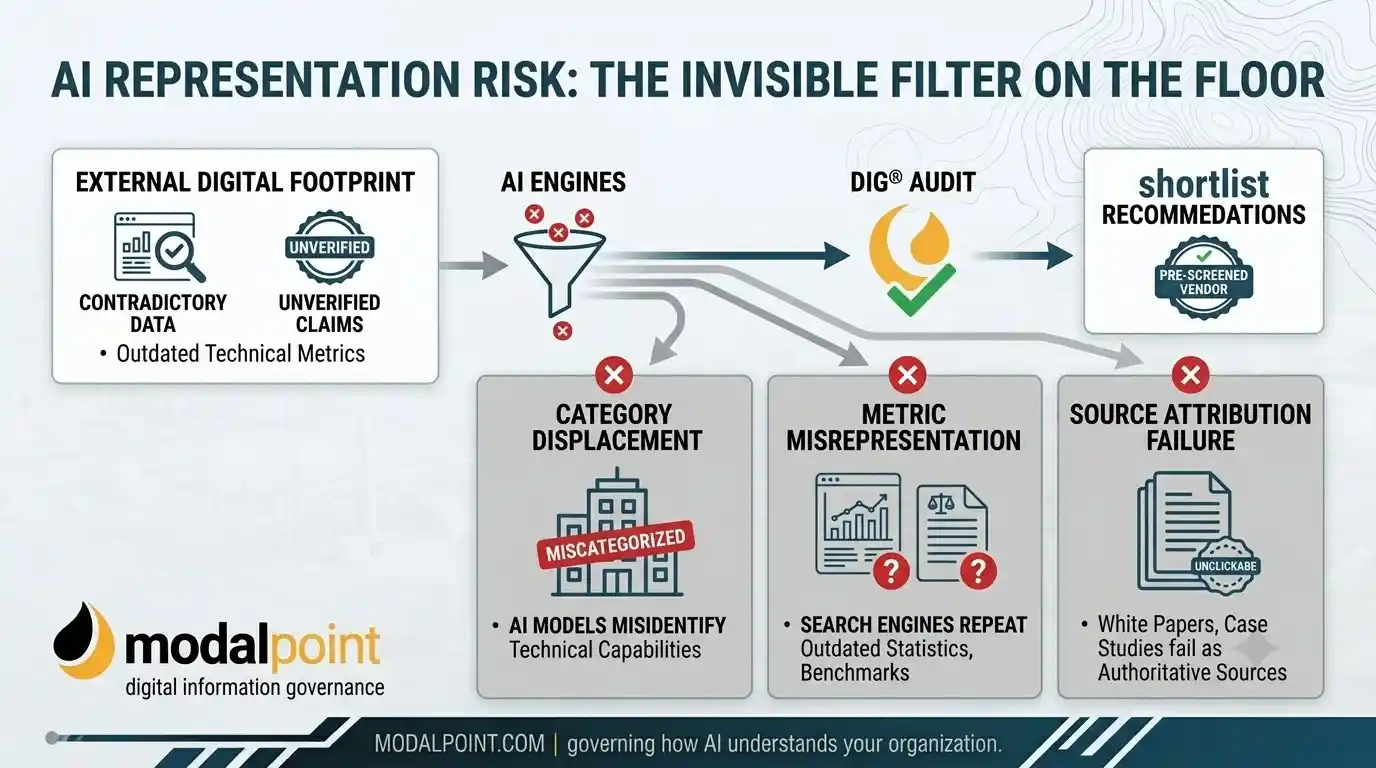
While your sales engineers prepare physical product demos for Houston, an invisible barrier operates in the background: AI Representation Risk. High-value geoscience buyers routinely rely on AI search models, Perplexity research queries, and ChatGPT summaries to pre-screen vendors, benchmark capabilities, and compile shortlist recommendations prior to attending trade shows.
If your digital assets present conflicting technical metrics, legacy product descriptions, or unverified claims, AI systems will miscategorize or ignore your business entirely during buyer discovery phases. This digital disconnect creates three direct commercial vulnerabilities:
- Category Displacement: AI models misidentify your core technical capabilities, causing prospective buyers to select direct competitors during automated market mapping.
- Metric Misrepresentation: Search engines repeat outdated performance statistics or unverified software benchmarks, creating legal and reputational exposure during legal review.
- Source Attribution Failure: Your proprietary research, white papers, and technical case studies fail to register as authoritative sources within global knowledge graphs.
Governing what AI platforms understand and report about your organization is essential to ensuring trade show opportunities convert into closed contracts.
Maximizing Event ROI: The Digital Information Governance® (DIG) Framework
To maximize your return on investment at IMAGE 2026 Houston, marketing and sales teams must bridge the gap between physical booth engagements and technical digital discovery. ModalPoint provides the advisory framework through Digital Information Governance® (DIG), ensuring your external digital presence accurately reflects your real-world technical expertise.
While our strategic partner EWR Digital executes structured technical SEO, digital PR, and schema deployments, ModalPoint diagnoses the fundamental AI exposure risks that threaten commercial growth.
| Governance Pillar | Operational Objective | Commercial Impact at IMAGE 2026 |
|---|---|---|
| Entity Structuring | Align corporate schema and technical taxonomy across global databases. | Prevents AI search tools from mischaracterizing subsurface software capabilities. |
| Claim Defensibility | Audit public-facing white papers and case study metrics for accuracy. | Protects executive teams from liability during technical and legal procurement reviews. |
| AEO / GEO Alignment | Optimize content specifically for AI Answer Engines and generative search models. | Ensures prospective buyers researching conference themes encounter your brand as a top recommendation. |
Executing an intentional governance plan before stepping onto the exhibition floor turns casual booth walk-bys into high-converting executive meetings. Explore how ModalPoint helps organizations safeguard their brand identity and lead how AI engines evaluate their expertise.
Industry Benchmark: Trade show research continuously indicates that high-value B2B buyers complete over 70% of their evaluation process digitally before initiating contact with sales representatives at major industry exhibitions (Center for Exhibition Industry Research).