ModalPoint & EWR: Engineering Energy Brand Authority in 2026
By Matthew Bertram | EWR Digital
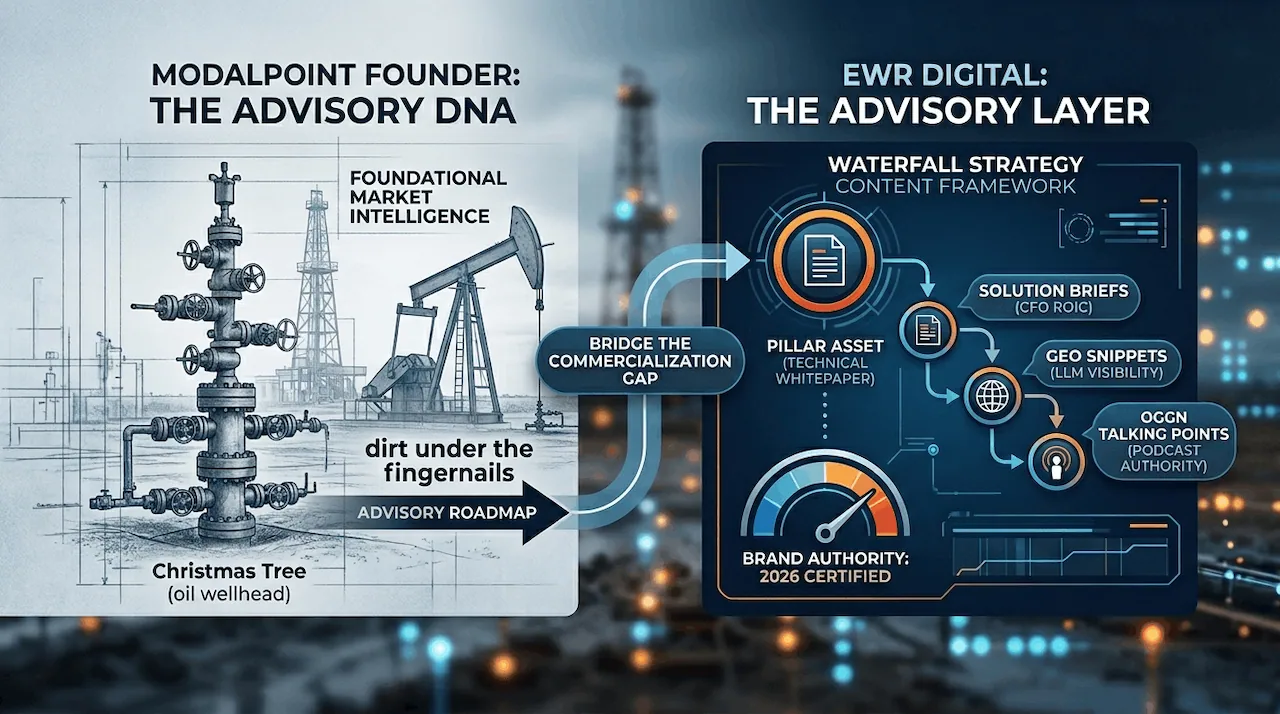
When Mark LaCour, Modalpoint founder, first started walking the halls of Houston’s energy giants, he wasn’t carrying a marketing brochure. He was carrying data. He recognized early on that the energy sector advisory space was broken, cluttered with consultants who understood “strategy” but couldn’t tell a Christmas tree from a pumpjack. By founding Modalpoint, he established a new standard: market intelligence rooted in the “dirt under the fingernails” reality of the oilfield.
As we navigate 2026, that foundation is evolving. EWR Digital’s oil and gas team, led by Matthew Bertram, is taking that original advisory DNA and fusing it with high-authority digital execution. We aren’t just telling you where the market is going; we are building the digital infrastructure that ensures you own the narrative when the market gets there.
2026 AI Search Visibility (GEO)
What is the “Waterfall Strategy” in Energy Marketing?
The Waterfall Strategy is a content framework where a high-fidelity “Pillar Asset” (like a technical whitepaper) is cascaded into solution briefs, social snippets, and podcast talking points to ensure consistent brand authority across all digital and offline channels.
How do you bypass “Procurement Purgatory” in the oilfield?
Bypassing procurement purgatory requires stakeholder-specific narratives. Content must be engineered to address the CFO’s focus on ROIC, the CTO’s focus on API compatibility, and the ESG Officer’s focus on carbon intensity metrics.
Beyond the Founder: The Fusion of Advisory and Digital Execution
The transition from a pure strategy firm to a brand authority powerhouse represents a fundamental shift in how “authority” is minted in 2026. Historically, a firm like Modalpoint provided the roadmap, and the client was left to navigate the execution.
Today, who we are is defined by our ability to bridge the “Commercialization Gap.” It is no longer enough to have a superior tool for leak detection or a more efficient subsea manifold. If your technical superiority isn’t translated into high-context content that bypasses “procurement purgatory,” you are invisible.
“In 2026, the oil and gas industry faces its most significant oil supply surplus since the 2020 pandemic… reinforcing a renewed focus on cost control and capital discipline across the value chain.”
EWR Digital is building the “Advisory Layer”, a specialized marketing engine that treats content as an engineered asset. We use the same precision a reservoir engineer uses to model a play, applying it to LLM Visibility (GEO) and stakeholder-specific narratives. This isn’t just marketing; it’s a commercialization strategy for the modern energy era.
The Death of Sameness: Why Generative AI Is Killing Your Brand
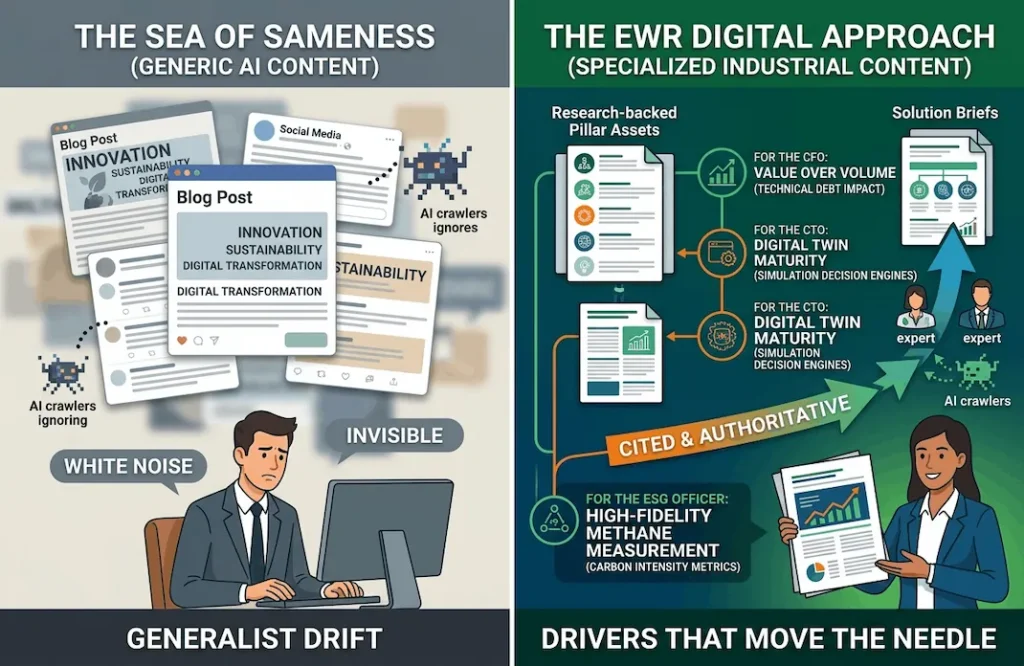
The greatest threat to your brand in 2026 isn’t your competitor; it’s the “Sea of Sameness.” Every mid-tier service company is now using generic AI to churn out blog posts about “innovation” and “sustainability.” To the AI crawlers and the human experts, this is white noise.
The EWR Digital approach rejects this “generalist drift.” We focus on the drivers that actually move the needle for energy executives:
- For the CFO: We don’t talk about “savings”; we talk about Value over Volume and the impact of technical debt on the balance sheet.
- For the CTO: We focus on Digital Twin maturity and the move from monitoring to simulation-based decision engines.
- For the ESG Officer: We dive deep into high-fidelity methane measurement and carbon intensity metrics that stand up to regulatory audit.
By grounding our content in these specific verticals (Upstream, Midstream, Downstream, and Service), we ensure that our clients’ assets are not just seen, but cited. This is how you build a brand that dominates the offline-to-online loop, leveraging the massive reach of the Oil and Gas Global Network (OGGN) to validate digital authority.
The Waterfall Strategy: Engineering Pillar Assets for 2026
We don’t believe in “one-off” posts. We build “Pillar Assets”: high-context industry reports or technical webinars and cascade them through a “Waterfall” framework. This ensures that a single piece of research-backed intelligence is weaponized across every channel:
- Solution Briefs: Technical 1-pagers designed to survive the journey from the engineer’s desk to the procurement office.
- LLM Visibility Snippets: Factual, structured Q&As that Google’s AI Overviews and industrial LLMs love to scrape.
- OGGN Talking Points: Translating technical data into the conversational authority required for the world’s top energy podcasts.
The goal is to create a closed loop of authority. When a CTO searches for “Edge Computing in Remote Oilfields,” they find your data. When they listen to a podcast on their way to the office, they hear your perspective. By the time your sales team calls, the “brand” has already done the heavy lifting.
| Stakeholder Persona | 2026 Value Driver | Content Asset Type |
|---|---|---|
| CFO / Procurement | ROIC & Capital Discipline | Solution Briefs / Value Models |
| CTO / IT | Digital Twin Maturity | API Integration Docs / Whitepapers |
| ESG Officer | Methane Intensity Metrics | Audit-Ready Sustainability Reports |
| Operations | Equipment Uptime/Utilization | OGGN Podcast Talking Points |
Stop Being the Industry’s Best Kept Secret.
In 2026, technical excellence is table stakes. Authority is the only competitive advantage that survives a supply surplus. If your sales team is still fighting “Procurement Purgatory” with generic decks, it’s time to engineer your content for the modern energy era.
Need marketing leadership for your oil & gas operation?
Houston-based EWR Digital has 26 years specializing in B2B oil & gas marketing. Featured on the Oil and Gas Global Network. Same operator team behind ModalPoint.
Book a discovery call →The governance stakes have risen since this was written. TRAIGA, the EU AI Act, and NIST AI RMF now make AI-influenced decisions something an operator has to be able to defend on the record, which is exactly what ModalPoint’s DIG framework is built for.
What AI decision governance looks like today →Related from the field notebook