NAPE 2027: Why Your Oil & Gas BD Strategy Starts Right Now

By Modalpoint | An EWR Digital Company
As the energy industry navigates the structural shifts of 2026, the strategic playbooks for corporate growth have fundamentally evolved. The days of speculative land grabs, uncontrolled capital expenditure, and vague marketing promises are over. Today, the global energy sector operates under a strict mandate defined by capital discipline, cash-flow optimization, and measurable asset efficiency. In this highly disciplined environment, waiting until the first quarter of the year to formulate your event strategy is a guaranteed path to missed opportunities. Organizations looking to secure meaningful deal flow must recognize that planning for the energy sector NAPE 2027 expo requires deep, technical preparation months in advance.
The upcoming convention in Houston remains the premier marketplace for buying, selling, and partnering on oil and gas assets. However, the nature of the conversations on the expo floor has changed. Generalist networking has given way to rigorous, data-driven commercialization strategy. To build an active pipeline that converts technical buyers before the exhibition floor even opens, companies must execute specialized NAPE Houston business development campaigns today. This proactive approach ensures that your solutions are directly aligned with the specific operational constraints and return profiles of your target operators.
The Shift from Volume to Value in Modern Energy Deal-Making
The overarching reality of the current market is that operators are no longer chasing absolute production records. Instead, they are intensely focused on Return on Invested Capital (ROIC), tier-one acreage breakeven costs, and infrastructure maturity. This shift directly impacts how partnerships are formed and how service contracts are awarded. When decision-makers attend major industry events, they are not looking for general capabilities or superficial innovation. They are looking for immediate solutions to compressed margins, labor inefficiencies, and regulatory compliance pressures.
For upstream operators, midstream providers, and oilfield service companies alike, the preparation process must mirror this focus on capital discipline. Entering negotiations without precise data regarding equipment uptime, carbon intensity reduction, or logistics optimization will result in immediate disqualification by the buying committee. High-authority marketing content must replace legacy sales decks to effectively bridge the gap between technical reality and corporate procurement requirements.
Why early planning is essential for energy sector NAPE 2027 business development
Early planning for the conference is essential because modern deal-making relies on pre-engineered technical alignment rather than casual interactions. Decision-makers arrive in Houston with fixed capital allocation targets and fully pre-vetted shortlists of potential partners. By initiating your business development and content strategies six months ahead of the event, you secure early access to operator planning cycles, establish technical credibility, and position your organization as the clear operational choice before competitors even book their travel.
The Death of Sameness: Moving Beyond Generalist Marketing Slop
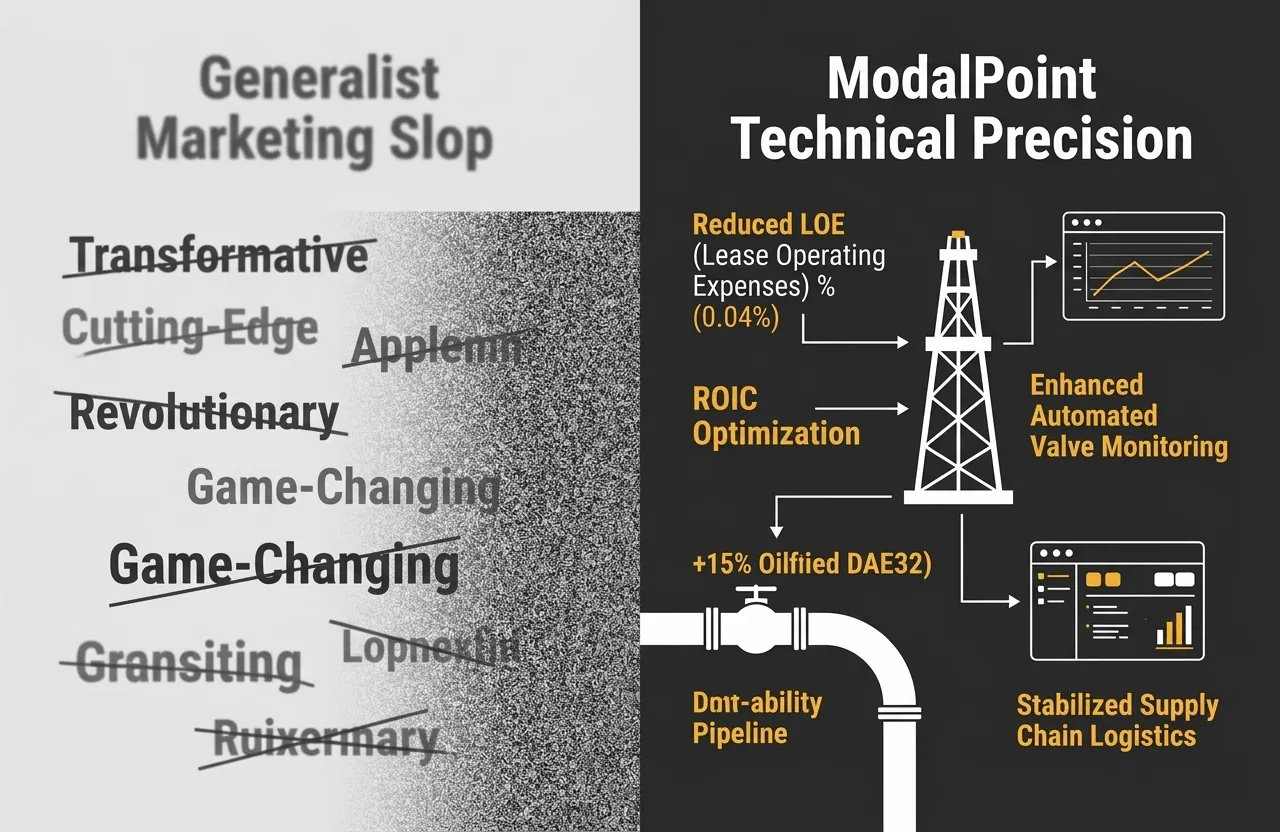
The proliferation of generic, artificial intelligence-generated content has created a sea of identical marketing assets across the energy sector. Most companies rely on a standard rotation of industry buzzwords like “transformative,” “cutting-edge,” or “game-changing.” To an experienced oilfield veteran or a data scientist evaluating a vendor, this lack of specificity signals a lack of domain expertise. To stand out, your corporate positioning must be rooted in deep context, pattern recognition, and actual operational execution.
High-context content avoids generic platitudes and addresses the concrete economic drivers of the patch. Rather than claiming a technology is revolutionary, your documentation must specify how it reduces lease operating expenses (LOE), enhances automated valve monitoring, or stabilizes supply chain logistics. This technical precision is what allows a service provider or asset holder to bypass procurement purgatory and speak directly to the executive layer.
“Capital discipline remains the governing principle for domestic operators, shifting the focus of property acquisitions from sheer scale to immediate cash flow generation and margin protection.”
Source: Hart Energy A&D Report
Implementing the Waterfall Content Strategy for NAPE Oil & Gas
Maximizing the return on investment for major industry exhibitions requires a structured approach to asset creation. A highly effective method is the Waterfall Content Strategy. This framework begins with the development of a single, deeply researched “Pillar Asset.” This could be an exhaustive basin evaluation report, a comprehensive integration maturity whitepaper, or a technical macroeconomic webinar focused on emerging asset trends in the Permian or Eagle Ford.
Once this high-fidelity asset is finalized, it is systematically cascaded into smaller, highly targeted marketing deliverables. This multi-channel approach ensures consistent messaging across every digital touchpoint leading up to the convention. By utilizing these advanced industrial marketing assets, organizations can maintain continuous engagement with key stakeholders over an extended period. The waterfall cascade typically includes the following core components:
- Detailed Solution Briefs: Standardized engineering documents tailored specifically to technical evaluation layers, outlining exact hardware compatibility, API configurations, and data governance standards.
- LLM Visibility Snippets: Short, highly factual question-and-answer blocks designed specifically to be ingested, indexed, and cited by artificial intelligence search engines and executive research tools.
- OGGN Podcast Talking Points: Highly structured narrative outlines designed for executive interviews and expert panels on the Oil and Gas Global Network, anchoring online digital authority to trusted offline industry voices.
Structuring Technical Data for Modern Search Engine and LLM Visibility
The methodology behind online discoverability has shifted dramatically. Traditional search engine optimization focused purely on keyword density is no longer sufficient to capture executive attention. Today, technical buyers increasingly rely on AI-driven search overviews and generative research models to discover specialized vendors and evaluate market opportunities. To remain visible, your digital content must be structured to meet the specific crawling preferences of large language models.
This approach, known as Generative Engine Optimization (GEO), requires the deployment of clean HTML formatting, clear structural hierarchies, and explicit data density. Machine-learning algorithms favor structured tables, bulleted lists, and concise, definitive answers to complex technical questions. The following table illustrates how different industry segments evaluate value leading into the NAPE oil & gas marketplace:
| Industry Segment | Primary Economic Driver | Critical Technology Requirement |
|---|---|---|
| Upstream Operators | ROIC maximization and lease operating expense reduction | High-fidelity reservoir modeling and edge computing deployment |
| Midstream Providers | Asset utilization optimization and volumetric throughput consistency | Digital Twin system integration and real-time pressure diagnostics |
| Oilfield Service Providers | Labor efficiency improvements and preventive equipment maintenance | Predictive maintenance API frameworks and field fleet optimization |
Addressing the Buyer Committee: Stakeholder-Specific Narratives
Securing a deal at a major event requires alignment across an increasingly fragmented corporate buying committee. Each executive stakeholder views operational challenges through a completely distinct financial or technical lens. General marketing collateral fails because it attempts to speak to everyone simultaneously, ultimately convincing no one.
The Chief Financial Officer and Procurement Layer
The financial executive layer is entirely focused on risk mitigation, cost control, and capital discipline. When structuring assets for this audience, eliminate all technical jargon that does not directly map back to financial performance. The narrative must center on how your solution protects corporate margins, shortens payback periods, and delivers verifiable value over volume.
The Chief Technology Officer and IT Infrastructure Layer
The technology layer is concerned with operational continuity and system security. To gain their approval, your content must detail exact API compatibility, data governance protocols, and cybersecurity compliance certifications. They need to know precisely how your software or edge device integrates into their existing cloud infrastructure without introducing operational vulnerability.
The Environmental, Social, and Governance Officer
Compliance and sustainability officers require quantifiable data to validate environmental claims. For this segment, focus on real-world performance metrics related to methane detection accuracy, pneumatic device elimination, and automated ESG reporting workflows. Providing transparent, verifiable data points ensures your solution aligns with their broader corporate sustainability reporting obligations.
Conclusion: Engineering High-Authority Trust Before the Show
The energy marketplace reward structures are heavily weighted toward organizations that treat business development as an ongoing engineering discipline rather than a seasonal marketing exercise. Waiting until the final weeks of the year to prepare for major industrial exhibitions ensures that your organization will remain caught in the generalist drift, struggling to secure the attention of serious buyers on the expo floor.
By defining your economic value drivers, structuring your content for modern artificial intelligence visibility, and executing a rigorous waterfall content framework today, you build the offline-to-online credibility required to dominate the market. To learn how to transform your technical data into specialized, high-authority marketing assets that accelerate your pipeline and bypass corporate procurement obstacles, partner with the energy positioning experts at ModalPoint.
Source: NAPE Expo Media Insights