TRAIGA vs. Federal Civil Rights Law: The Venn Diagram
Texas' AI law uses an 'intent to discriminate' standard — but it doesn't preempt Title VII, ECOA, FHA, ADA, or ACA Sec. 1557.

The Short Version
Texas’ Responsible AI Governance Act (HB 149, effective January 1, 2026) is the most business-friendly AI law signed in the United States to date. It introduces an intent-based discrimination standard that explicitly rejects disparate-impact liability. That is the sharpest divergence from every other major AI governance framework on earth — Colorado, New York City, the EU AI Act, and all of the existing federal civil rights statutes.
Here is what almost no one is saying out loud:
TRAIGA changes the state-law standard. It does not preempt federal civil rights law.
A Texas employer, lender, housing provider, healthcare system, or public-accommodations business that relies on the TRAIGA intent standard as a complete defense is building a compliance program on one leg of a two-legged stool. The other leg — federal disparate-impact liability — is still fully operative, and every federal civil rights statute your organization is currently subject to continues to apply on the day TRAIGA takes effect.
This is the Venn diagram Texas operators need before they stand up any AI-driven decision system.
What TRAIGA Actually Says
TRAIGA’s most consequential sentence is in Section 552.056(c) of the final bill text. Reproduced verbatim:
“A disparate impact shown to result from an artificial intelligence system is not sufficient, by itself, to show an intent to discriminate.”
That is a deliberate, specific rejection of disparate-impact liability under Texas state law. It means:
- A plaintiff bringing a Section 552.056 claim in a Texas state court cannot prove unlawful discrimination simply by showing that an AI system produced different outcomes across protected classes
- The Texas Attorney General — the sole enforcement authority under TRAIGA — cannot bring a 552.056 action on statistical disparity alone
- A showing of disparate impact is evidence the AG may consider, but it is not sufficient
Combined with TRAIGA’s safe harbor in Section 552.105 (rebuttable presumption of reasonable care for substantial compliance with the NIST AI Risk Management Framework, internal red-teaming, and documented review), the Texas state-law exposure picture is comparatively forgiving.
What TRAIGA Does NOT Say
TRAIGA does not include a preemption clause. It does not say federal law is displaced. It does not alter the legal standards under any federal civil rights statute. It does not affect the authority of any federal enforcement agency. Every federal civil rights law that currently applies to your organization continues to apply, unchanged, on January 1, 2026.
The relevant federal laws — and the standards they use — all pre-date TRAIGA by decades, and all of them recognize disparate-impact liability in at least some form.
The Five Federal Laws TRAIGA Does Not Touch
Here are the federal statutes Texas operators most frequently miss when calculating their post-TRAIGA exposure.
1. Title VII of the Civil Rights Act of 1964 (Employment)
- Applies to: Employers with 15 or more employees, employment agencies, labor organizations, and federal contractors (regardless of employee count under some provisions)
- What it covers: Hiring, firing, promotion, compensation, and terms/conditions of employment, including decisions made by or with the assistance of AI systems
- Standard: The Supreme Court’s ruling in Griggs v. Duke Power (1971) established that employment practices with disparate impact on protected classes violate Title VII unless the employer can show the practice is job-related and consistent with business necessity — and even then, the plaintiff can defeat the defense by showing an alternative practice with less disparate impact would serve the same purpose
- Enforcer: U.S. Equal Employment Opportunity Commission (EEOC) + private right of action
- Relationship to TRAIGA: Unaffected. Any Texas employer with 15+ employees using AI in hiring, screening, promotion, performance management, or termination decisions remains fully subject to Title VII disparate-impact review.
The EEOC’s Artificial Intelligence and Algorithmic Fairness Initiative has confirmed that AI-driven employment tools are fully within Title VII’s scope. Nothing in TRAIGA changes that.
2. Equal Credit Opportunity Act / ECOA (Lending)
- Applies to: Any creditor, meaning any person or entity that regularly extends, renews, or continues credit
- What it covers: All credit decisions, including credit-scoring, underwriting, pricing, and adverse-action notices
- Standard: ECOA and Regulation B recognize disparate-impact claims. The Consumer Financial Protection Bureau has explicitly confirmed that unexplained AI-driven credit decisions violate ECOA’s adverse-action notice requirement — if you cannot explain why the algorithm said no, you cannot provide the statement of specific reasons ECOA requires
- Enforcer: CFPB, federal banking agencies, DOJ, and private right of action
- Relationship to TRAIGA: Unaffected. ECOA continues to govern every AI-influenced credit decision in Texas, and TRAIGA’s safe harbor does not cure an adverse-action notice deficiency.
3. Fair Housing Act (Housing)
- Applies to: Housing providers, landlords, property managers, real-estate services, and housing-related financial services
- What it covers: Marketing, tenant screening, rental decisions, pricing, and mortgage-related decisions — including AI-driven tenant screening and automated underwriting
- Standard: The Supreme Court confirmed in Texas Dept. of Housing v. Inclusive Communities Project (2015) that the Fair Housing Act supports disparate-impact claims. HUD has subsequently issued guidance applying the standard to algorithmic tenant screening tools
- Enforcer: HUD, DOJ, state fair housing agencies, and private right of action
- Relationship to TRAIGA: Unaffected. Any Texas landlord or housing provider using AI tenant screening, fraud detection, or pricing optimization remains subject to FHA disparate-impact review.
4. Americans with Disabilities Act (Public Accommodations + Employment)
- Applies to: Employers (Title I, 15+ employees), public entities (Title II), and public accommodations including most retail, hospitality, healthcare, and professional services (Title III)
- What it covers: Reasonable accommodation, accessibility of digital interfaces, and avoidance of discrimination against individuals with disabilities — including screening algorithms that disadvantage applicants with disabilities
- Standard: Disparate impact is recognized under the ADA Title III in many contexts, and joint DOJ + EEOC guidance has confirmed that AI hiring tools can violate the ADA even without discriminatory intent
- Enforcer: EEOC, DOJ, and private right of action
- Relationship to TRAIGA: Unaffected. AI accessibility gaps, algorithmic bias against applicants using assistive technologies, and automated decision tools that screen out applicants with disabilities remain fully actionable under the ADA.
5. Section 1557 of the Affordable Care Act (Healthcare)
- Applies to: Any health program or activity receiving federal financial assistance — including most hospitals, federally qualified health centers, Medicare/Medicaid providers, and most insurance plans
- What it covers: Non-discrimination in healthcare decisions, including AI-driven clinical decision support, risk stratification, and patient-routing tools
- Standard: The HHS 2024 final rule under Section 1557 explicitly reaches “patient care decision support tools” — which HHS defined to include AI and algorithmic tools used in clinical decisions. Covered entities must make reasonable efforts to identify and mitigate discrimination resulting from these tools, including disparate impact
- Enforcer: HHS Office for Civil Rights + private right of action in some contexts
- Relationship to TRAIGA: Layered, not displaced. A Texas healthcare provider using AI in patient-facing decisions is subject to TRAIGA’s disclosure timing rules (Sec. 552.051(b)) and the Section 1557 non-discrimination standard and Texas SB 1188’s EHR provisions. TRAIGA gives state-law cover on one dimension; the other two dimensions continue unchanged.
The Venn Diagram Texas Operators Actually Need
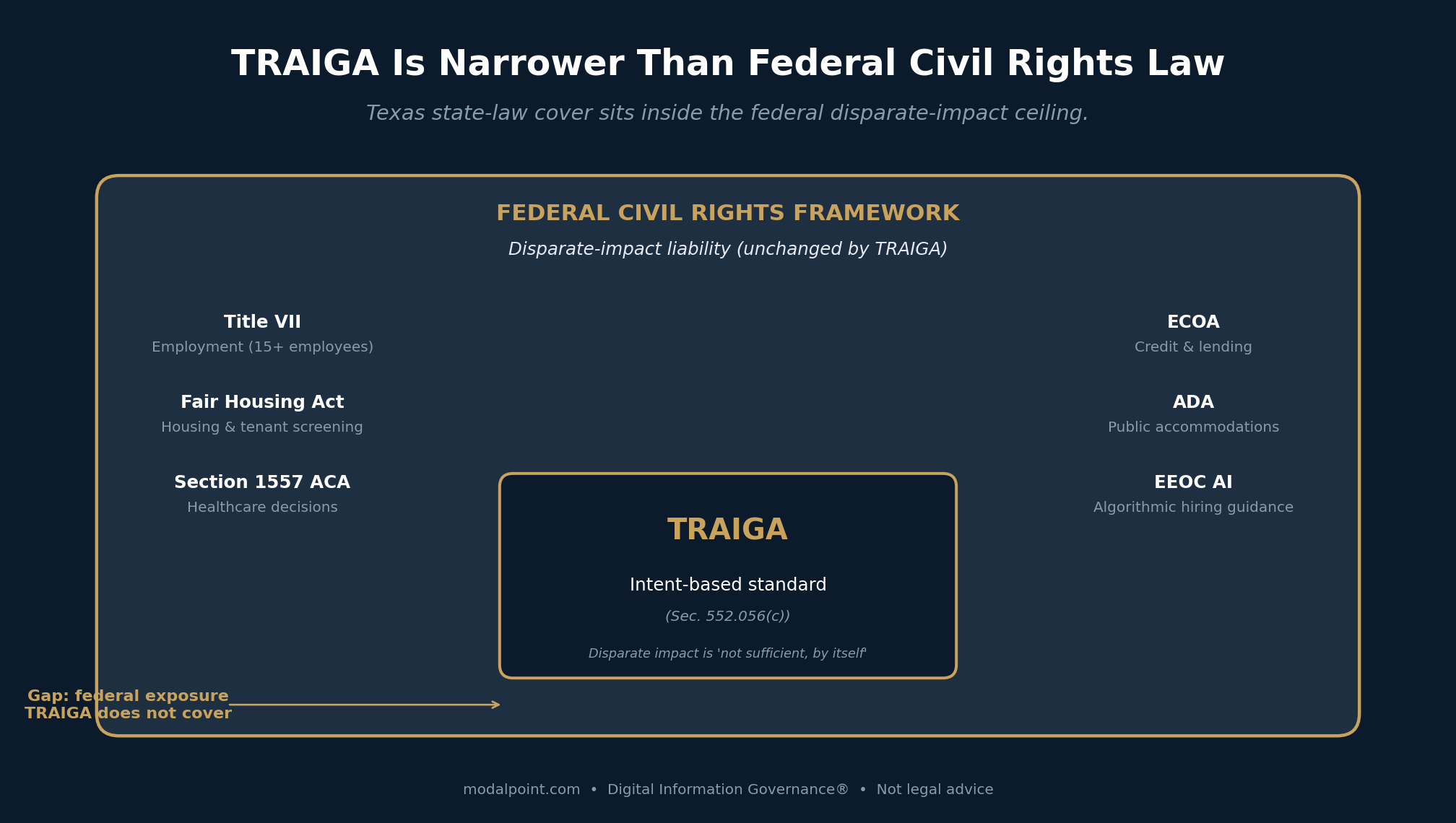
Here is the practical way to think about your post-TRAIGA exposure, by deployer profile:
| Deployer profile | TRAIGA state exposure | Federal exposure | Net result |
|---|---|---|---|
| Texas employer with fewer than 15 employees | Intent standard (552.056(c)) | None (Title VII threshold not met) | TRAIGA safe harbor meaningful |
| Texas employer with 15+ employees | Intent standard | Title VII disparate impact applies | TRAIGA does not cure Title VII exposure |
| Texas consumer lender / creditor | Intent standard | ECOA disparate impact + adverse-action notice requirements apply | TRAIGA does not cure ECOA exposure |
| Texas housing provider / landlord / property manager | Intent standard | FHA disparate impact applies | TRAIGA does not cure FHA exposure |
| Texas public accommodations business (retail, restaurant, hotel, professional services) | Intent standard | ADA applies (Title III) | TRAIGA does not cure ADA exposure |
| Texas healthcare provider receiving federal funds | Intent standard + disclosure timing (552.051(b)) | Section 1557 ACA applies + Texas SB 1188 | Triple layer — TRAIGA is the most permissive of the three |
| Texas insurer regulated under Texas Insurance Code | Carved out of 552.056 (552.056(d)) | Insurance-specific federal frameworks apply where relevant | State carve-out does not affect federal exposure |
| Texas federally-insured depository institution | Effectively carved out | Federal banking regulator guidance applies | Federal regime controls |
| Texas-only business with no federal touchpoint | Intent standard + safe harbor | None | TRAIGA safe harbor is meaningful |
The critical inference: any Texas organization large enough to trigger a federal civil rights statute is still exposed on the federal dimension, regardless of how carefully it complies with TRAIGA. For most operators in Texas energy, healthcare, financial services, real estate, and professional services, that means building two compliance positions simultaneously: the TRAIGA intent defense for state exposure, and a disparate-impact governance program for federal exposure.
What This Means For Your Texas Operation
Three practical implications for any Texas operator building or deploying AI in 2026:
1. Your Governance Program Needs to Satisfy the More Demanding Standard, Not the Weaker One
Because the federal standard is the ceiling, your bias testing, impact assessment, and documentation program must be built against the disparate-impact framework. If you only build a TRAIGA intent-defense binder, you leave your federal exposure uncovered. If you build a disparate-impact governance program, you automatically also satisfy TRAIGA’s intent standard — the state standard is strictly weaker than the federal standard.
Action: Every AI system in your inventory should have a disparate-impact assessment on file, even in Texas, whenever the system is used for a decision implicating a federal civil rights statute. This is not optional; it is the baseline.
2. The NIST AI RMF Safe Harbor Gets You Both
TRAIGA’s Section 552.105 creates a rebuttable presumption of reasonable care for “substantial compliance” with NIST AI RMF. Critically, NIST AI RMF’s Measure function explicitly addresses disparate-impact bias testing — which means a NIST-aligned governance program produces exactly the artifacts that serve both the Texas intent defense and the federal disparate-impact review.
Action: Build your governance binder on NIST AI RMF’s Govern / Map / Measure / Manage structure. One binder, both defenses. This is the core insight behind our Digital Information Governance® framework.
3. AI-Generated Explanations Must Be Real
ECOA’s adverse-action notice requirement, HHS’ Section 1557 rule, and the EEOC’s Title VII guidance all converge on a single operational requirement: if your AI system produces a decision that disadvantages a protected class, you must be able to explain why in terms specific enough to be actionable. “The algorithm said no” is not an explanation. “The applicant’s debt-to-income ratio exceeded our threshold of X, applied uniformly across all applicants” is an explanation.
Action: Every AI system in your inventory should have a documented explanation protocol — what the system outputs, how that output translates into a human-readable reason, and who is responsible for generating the adverse-action notice when the system says no.
The Operator’s Playbook
If you are running or building AI-influenced decision systems in Texas, the playbook for surviving both TRAIGA and federal civil rights law looks like this:
-
Inventory first. You cannot govern what you cannot see. Build a complete AI system register covering every model, embedded vendor tool, and shadow-IT LLM in use. Tag each one with its decision context and the federal statutes it implicates.
-
Map to NIST AI RMF. Use the Govern / Map / Measure / Manage structure to document your controls. This single document invokes the TRAIGA safe harbor and produces the bias-testing artifacts federal regulators will look for.
-
Document intent. For every system, write down why it exists, what outcomes it is designed to produce, and why those outcomes are legitimate. This is your Section 552.056(c) defense.
-
Run bias tests. Not because TRAIGA requires it, but because Title VII, ECOA, FHA, ADA, and Section 1557 require it. Document the results. Document the mitigations. Document the residual risk. Document why you proceeded.
-
Build the adverse-action explanation layer. Every decision system that can say no to a person needs a documented pathway from algorithmic output to human-readable reason.
-
Have a cure playbook. TRAIGA gives you 60 days to cure after notice from the AG (Sec. 552.104). You cannot build that runbook after the letter arrives.
-
Train your workforce. EU AI Act Article 4 has required AI literacy for employees since February 2025. Even if you have no EU exposure, a documented workforce AI use policy and training log is table stakes for every other framework.
Getting Started
Most Texas operators we work with begin with a five-day Governance Readiness Assessment that maps their current state against both TRAIGA and the federal civil rights frameworks that apply to their operations. The output is a one-page gap report identifying exactly which of the seven playbook items above are missing, and a recommended sequence for building them before the Texas AG complaint portal goes live on September 1, 2026.
From there, most organizations move into either a “Texas Ready” sprint (focused on TRAIGA-facing artifacts) or a full “Cross-Border Governance Binder” engagement (for organizations with any EU or federal-funded touchpoint). Both engagements are delivered through our Digital Information Governance® framework.
→ Request a Governance Readiness Assessment (Calendly embed pending)
A Final Note
TRAIGA is a genuinely business-friendly statute. The intent-based standard is a meaningful shift in Texas law, and the NIST AI RMF safe harbor is a real defense. None of the analysis above diminishes those facts.
What it does say is this: TRAIGA is not a free pass. It is a narrower state-law standard operating inside a federal civil rights framework that has not moved. Texas operators who build their AI governance programs as if TRAIGA were the only law they had to worry about are going to be surprised — and the surprise will not come from the Texas AG.
Build the binder that satisfies both. It is not meaningfully harder than building the binder that only satisfies one.
This article is informational and does not constitute legal advice. ModalPoint is not a law firm and does not practice law. For legal counsel on TRAIGA or federal civil rights liability, consult qualified attorneys. ModalPoint builds the operational governance programs that make legal compliance verifiable.
ModalPoint is a Houston, Texas-based AI governance advisory and a division of EWR Digital. Written by Matthew Bertram, President of ModalPoint and CEO of EWR Digital. Digital Information Governance® is a trademark of Matthew Bertram.
Frequently Asked Questions
Does TRAIGA preempt federal civil rights law?
No. TRAIGA changes the Texas state law standard, it does not preempt federal law. It contains no preemption clause and does not alter the standards under any federal civil rights statute. Every federal civil rights law that applied to your organization before TRAIGA continues to apply unchanged, so relying on the TRAIGA intent standard as a complete defense leaves federal disparate impact exposure fully operative.
What does TRAIGA actually change?
TRAIGA introduces an intent based discrimination standard. Section 552.056(c) states that a disparate impact shown to result from an AI system is not sufficient, by itself, to show an intent to discriminate. A plaintiff or the Texas Attorney General, the sole enforcement authority, cannot prove a 552.056 claim on statistical disparity alone. Combined with the Section 552.105 safe harbor, the Texas state law exposure is comparatively forgiving.
Which federal laws still apply to AI decisions in Texas?
Five that operators most often miss: Title VII of the Civil Rights Act for employment, the Equal Credit Opportunity Act for lending, the Fair Housing Act for housing, the Americans with Disabilities Act for public accommodations and employment, and Section 1557 of the Affordable Care Act for healthcare. All recognize disparate impact liability in some form, and TRAIGA does not touch any of them.
How should a Texas operator build one governance program for both standards?
Build against the more demanding federal disparate impact standard, because a program that satisfies it automatically also satisfies TRAIGA’s weaker intent standard. TRAIGA’s Section 552.105 safe harbor rests on substantial compliance with the NIST AI RMF, whose Measure function covers disparate impact bias testing, so one NIST aligned binder produces the artifacts for both the Texas intent defense and federal review. TRAIGA also gives a sixty day window to cure after notice from the Attorney General.
Talk to ModalPoint
A 30-minute call to see if ModalPoint is the right firm and whether the timing makes sense. No obligation either way.