Anatomy of an AI Data Hall: Power, Cooling, OT and Where AI Fits
We built this the same way we built our jack-up rig: a typical liquid-cooled AI data hall, traced from public patent drawings, assembled one system at a time, then cut open so you can follow the two things every data center exists to move. Power comes in at one end. Heat goes out at the other. They meet at the rack.
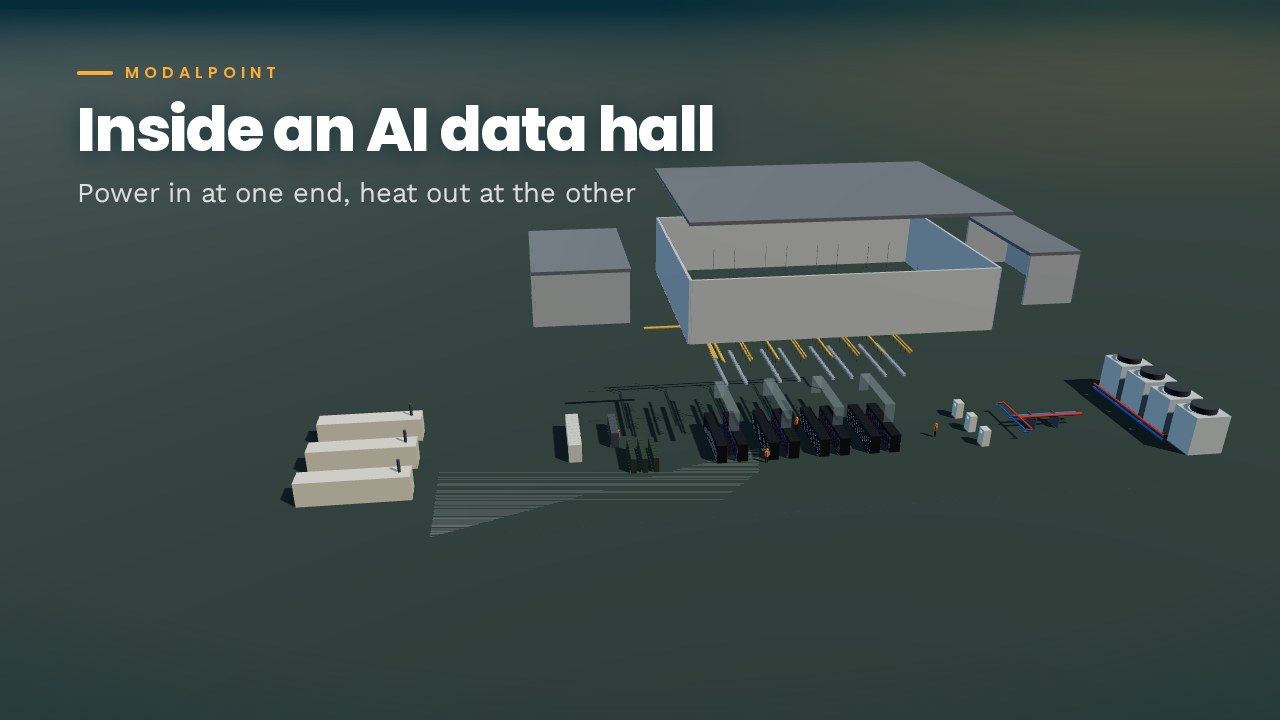
Take it apart yourself.
The model runs in your browser. Drag to turn it, pull every system apart with the slider, and open one GPU rack to see the cold plates on the chips. It works on a phone.
It sits beside our three offshore structures. See all the exhibits.
What you are looking at
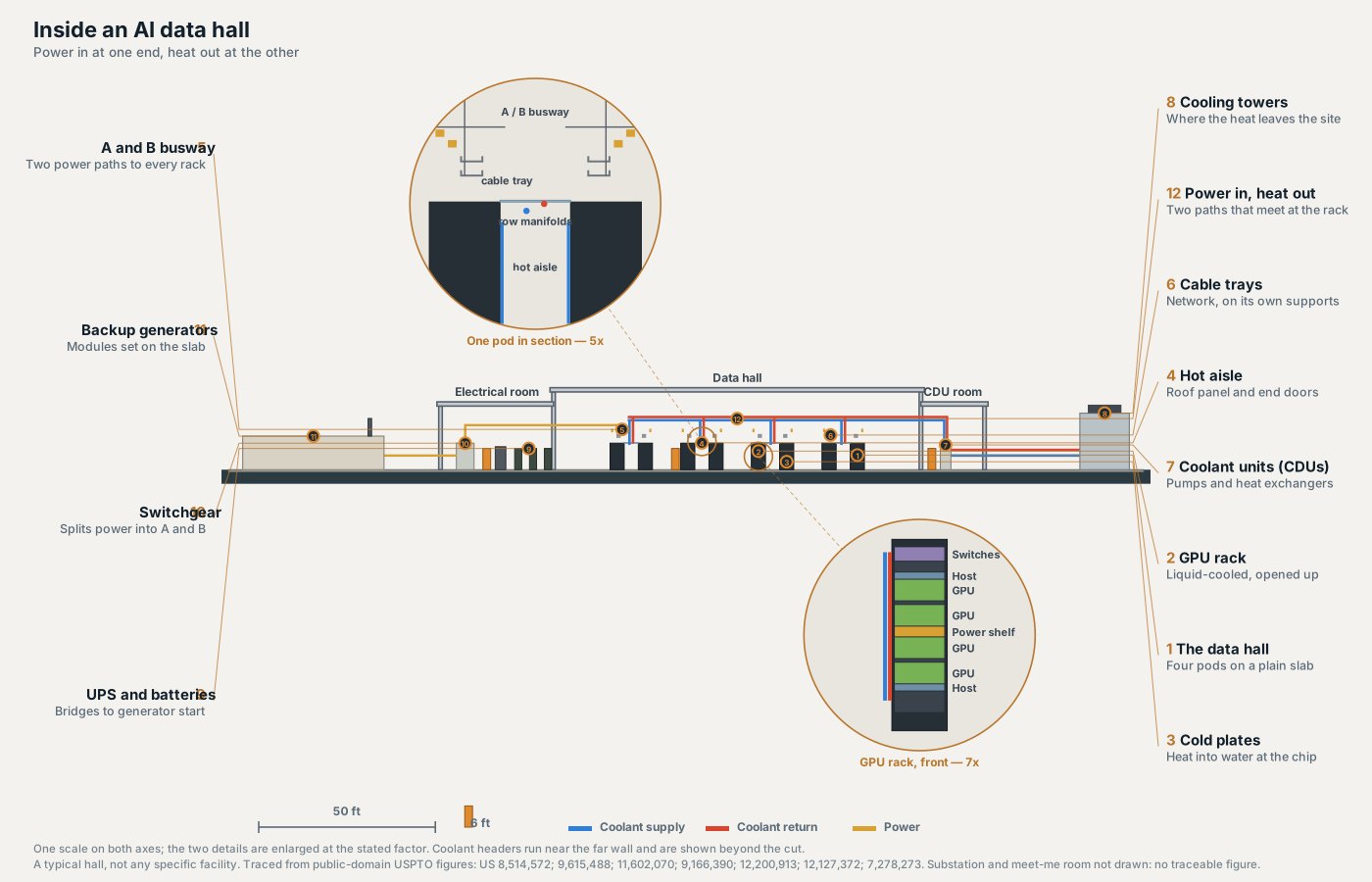
Read it left to right. The power path comes first, then the hall, then the cooling path.
- Backup generators. Diesel sets in weatherproof enclosures, each a self-contained module on the slab. They start when utility power fails.
- Switchgear. Where power enters the building and is split into two separate paths, A and B.
- UPS and batteries. They carry the hall without a break for the time it takes the generators to start and take the load.
- A and B busway. Two separate power runs above every row. Each rack plugs into both, so either path can be taken down without stopping the rack.
- The data hall. Four pods of racks on a plain slab. Rows face outward in pairs, fronts to the aisle where people work, rears into an enclosed hot aisle.
- The GPU rack. Network switches at the top, then host servers, GPU boxes and a power shelf. A supply and a return manifold run up the back.
- Cold plates. A metal plate on each processor with coolant running through it, so heat goes into water at the chip instead of into the room.
- Coolant distribution units. Pumps and heat exchangers between the racks' clean, closed loop and the building's outside loop.
- Cooling towers. Where the heat finally leaves the site.
- The people. A technician at the rack, an electrician, a facilities engineer. Small on purpose, as on the rig.
Twelve systems, and what controls them
Each system in the interactive hall has its own link, which opens the model on that part with a short explanation and a line on what the building's control systems measure or decide there. That second layer is operational technology (OT): the building management, power monitoring and cooling controls that run the facility, as opposed to the computers it houses.
| System | What runs or decides it |
|---|---|
| Switchgear | Transfer to generator is automatic. Switching back, and switching for maintenance, follows a written procedure carried out by a qualified electrician. |
| UPS and batteries | Battery monitoring on every string, and fire detection that can trip automatically in a system kept apart from everything else. |
| Backup generators | Each set started, synchronized and loaded by its own controls. Test runs are scheduled and logged. |
| A and B busway | Power monitoring on every busway and plug-in. Before work on one path, someone confirms the other can carry the full load. |
| The data hall | A data center management system tracks each rack's power, temperature and position. Placement of new equipment is a person's decision. |
| Liquid-cooled GPU rack | Flow, inlet and outlet temperature and power reported per rack. On low flow, the equipment protects itself in hardware. |
| Cold plates | Coolant through a plate on each processor. The tray couplers seal when pulled apart. |
| Hot-aisle containment | Temperature and pressure either side of the containment drive the room cooling. An open door shows up in the data. |
| Cable trays | The network, on its own supports, separate from power. |
| Coolant distribution units | Supply temperature, pressure and flow held to setpoints, with leak and water-quality alarms. A setpoint change is an engineering decision. |
| Cooling towers | Fan speeds, pump speeds and how many towers run, set by the plant controls. |
| Power in, heat out | Each path has its own control system, usually separate from the network the computers run on. |
How much power this is
Data centers used about 4.4% of US electricity in 2023, 176 TWh, up from 58 TWh in 2014. The Department of Energy's report from Lawrence Berkeley National Laboratory projects 325 to 580 TWh by 2028, which would be 6.7% to 12% of the US total.
Texas is where that shows up first. ERCOT told the Texas Senate in July 2026 that about 474 GW of large loads were seeking to connect to its grid as of June, and that about 90% of them were data centers. Those are requests, not plants under construction, and many will never be built.
The rack is where the change is sharpest. Uptime Institute's 2025 survey found most growth in racks of 10 to 30 kW and few facilities above 30 kW. NVIDIA's published design for its GB200 NVL72 rack calls for 120 kW of cooling capacity in one rack. Air cannot carry that much heat out of a cabinet, which is why the racks in this model are liquid-cooled. In one published test of a 53 kW rack, cold plates carried 94% of the heat into the liquid; that is a single experiment, not an industry figure.
What Texas now asks of a large load
Senate Bill 6, signed in June 2025, applies to loads of 75 MW and up. A large load has to tell its utility what on-site backup generation it has. In an energy emergency, ERCOT can direct a large load with backup generation to either run that generation or curtail. Loads connected after the end of 2025 must have the equipment to be curtailed during firm load shed.
That puts a grid operator's instruction at the top of the generator yard in this model. When the instruction comes, someone inside the facility decides which work stops, which keeps running on the generators, and in what order. That decision should be written down before the emergency, not made during it.
Why there are two of everything
Power is the most common cause of a serious outage. In Uptime Institute's 2026 analysis, power problems caused 45% of operators' most recent impactful outages in 2025, down from 54% the year before, and failures of UPS systems, transfer switches and generators dominated.
That is what the A and B paths and the duplicate plant are for. Uptime's Tier III means the facility is concurrently maintainable: any component can be taken out for maintenance without shutting anything down. Tier IV adds fault tolerance: independent, physically separate systems, so an unplanned failure does not affect the computers either.
The control layer is where the decisions are
The steel and copper in this model are settled engineering. What is changing is the layer that runs them. Each path has its own controls: building management for cooling, power monitoring for the electrical side, and a data center management system that tracks every rack. Those systems are increasingly connected to each other and to the outside, and Uptime's 2026 report notes that as IT and OT systems become more integrated, security risks and incidents are expanding.
The equipment is already a target. In 2022 CISA and the Department of Energy warned that attackers were getting into internet-connected UPS devices, often through unchanged default passwords. In July 2025 CISA published an advisory for UPS monitoring software rated 10.0, the maximum severity, in which an unauthenticated attacker could shut down the equipment connected to the UPS.
AI has also been running the cooling for a while. DeepMind and Google described a model recommending cooling settings to operators in 2016, and by 2018 a system making those changes itself inside safety limits, with operators supervising. Meta published in 2024 that reinforcement learning on airflow settings had cut supply fan energy by 20% and water use by 4% in one region, after piloting it since 2021.
Eight places AI fits, and where it has to stop
Every system in this hall already produces a stream of measurements. That makes each one a candidate for AI, and it makes the governance question concrete. The table is our read of where analytics adds the most, and who should still own each decision. Only the first row is documented in published operator accounts; the rest is a map of opportunity, not a list of what any operator runs today.
| System | Already measures | What AI could add | Who should decide |
|---|---|---|---|
| Cooling plant controls | Temperatures, flows, fan and pump speeds, weather | Recommend or set plant settings that hold conditions with less energy. This is the documented case (DeepMind, Meta) | Facilities engineer. Safety limits stay hard-coded, and operators can take control back |
| Coolant distribution units | Supply and return temperature, pressure, flow, water quality | Spot a pump, valve or heat exchanger drifting before it alarms; flag a leak pattern early | Facilities engineer. Leak detection and shutoffs stay in the unit's own protection |
| Rack and server telemetry | Power draw, coolant flow, inlet and outlet temperature | Match cooling to the work actually scheduled on each row, instead of to the worst case | Data center operations, inside limits facilities sets |
| Power monitoring | Load on every busway and plug-in, A and B | Warn before a row's load would exceed what one path can carry alone | Electrical lead. Breakers and protective relays stay the hard stop |
| UPS and battery monitoring | String voltage, cell temperature, internal resistance | Predict which strings will fail their next test, so they are replaced first | Electrical lead and maintenance planner |
| Generator controls | Run hours, test results, fuel, start times | Plan tests and maintenance from condition rather than the calendar | Facilities manager. Automatic start and transfer stay in the generator and switchgear controls |
| Capacity planning | Space, power and cooling used per row | Suggest where new racks fit without stranding power or cooling | Capacity planner. The placement is still signed off by a person |
| OT network gateways | Traffic between building systems and the outside | Flag unusual traffic on the control network, the industrial security view | OT security team, with the facility manager |
The pattern is the same one we found on the rig. The closer a system sits to something that can drop the whole hall, the further AI should sit from the switch. We would hold any of these systems to three rules:
- Advise, then decide. The model recommends, a named person decides, and the record keeps both: what the model saw, what it said, and what was done.
- Stay out of the protection path. Breakers, protective relays, automatic transfer, fire detection and suppression, and leak shutoffs stay in certified, independent systems. AI can watch them and help plan their maintenance. It should not be the thing that trips them or holds them off.
- Know where the model learned. A model tuned on an air-cooled hall is not evidence for a liquid-cooled one, and one trained on another operator's plant is not evidence for yours. Validate on the facility, and say so in writing before anyone relies on it.
Those rules are what ModalPoint works on. AI decision governance is about the decision, not the database: who signs off, what gets logged, and how you prove it later. A data hall in Texas now has two kinds of decision that need that record: the ones an AI system makes or recommends inside the building, and the ones a grid operator can require of it from outside.
Where the model comes from
Every piece was traced from figures in seven public domain US patents: US 8,514,572 (a data centre: the plan, the contained pods and the air path); US 9,615,488 (hot-aisle containment); US 11,602,070 (a containment frame carrying busway); US 9,166,390 (the overhead busway and cable tray); US 12,200,913 (the liquid-cooled rack, the coolant distribution and the cold plates); US 12,127,372 (the order of equipment in a liquid-cooled GPU rack); US 7,278,273 (a modular campus with power and cooling modules). It is a typical facility, not a depiction of any specific site or operator.
Two systems are missing on purpose. We found no public patent drawing of a utility substation or a network meet-me room that could be traced, so neither is drawn. We would rather leave a system out than invent it.
Why an energy firm built a data hall
Data centers are about nine in ten of the large loads asking to join the Texas grid, and most people in energy have never seen inside one. The decisions about it are being made now, by utilities, by ERCOT, by the companies selling it power and equipment, and by the operators putting AI into its controls. We think they decide better when they can see the whole thing. Our Texas data center map shows who is building where. This shows what they are building.
If there is a structure you want taken apart next, tell us which.
Sources
- US Department of Energy, LBNL report on data center electricity demand (Dec 2024)
- ERCOT, Senate Business & Commerce testimony, large load interconnection requests (Jul 2026)
- Texas Legislature, SB 6 (89th Legislature), enrolled text
- Texas Legislature Online, SB 6 history
- Uptime Institute, Global Data Center Survey 2025
- NVIDIA, GB200 NVL72 designs contributed to the Open Compute Project (Oct 2024)
- Heydari et al., direct-to-chip cold plate liquid cooling, Applied Thermal Engineering (2024)
- Uptime Institute, Annual Outage Analysis 2026
- Uptime Institute, Tier Classification System
- DeepMind, safety-first AI for autonomous data centre cooling (Aug 2018)
- Meta Engineering, reinforcement learning for data center cooling (Sep 2024)
- CISA and DOE, mitigating attacks against UPS devices (Mar 2022)
- CISA advisory ICSA-25-182-05, UPS monitoring software (Jul 2025)