What Is an FPSO? How a Floating Oil Field Works, and Where AI Fits
An FPSO is a ship that is also an oil field's processing plant and its storage tank. The letters stand for floating production, storage and offloading. Oil and gas come up from wells on the seafloor, the plant on deck separates them, the hull stores the oil, and every few days a shuttle tanker comes to take it away. In the design we drew, only the gas goes ashore by pipeline.
Ours is the base-case vessel of a US government study: the Final Environmental Impact Statement the Minerals Management Service published in January 2001 on using FPSOs in the deepwater Gulf of Mexico, report MMS 2000-090. Nearly every figure in this article comes from that one document, so read them as the study's numbers for its base case, not as a survey of the vessels working today. We built it the way we built our jack-up rig, our pump jack and our LNG plant: a typical example, traced from public records, then cut open so you can follow the oil from the seabed to the tanker. The tour runs 47 seconds with no sound, and every label is on screen.
Take it apart yourself.
The model runs in your browser. Drag to turn it, take it apart with the slider, and press Cut it open to take the starboard side away and see the tanks, and the risers inside the turret. Each of the twelve systems has its own card. It works on a phone.
It sits beside our other exhibits: the jack-up rig, the fixed platform and the semisubmersible offshore, and the pump jack, the LNG plant and the data hall on land. See all the exhibits.
What you are looking at
Start on the seabed and follow the oil up through the ship and out to the tanker.
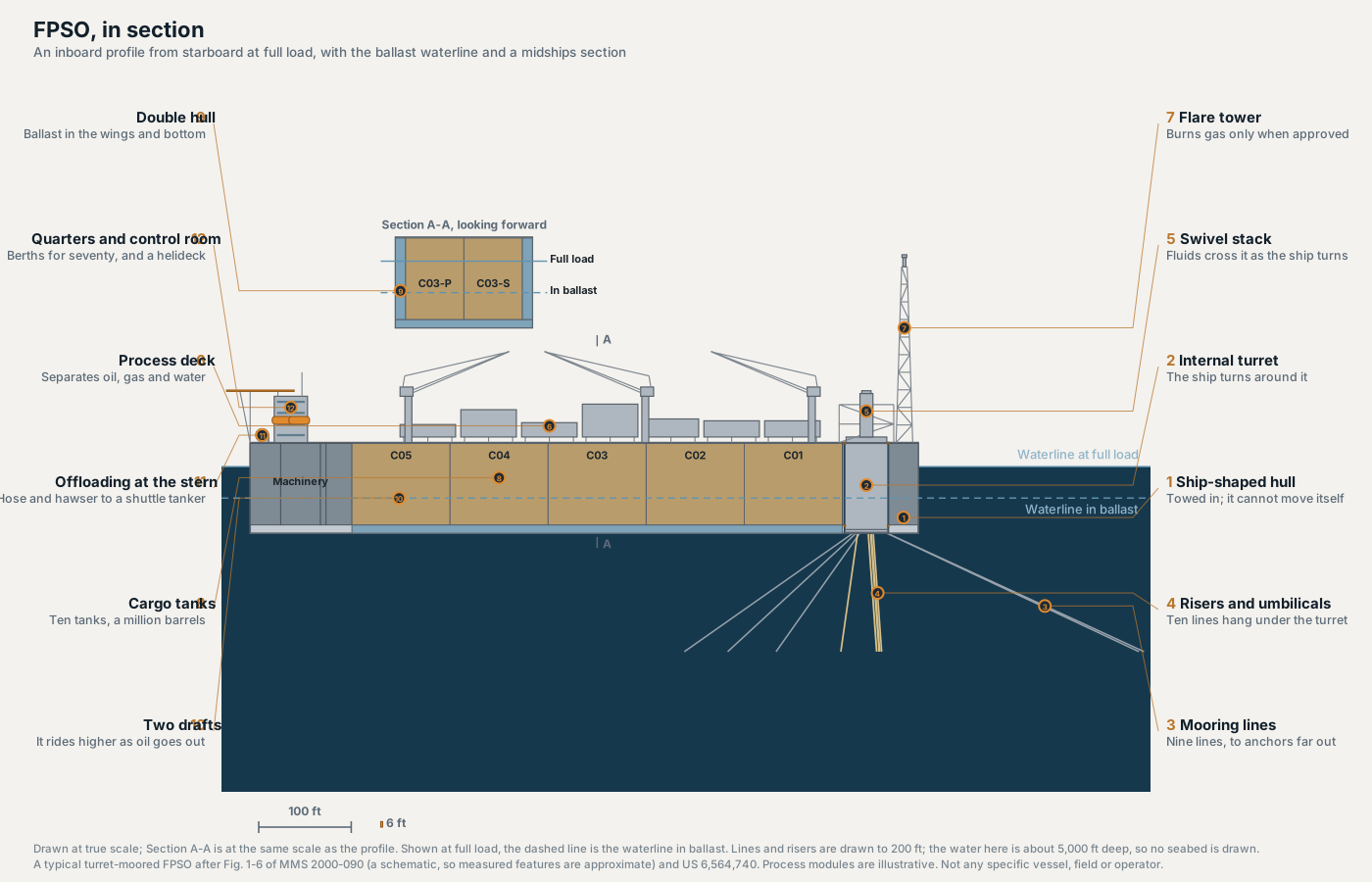
- Mooring lines. Nine chain and wire lines in three clusters, running out to anchors 8,000 to more than 10,000 feet away, in about 5,000 feet of water.
- Risers and umbilicals. Ten lines from the seafloor: six production risers bring the well stream up, three umbilicals carry power, hydraulics and signals down to the subsea equipment, and one riser sends gas back down for export.
- Turret. A drum in a shaft 49 feet across, through the forward hull. Every line and riser is made fast to it, and the ship turns around it.
- Swivel stack. On top of the turret, one rotating joint for each stream, so oil, gas and signals can cross from the still turret to the turning ship.
- Process deck. Modules on a raised deck that separate the well stream into oil, gas and water.
- Flare tower. At the bow, the opposite end from the quarters.
- Cargo tanks. Ten tanks of 100,000 barrels each, in five pairs along the hull.
- Double hull. Two skins of steel at the sides and along the bottom, with ballast water between them.
- Offloading station. At the stern, a hose reel and the winch for the hawser that holds the tanker.
- Quarters, control room and helideck. At the stern: berths for 70, a normal crew of 40 plus 30 for service crews and visitors, rotating ashore by helicopter every 14 days.
Why a ship, and not a pipeline
Oil from Gulf platforms has mostly gone ashore by pipeline, and the study explains why that gets harder the deeper you go. In "deep, rugged, cold, and distant seafloor environments," laying an oil pipeline and keeping crude flowing through it means "overcoming technological challenges," and the cost becomes a limit on what gets developed at all. Gas is easier. Gas lines are smaller and simpler to lay, and the flow problems of crude oil do not apply to processed gas. So the base case sends its gas ashore by pipeline and keeps its oil on board.
In the study's words, an FPSO gives "a deepwater production and transportation option in lease areas that are beyond the reach of current oil pipeline infrastructure." It defines deepwater as more than 650 feet. The advantages it lists are the industry's, as the study reports them: an FPSO can be built and installed faster, so production starts sooner; shuttle tankers can replace a long export line, cutting tariffs and up-front capital; the cargo can go to whichever refinery pays best; the vessel can be leased, then moved and reused on another field; and it has more deck space than other structures, so the plant can grow if the wells do better than expected.
When the study was written no FPSO worked in the US Gulf. A survey it cites counted 71 in service or under construction worldwide in 1999, 29 built for the job and 42 converted from oil tankers, in every major offshore producing region except the US Gulf of Mexico.
From the seabed to a tanker
Follow the oil. The production risers come up from manifolds on the seafloor. Near the vessel they hang almost straight down to 1,000 feet or more, then curve away across the bottom in what is called a lazy wave. They reach the ship through the turret, cross the swivel stack, and arrive at the process deck. There the stream is split three ways: oil is treated to export quality and sent to the tanks, gas is compressed for export or burned in the turbine generators that power the vessel, and water is treated and discharged under a permit. For its base case the study sizes the plant for 150,000 barrels of oil, 200 million cubic feet of gas and 70,000 barrels of water a day, which it calls a representative peak production scenario.
Oil goes to a shuttle tanker as often as every three days at the peak and as seldom as every ten. Moored bow-on about 260 feet astern on a single hawser, the tanker swings with the FPSO on the one turret, and a retractable hose carries the oil across. In the study that tanker carries 500,000 barrels, about the largest the depths of the Gulf coast ports allow, and the system pumps 50,000 barrels an hour. By our arithmetic, 500,000 barrels is a little over three days of oil at the peak rate, close to that three-day interval, and a full cargo loads in about ten hours.
Where is the risk? The trade press summed up the study's answer when it came out: most of the risk of oil spills lies with the shuttle tankers, not with the FPSO itself. Of the spill risk on the FPSO, leaving out offloading and the tanker, only 5% is unique to FPSOs; the other 95% would be just as likely on any other deepwater platform. Offloading, in the study's comparison, is like lightering, the ship-to-ship transfers already done in the Gulf, with "a history of low spill frequency and small spill volumes." And it puts the voyage beside the alternative: 1.21 spills of more than 1,000 barrels for every billion barrels moved by tanker, against 1.32 by offshore pipeline. Those tanker figures come from incidents going back to the 1970s, and the study says its tanker estimate may well be conservative.
The turret, and why the ship turns
The turret is what makes this a ship rather than a barge on anchors. All nine mooring lines and all ten risers are made fast to it, and the hull turns around it. In the study's words, the vessel can "pivot on the mooring system and take the position of least resistance with respect to the prevailing wind, waves, and current," which "minimizes the loading of forces" on the hull. In the base case this happens passively, with no thrusters: the hull has no engine of its own, and three to five tugs tow it to the field.
Ours turns on an upper and a lower bearing. The chains are made fast to a chain table at its foot, and a single hoist on its pull-in deck tensions them in turn, the arrangement in US 6,564,740. That patent also notes the great risk to the people on deck if a wire rope breaks under that load. Because the hull swings all the way round, no pipe or cable can cross the joint in one piece, so every stream passes through its own swivel in the stack on top.
Some FPSOs elsewhere are built to disconnect from their moorings and leave ahead of a storm or an iceberg. This one does not, because "some weather systems forming in the GOM may not allow adequate time for an orderly disconnection." It is designed instead to stay on station through a 100-year storm, though the study allows that some operators may propose a disconnectable system.
A million barrels, and two drafts
The hull is the storage tank. The cargo tanks hold a million barrels, with slop tanks for oily waste at the after end, and every cargo tank is kept inert and pressurized except when someone has to go in. Around them are two skins of steel. Because the Coast Guard treats an FPSO as a tank vessel, the study builds in the double hull that the Oil Pollution Act of 1990 requires of tankers. Between the skins sits segregated ballast, so oil and ballast water never mix.
That ballast is how the ship stays trim as its cargo changes. Full of oil, the hull draws 72 feet. In ballast it draws 38, and stands 34 feet higher out of the water: those are the two drafts. Ballast comes aboard as oil goes out to the tanker and goes back over the side as the tanks fill, where permit conditions call for it to be checked for free oil. Our model floats at full load; the section drawing marks both waterlines.
The record the study had
How safe is it? One worldwide record was all the study had to work from, and it says so: a 1999 survey done for an industry consortium, "the only known and available recent attempt" at a world history of FPSO operations that includes their spills. It found 97 operations since the late 1970s, 413 years of service between them and an estimated 5.9 billion barrels processed. Answering was voluntary, and spill data came back for only 28 of the 97. Those 28, with 121 years of service and 2.0 billion barrels produced, reported 194 spills totalling 5,407 barrels: 2.7 barrels for every million produced. Beside it the study sets the US Gulf's own offshore record since 1980: about 5.5 billion barrels produced and 61,500 spilled, or 11.2 per million. By the study's own account the FPSO data are limited, and they cover fewer than a third of the operations.
Of the spills in the survey, the largest was 3,900 barrels, in the North Sea. During the startup of a new FPSO, an overboard dump valve was left open by mistake. In the survey's judgment the cause was operational, not hardware, and the study adds that this kind of human error "could potentially occur during the startup of any new production system." Keep that one in mind; it comes back below.
Twelve systems, and what controls them
Each system in the interactive FPSO has its own link, which opens the model on that part with a short explanation and a line on what is measured or decided there. That second layer is operational technology (OT): the controllers, sensors and shutdown systems that run the vessel, as opposed to the office systems that report on it.
| System | What runs or decides it |
|---|---|
| Ship-shaped hull | No engine of its own. The weather sets its heading; the crew controls how it is loaded. |
| Internal turret | Holds still while the ship turns. Chains and risers come aboard on wire rope under heavy load, each pull planned in advance. |
| Mooring lines | Line tension says the vessel is still held. Who hears about a slack line, and how fast, is set when the alarms are. |
| Risers and umbilicals | Every valve on the seafloor is worked from the vessel, through the umbilicals. |
| Swivel stack | Every stream crosses this one rotating joint. The shutdown logic decides what counts as a leak here. |
| Process deck | A process control system, around the clock. The trip limits, and who may bypass a trip, are the decisions that matter. |
| Flare tower | Gas is flared for days at a time while a well is tested, when justified and approved. A record of when, and on whose approval, makes that checkable. |
| Cargo tanks | Levels and inert gas pressure are read on a screen in the accommodation, a long way from the tanks. |
| Double hull | Passive steel. The checks on discharged ballast water for free oil are the evidence it is working. |
| Two drafts | A central ballast control station runs ballast, bilge, heel and trim. |
| Offloading at the stern | Break-away hoses and shut-off valves. The design decides which valve closes on its own. |
| Quarters, control room and helideck | The central control center sits inside the temporary safe refuge. |
Eight places AI fits, and where it has to stop
The study did something useful for this question. Its Table 4-33 lists, hazard by hazard, the protection the base-case vessel already has and the further measures it judged feasible. Several of those measures are monitoring: oxygen in the cargo tanks, flow in the risers, pressure on the offloading hose, loads on the hull. That is where analytics would sit. Below, those rows are taken system by system: the second column is the study's, and the last two are our read of what a model could add and who should hold the decision, not a report of what any operator runs.
| System | What the study lists | What a model could add | Who decides |
|---|---|---|---|
| Mooring lines | Against foundering, has: design for the 100-year wave and the 100-year current. Feasible: classing the hull and mooring system, or designing past the 100-year storm | Read each line's tension against the weather and the vessel's position, and flag a line that stops carrying its share | The marine crew. What a slack line alarm stops, an offloading for one, is set by people in advance |
| Risers and umbilicals | Has: pressure monitoring for the main leaks, under API RP 14C. Feasible: a device that detects and alarms on no flow or a loss of flow | Balance flow and pressure at both ends of each riser, to find a small leak a pressure switch would miss | Shutting a riser in stays with the safety system. A person decides what a suspected leak from a model sets off |
| Swivel stack | Has: ventilation, gas detection that shuts down and blows down, firewater and foam. Feasible: an empty or ballast space between the turret and the storage tanks | Trend the swivel's temperatures and pressures and the gas readings around it, to see a seal wearing before it leaks | Gas detection and the shutdown stay hard-wired. A person approves when a seal is changed |
| Process deck | Has: fire and gas detection that shuts down and blows down, and the plant raised above the tanks. Feasible: two levels of upset protection under API RP 14C, and automatic isolation between process vessels | Rank alarms, catch an instrument drifting, suggest setpoints as the well stream changes | Both levels of protection stay outside the model. A named person approves any bypass, with a time limit and a record |
| Cargo tanks | Has: inert gas, crude oil washing and a double hull. Feasible: continuous monitoring of the oxygen in every cargo tank, to keep it below 5% | Watch each tank's oxygen and inert gas pressure for a slow drift, and for an analyzer that disagrees with its neighbors | The 5% limit and its alarm stay as they are. Who enters a tank is decided by permit, by a person |
| Two drafts | Feasible: a central ballast control station, "to reduce the potential for human error in ballasting," and real-time monitoring of the loads on the hull | Propose each ballast and loading sequence, and check it against the measured loads on the hull | A person checks the plan against the hull's strength and stability, and approves it |
| Offloading at the stern | Has: a hose with a marine break-away coupling and shut-off valve, and an isolation valve on each pump. Feasible: an automatic shutdown valve upstream of the hose, tripped by a low-pressure sensor | Watch hose pressure and flow through the transfer for the signature of a leak, and the tanker's position on its hawser | The low-pressure shutdown stays automatic. Starting and stopping a transfer is a person's call |
| Double hull | Against collision, has: monitoring, alarms and navigation aids. Feasible: collision avoidance radar, an attendant vessel, an exclusion zone | Track the ships around the field and flag one whose course will cross the exclusion zone | Calling the ship, and stopping an offloading, are a person's decisions |
On the riser row the study is at its most candid. On its own base-case protection, it says: "Pressure sensor may not effectively detect leakage especially for small leaks, especially if the sensor is located subsea where the external pressure may be about that of the riser or pipeline pressure." That is the gap a model is good at: a small, slow change spread across many readings. It is also exactly where a model should not become the protection. The useful version runs beside the pressure switches, a person decides whether what it finds becomes a shut-in, and the record keeps both.
We found the same pattern on the rig, the pump jack and the LNG plant. The closer a setting sits to something that can hurt a person or spill oil, the further a model should sit from it. We would hold any of these systems to three rules:
- Advise, then decide. The model recommends, a named person decides, and the record keeps both: what the model saw, what it said, and what was done. The study's own reason for central ballast control is human error. A model that drafts ballast plans helps only if someone still checks them.
- Stay out of the protection path. Gas detection, shutdown and blowdown, the two levels of upset protection, the break-away coupling and the hose's low-pressure trip are the vessel's protection. AI can watch them and help plan their maintenance. It should not be the thing that trips them or holds them off.
- Know where the model learned. A model trained on months of a field running steadily has seen very little of startup, and startup is when the largest spill in the study's record happened. A new vessel has no history of its own at all. Validate on this vessel, and write down what the model has never seen before anyone relies on it.
Those rules are what ModalPoint works on. AI decision governance is about the decision, not the database: who signs off, what gets logged, and how you prove it later. We cover the wider picture in how oil and gas companies use AI, and the governance it needs, and the same map across the whole value chain in AI in oil and gas.
Where we are least sure
Some of this rests on less than we would like, and we would rather say so here than bury it:
- Nearly every figure, and the vessel itself, come from one 2001 study's base case. Trade papers reported the same base case at the time, but they were reporting the study, so their coverage is not an independent check. Real vessels vary, and we have not tried to say how far.
- In its text, the study says internal turrets are "typically located just forward of midships." Both of its figures draw this one 56 feet aft of the bow. We followed the figures.
- Its schematic is marked not to scale. We used only its labelled dimensions as dimensions; the other proportions, such as where each tank starts and how wide the double hull is, are measured off it.
- No source states the flare tower's height. Ours is measured off the study's illustration.
- Our mooring lines and risers stop 200 feet below the surface. With the water about 5,000 feet deep and the anchors more than a mile and a half away, no view of the ship could show the rest.
- Process modules, cranes and quarters are the right kind of equipment in the right place, not a copy of any plant. We have not drawn the shuttle tanker.
- Every spill figure is the study's: a 1999 survey with a partial, voluntary response, and tanker data going back to the 1970s that the study says may well be conservative.
You can read the whole study, which is public and runs to hundreds of pages: its section 1.4 has the base case and Table 4-33 the risk measures. If you run, inspect or design a vessel like this and something here is drawn wrong, tell us what and we will fix it.
Where the model comes from
Our vessel is the base case of MMS 2000-090. Its principal dimensions are the labels on the study's Fig. 1-6, the layout follows its Fig. 1-4 illustration, and the systems follow its text. For the turret we followed one public domain US patent: US 6,564,740 (the internal turret, its two bearings, the chain table and the hoist). It is a typical vessel, not a depiction of any specific vessel, field or operator.
The video and the interactive version are the same model: we render the video frame by frame from the page you can open above, so what you take apart is exactly what you watched.
Why an energy firm built an FPSO
It is the offshore structure most people outside the industry have never heard of: a processing plant, a tank farm and a marine terminal on one hull, with a crew of 40 and no road to it. In the study, the central control center is in the quarters, and the cargo and ballast tanks are watched and run from there too, each system with settings someone owns. Among the people deciding how AI gets into that room are the operators and the companies selling them control systems, sensors, subsea controls and analytics. If you sell into floating production, this is the picture your buyer is working from, and our note on field level oil and gas sales covers how that buyer decides.
If there is a structure you want taken apart next, tell us which.
Sources
- Minerals Management Service, US Department of the Interior, Proposed Use of Floating Production, Storage, and Offloading Systems on the Gulf of Mexico Outer Continental Shelf, Western and Central Planning Areas, Final Environmental Impact Statement, OCS EIS/EA MMS 2000-090 (January 2001)
- Offshore, MMS issues environmental analysis for FPSOs in Gulf of Mexico (Feb 9, 2001)
- Oil & Gas Journal, MMS issues environmental analysis for FPSOs in Gulf of Mexico (Feb 9, 2001)