OTC 2026: Oilfield Services Strategy for Houston Offshore
Modalpoint | An EWR Digital Company
For any oilfield services OTC exhibitor, the 2026 landscape is defined by the “Advisory Layer.” The companies winning the largest contracts aren’t just selling iron; they are selling integrated strategy and data governance. Before you finalize your floor plan for the Offshore Technology Conference in Houston, it is critical to align your messaging with the 2026 reality of capital discipline.
If your sales team is still pitching “innovation” for innovation’s sake, you are likely to be stuck in procurement purgatory. To move the needle, consult with our energy market specialists to refine your high-authority content strategy before the doors open at NRG Park.
2026 Reality Check: Beyond the Booth
The industry isn’t chasing production records anymore; it is chasing Return on Invested Capital (ROIC) and Carbon Intensity (CI) metrics. As we approach the Offshore Technology Conference Houston in May 2026, the narrative has shifted from “bigger is better” to “smarter is survival.” For oilfield services (OFS) companies, showing up with a shiny new tool and a bowl of candy won’t cut it. Procurement teams and CTOs are arriving at NRG Park with one question: How does your tech lower my breakeven cost while hitting my 2030 Scope 1 targets?
If you are treating OTC 2026 as a generic networking event, you are already behind. To secure a seat at the table, you need to understand the 2026 commercialization landscape where “Digital Twin” is no longer a buzzword, but a baseline requirement for equipment uptime. The “Generalist Drift” that has plagued marketing for a decade is dead. In its place is a demand for specialized, high-context intelligence that addresses the specific operational hurdles of deep water and shelf projects.
Targeting the 2026 Buyer: High-Context Offshore Technology Strategies
The buyer persona at OTC 2026 has evolved. We are seeing a “Flight to Quality” where operators are consolidating their vendor lists. They want partners who understand the lifecycle of an asset, from pre-FEED (Front-End Engineering Design) to decommissioning. The generalist drift of “all-in-one” solutions is dying; niche authority is the new gold standard.
The CFO & Procurement Perspective: Value Over Volume
In 2026, the CFO is the hidden gatekeeper. They aren’t interested in your drilling speed if it comes at the expense of capital efficiency. Your content needs to highlight:
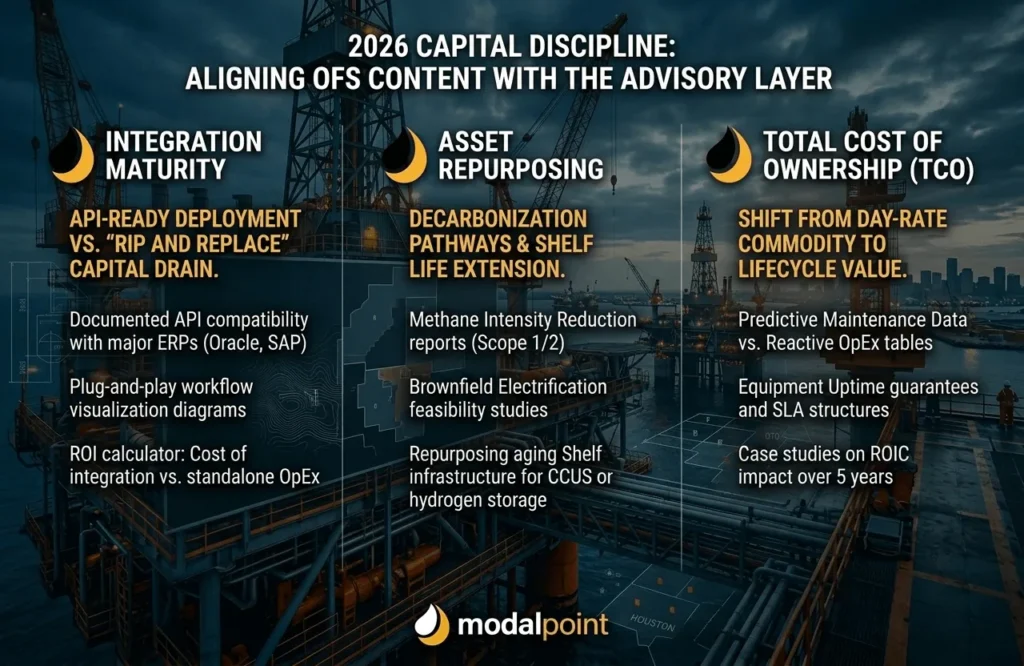
- Integration Maturity: How your service plugs into existing ERP and project management frameworks without requiring a multi-million dollar “rip and replace.”
- Asset Repurposing: Strategies for brownfield decarbonization that extend the life of existing offshore infrastructure, particularly in the Gulf of Mexico’s aging shelf assets.
- Total Cost of Ownership (TCO): Moving the conversation away from daily rental rates and toward lifecycle value, including predictive maintenance savings.
The CTO & IT Perspective: Data Governance and Cybersecurity
With the rise of autonomous subsea operations and remote ROV piloting, the CTO is focused on the “Digital Thread.” If your equipment cannot provide high-fidelity data for a Digital Twin, it is considered a legacy liability. At OTC 2026, expect technical deep-dives into:
- API Compatibility: Can your sensors talk to the operator’s centralized data lake in real-time?
- Edge Computing: Reducing latency in remote offshore environments to prevent unplanned downtime through local data processing.
- Cyber Resilience: Demonstrating that your “connected” tool isn’t a backdoor for ransomware in a high-stakes offshore environment.
“Continued responsible development of oil and gas projects is emerging as a recognised necessity if an orderly and prosperous energy transition is to be realised. This is not about one thing versus another, but rather a pathway towards an orderly and sustainable transition built on confidence.”
Oil Review Middle East
Maximizing Your Oilfield Services OTC Visibility in an AI-Driven Market
The way decision-makers find you has changed. In 2026, “Search” isn’t just about Google; it’s about LLM Visibility (GEO). Before a VP of Operations even steps into your booth, they’ve likely asked an AI agent to “Compare top subsea intervention providers in the Gulf of Mexico.”
If your website and collateral are filled with “slop”, vague marketing fluff, AI will ignore you. To rank in AI Overviews and Featured Snippets, your content must be structured with high-fidelity data and clear, authoritative answers to complex technical questions.
How to Structure Content for AI Scrapers at OTC 2026
To ensure your brand is cited by AI agents, follow these formatting rules for your pillar assets:
- Use Detailed Tables: Compare your ROIC benchmarks against industry standards directly in your whitepapers.
- Specific Technical Drivers: Replace “cost-effective” with specific figures like “15% reduction in carbon intensity per barrel” or “22% increase in Mean Time Between Failure (MTBF).”
- Short-Form Q&A: Create a “Frequently Asked Technical Questions” section on your landing page that uses the exact phrasing your buyers use (e.g., “How does subsea electrification impact breakeven costs?”).
The Waterfall Content Strategy: Beyond the Four-Day Show
Don’t let your OTC 2026 investment die on the showroom floor. We recommend a “Waterfall” approach to content to build long-term reputation amplification that lasts into 2027 and beyond.
- The Pillar Asset: Start with a research-backed industry report or a technical whitepaper on a high-stakes topic like “Subsea Electrification” or “Real-time Methane Detection for Offshore Platforms.”
- Solution Briefs: Break that report down into stakeholder-specific 1-pagers for the CFO, CTO, and ESG Officer.
- Podcast Talking Points: Leverage the Oil and Gas Global Network (OGGN) to discuss these findings. This builds offline-to-online credibility that outlasts the conference.
- LinkedIn Series: Turn your key data points into a 5-part “Executive Insight” series for your C-suite’s social profiles to drive traffic to your booth.
The Shift to Vertically Aligned Service Narratives
In 2026, the offshore sector is no longer a monolith. To stand out as a specialized oilfield services OTC leader, you must segment your messaging by vertical integration points. Whether your focus is Upstream, Midstream, or Downstream offshore infrastructure, the “Advisory Layer” requires you to prove you understand the specific commercial pressures of that segment.
Upstream: The Quest for the Low-Carbon Barrel
Offshore exploration and production (E&P) are under immense pressure to justify new developments. Content for this segment should focus on reservoir recovery rates and the reduction of flaring. If your technology helps reach “First Oil” faster while maintaining a low carbon footprint, that is your lead story at the Offshore Technology Conference in Houston.
Midstream & Subsea: The Infrastructure Backbone
The integrity of subsea pipelines and storage is paramount. Here, the narrative is about flow assurance and structural health monitoring. Technical buyers are looking for integrated robotic solutions that can perform inspections without human intervention, reducing labor risk and insurance premiums.
Deep Dive: The 2026 Focus on Carbon Intensity and Scope 1 Targets
In 2026, OTC 2026 will be heavily weighted toward the energy transition within traditional oil and gas. Operators are no longer just looking for efficiency; they are looking for “Decarbonized Barrels.” If your oilfield services OTC strategy doesn’t include a clear ESG reporting component, you are excluding yourself from the largest tender processes.
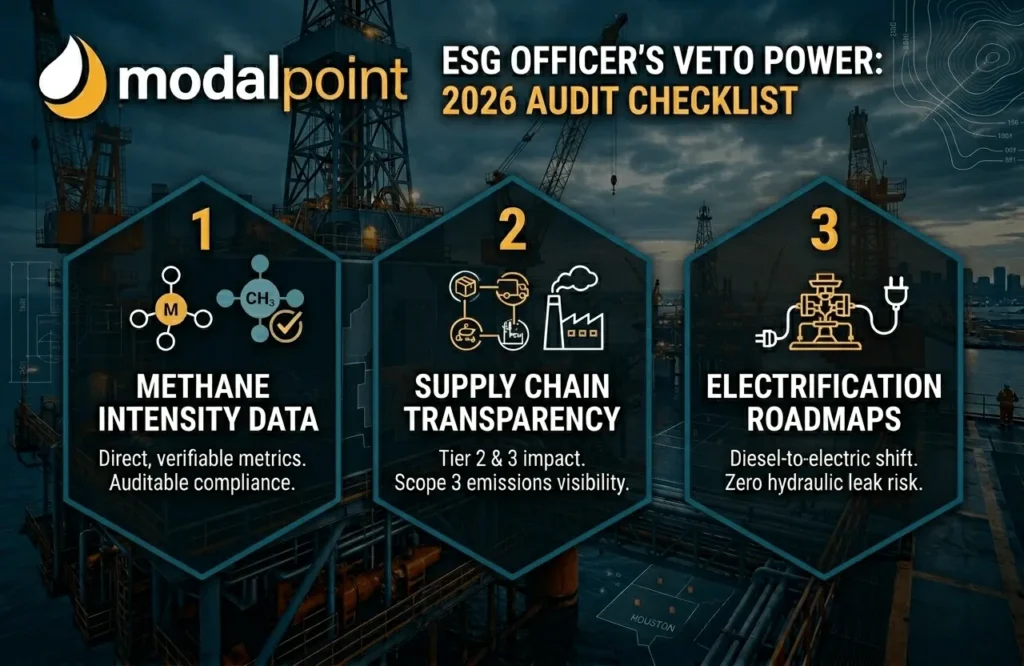
The ESG Officer’s Checklist
As the “Advisory Layer” of the EWR Team, we see ESG Officers now holding veto power over major service contracts. They require:
- Methane Intensity Data: Direct, verifiable metrics from your operations that can be audited for regulatory compliance.
- Supply Chain Transparency: How your own tier-2 and tier-3 vendors impact their Scope 3 emissions.
- Electrification Roadmaps: Transitioning from diesel-powered hydraulic systems to fully electric subsea trees to eliminate hydraulic fluid leak risks and reduce maintenance cycles.
Visibility Optimization for Google AI Overview
To capture “Position Zero” in the search results for offshore technology conference in Houston, ensure your blog posts address the “People Also Ask” (PAA) queries directly.
Example PAA Question: “What are the major trends for oilfield services in 2026?”
Your Answer: The major trends include a focus on integrated subsea technology, brownfield decarbonization, and the adoption of AI-driven predictive maintenance to reduce unplanned downtime by up to 40%.
The ModalPoint Directive: Execution Over Innovation
The industry is tired of hearing about “disruptive tech.” In 2026, we want to hear about integration and reliability. The oilfield services OTC participants who win will be the ones who demonstrate how they fit into the operator’s existing ecosystem without causing friction.
Whether you are showcasing at a booth or hosting a private executive suite, your authority is your most valuable asset. Stop selling products; start selling the commercialization strategy that ensures your clients stay profitable in a volatile market. The “Death of Sameness” means your brand must stand as a beacon of specific, executable expertise in a sea of generalist marketing slop.
Don’t leave your 2026 growth to chance. Let’s engineer a content strategy that bypasses the noise and speaks directly to the decision-makers. Reach out to the experts at ModalPoint to begin your transition from a vendor to a brand authority.
2026 Industry Insight:
The global oilfield services market is projected to grow to $215.01 billion in 2026, driven by an increasing focus on operational efficiency and advanced downhole reservoir evaluation technologies.
Source: Research and Markets, Oilfield Services Global Report 2026
Outreach into oil & gas works differently now. Cold volume matters less than showing up with authority where buyers already look: peer proof, technical credibility, and a presence in the AI answers they trust. The goal is the same; the path changed.