oil gas market intelligence
Why Your Oil & Gas Brand is Invisible to AI Search Tools
By Matthew Bertram | EWR Digital
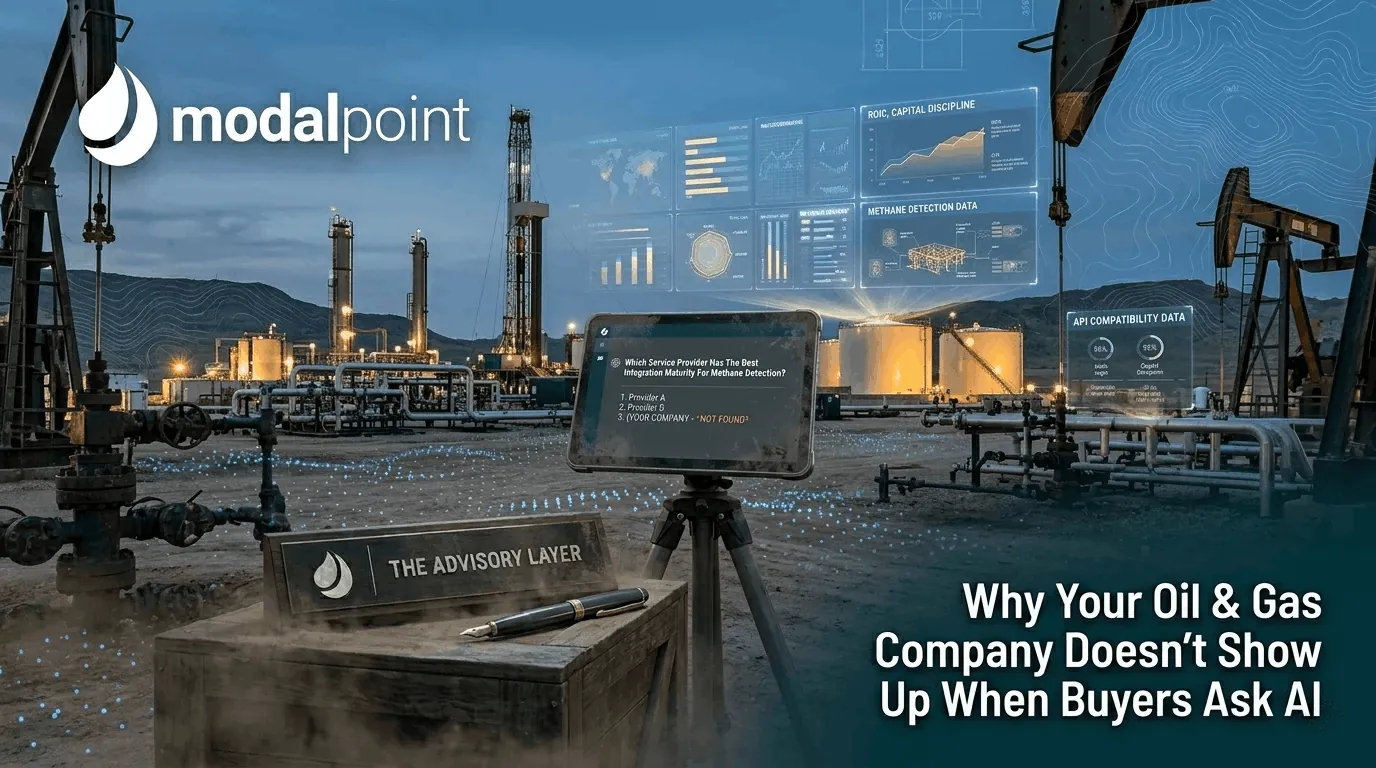
The 2026 reality check is here and it is brutal for the unprepared. The industry isn’t chasing production records anymore; it’s chasing ROIC and operational visibility. If your enterprise isn’t appearing in the conversational interface of a procurement officer’s LLM, you don’t exist. We have moved past the era of SEO keywords into the era of oil gas AI visibility. If a CTO asks an AI agent which service provider has the best integration maturity for methane detection, and your name isn’t in the generated response, you’ve lost the deal before the first human phone call was ever made. The problem is that most energy companies are still dumping “slop” into the digital ether. They use generalist marketing terms like “cutting-edge solutions” and “world-class service.” These words are invisible to Large Language Models (LLMs) because they lack context, data, and vertical specificity. To win in 2026, you must pivot from being a “vendor” to being a “verifiable data source.”The Death of Generalist Content in the Age of LLM Oil and Gas Search
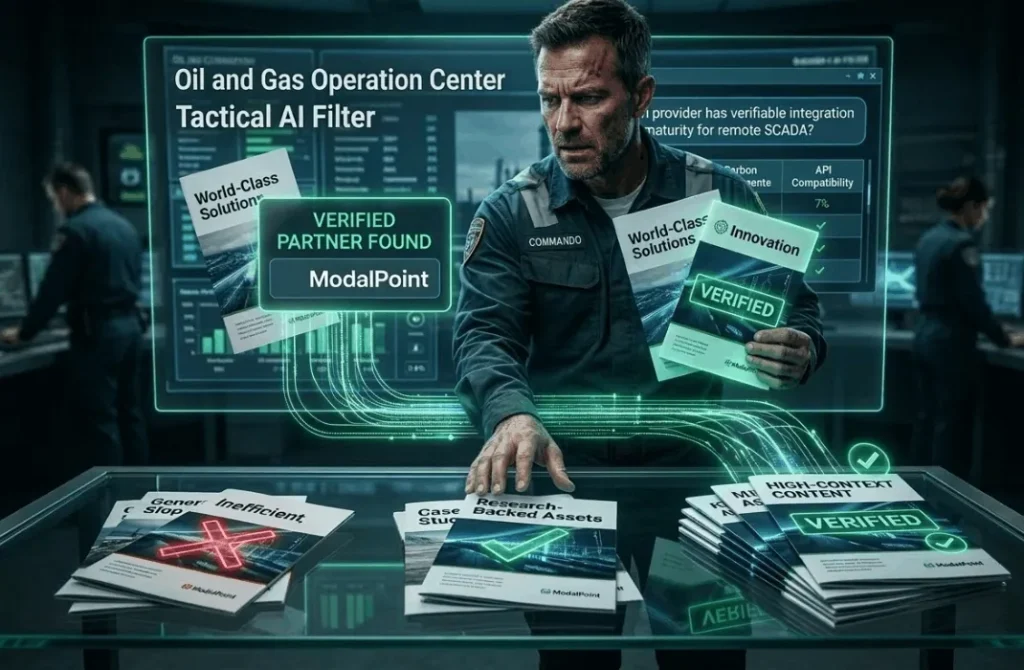 The “Generalist Drift” is the silent killer of Energy Tech marketing. When you use broad terminology, you are essentially telling the AI that you are just like everyone else. LLMs are trained on pattern recognition. If your whitepapers and case studies look like every other service company’s marketing collateral, the AI will bucket you into a generic category. This is why digital information governance is no longer just an IT concern; it is a fundamental marketing requirement.
To stand out, your content must be “high-context.” This means replacing “innovation” with specific mentions of API compatibility, SCADA integration, or specific ROIC improvements in the Permian or North Sea. When the AI “scrapes” or “crawls” your site, it should find a dense map of technical specifications and localized results. That is how you achieve oilfield services AI search dominance.
The “Generalist Drift” is the silent killer of Energy Tech marketing. When you use broad terminology, you are essentially telling the AI that you are just like everyone else. LLMs are trained on pattern recognition. If your whitepapers and case studies look like every other service company’s marketing collateral, the AI will bucket you into a generic category. This is why digital information governance is no longer just an IT concern; it is a fundamental marketing requirement.
To stand out, your content must be “high-context.” This means replacing “innovation” with specific mentions of API compatibility, SCADA integration, or specific ROIC improvements in the Permian or North Sea. When the AI “scrapes” or “crawls” your site, it should find a dense map of technical specifications and localized results. That is how you achieve oilfield services AI search dominance.
The Procurement Purgatory of Undefined Data
Procurement teams are now using specialized AI tools to vet vendors. These tools don’t look at your “About Us” page for inspiration. They look for specific proof points regarding capital discipline and “Value over Volume.” If your technical assets are buried in unsearchable PDFs or hidden behind poorly indexed portals, the AI simply skips you. You are effectively in procurement purgatory because your data is not “machine-readable.”Artificial intelligence is not just a tool for efficiency; it is becoming the primary filter through which industrial buyers discover and validate technical partnerships in the energy sector. Boston Consulting Group (BCG)
How to Optimize for AI Overviews and Position Zero in 2026
The goal is no longer just ranking #1 on a Google search page. The goal is being the definitive answer in the “AI Overview” or the “Featured Snippet” box. To do this, you must adopt a “Waterfall” content strategy. Start with a high-fidelity “Pillar Asset,” such as an industry report on carbon intensity or a technical webinar hosted on the Oil and Gas Global Network (OGGN). From there, you cascade that data into smaller, factual snippets that LLMs love.Structuring Content for LLM Visibility (GEO)
Generative Engine Optimization (GEO) is the new SEO. To ensure LLM oil and gas visibility, your content must be structured in a way that provides clear, short answers to complex questions. Use tables to compare breakeven costs and bullet points to list cybersecurity protocols. This formatting makes it easy for AI to scrape and cite your brand as an authority. If you provide the most structured answer to “How do digital twins reduce downtime in offshore rigs?”, you will be the brand the AI recommends. Furthermore, you need to tie your online presence to offline credibility. By appearing on industry-leading podcasts and being cited in reputable trade journals, you create a “reputation loop” that AI models recognize as a signal of authority. It’s not just about what you say on your website; it’s about how many authoritative sources link back to your technical data.Targeting the Stakeholder: From CFO to ESG Officer
In the 2026 market, a one-size-fits-all sales deck is a liability. Your content needs to be “vertically aligned” and persona-specific. The AI agents serving a CFO are looking for ROIC and capital discipline. The agents serving an ESG officer are looking for methane detection precision and sustainability reporting metrics. Your website should have dedicated sections that address these specific drivers without the fluff.The CFO and Procurement Narrative: Capital Discipline
For the financial side of the house, your content must focus on “Value over Volume.” Discuss how your service reduces integration maturity timelines or lowers the total cost of ownership (TCO). Use hard numbers. Instead of saying “We save you money,” say “Our solution reduces OPEX by 14 percent in mature basins through automated edge computing.”The CTO and IT Narrative: Data Sovereignty and Security
When targeting the technical leaders, the focus shifts to cybersecurity, API compatibility, and “Digital Twin” integration. They need to know that your software won’t create a vulnerability in their network. Providing detailed documentation on your data governance practices is the best way to bypass their skepticism. This is where high-context, research-backed assets become your strongest sales tool.Technical Summary: 2026 Oil & Gas AI Search Visibility (FAQ)
How does high-context content improve ROIC for oilfield service companies?
High-context content improves ROIC by reducing the sales cycle and bypassing “procurement purgatory.” By providing specific technical data such as integration maturity, API compatibility, and verifiable OPEX reduction, service companies allow AI-driven procurement tools to validate their solutions without manual back-and-forth. This increases capital discipline by ensuring marketing spend is directly tied to lead qualification for high-value contracts.Why is “Digital Transformation” a dead term in the 2026 energy market?
In 2026, “Digital Transformation” is considered a generalist term that lacks operational accountability. The industry has shifted toward “Operational Execution” and “Integration Maturity.” Buyers now prioritize solutions that offer immediate “Digital Twin” compatibility and measurable carbon intensity reduction rather than broad, undefined “innovation” initiatives.What is Generative Engine Optimization (GEO) for Oil and Gas?
GEO for the energy sector is the process of structuring technical data such as breakeven costs, methane detection precision, and labor efficiency metrics into machine-readable formats (tables, bulleted lists, and factual Q&As). This allows Large Language Models (LLMs) to identify, scrape, and cite a brand as a high-authority source in AI-generated overviews and conversational search results.Moving from AI Slop to High-Authority Assets
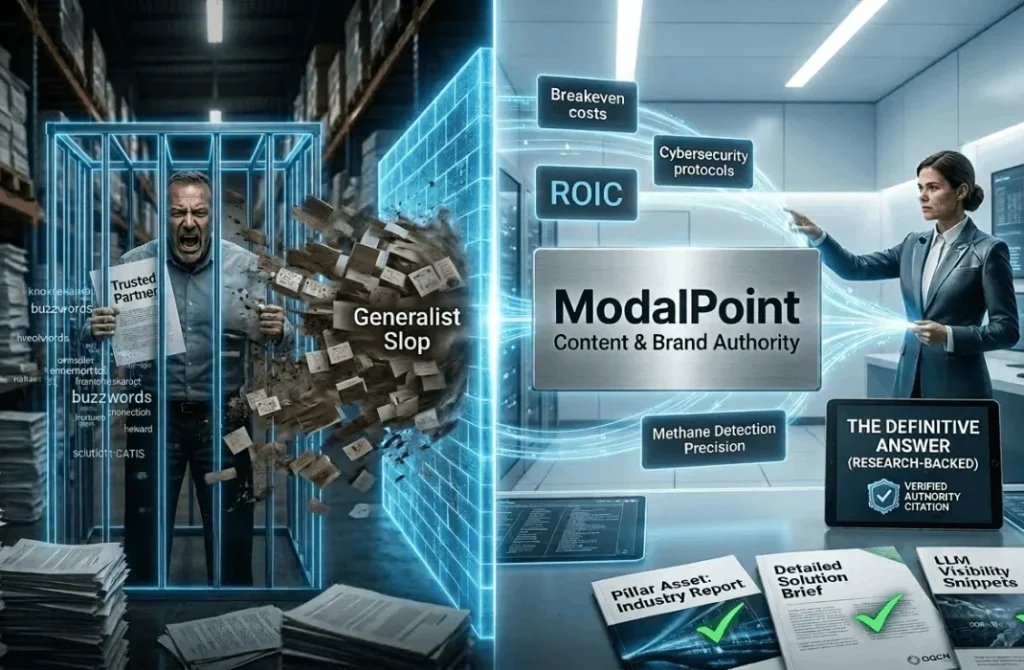 The age of “Digital Transformation” as a buzzword is dead. In 2026, it has been replaced by “Operational Execution.” If your marketing is still stuck in 2022, using generic AI-generated slop, you are actively damaging your brand’s reputation and visibility. High-authority content is the only way to break through the noise. It requires the grit of an oilfield veteran and the precision of a data scientist to produce material that actually moves the needle.
Stop letting your competitors win the “AI Search” battle. It’s time to audit your digital footprint and ensure that every piece of content you produce is optimized for the conversational future of the energy industry. Whether you are in Upstream, Midstream, or Downstream, your “commercialization strategy” must include a plan for AI visibility.
If you’re ready to stop being invisible and start being the authority that AI agents recommend, you need a partner that understands the “Advisory Layer” of the energy market. You need to build a brand that is resilient, data-driven, and specialized. You need Modalpoint.
The age of “Digital Transformation” as a buzzword is dead. In 2026, it has been replaced by “Operational Execution.” If your marketing is still stuck in 2022, using generic AI-generated slop, you are actively damaging your brand’s reputation and visibility. High-authority content is the only way to break through the noise. It requires the grit of an oilfield veteran and the precision of a data scientist to produce material that actually moves the needle.
Stop letting your competitors win the “AI Search” battle. It’s time to audit your digital footprint and ensure that every piece of content you produce is optimized for the conversational future of the energy industry. Whether you are in Upstream, Midstream, or Downstream, your “commercialization strategy” must include a plan for AI visibility.
If you’re ready to stop being invisible and start being the authority that AI agents recommend, you need a partner that understands the “Advisory Layer” of the energy market. You need to build a brand that is resilient, data-driven, and specialized. You need Modalpoint.
2026 Industry Insight:
According to a recent study, over 70 percent of industrial B2B buyers now utilize AI-powered search engines and conversational agents as their primary method for initial vendor research and technical vetting. Source: McKinsey & Company
Related reading & references
- DIG in Oil & Gas: the foundational case
- Microsoft Agent 365 vs. AI decision governance
- the 5-day Governance Readiness Assessment
- External reference: the Texas TRAIGA bill (HB 149)
Where this stands in 2026
The governance stakes have risen since this was written. TRAIGA, the EU AI Act, and NIST AI RMF now make AI-influenced decisions something an operator has to be able to defend on the record, which is exactly what ModalPoint’s DIG framework is built for.
What AI decision governance looks like today →
Frequently asked questions
Why is "Digital Transformation" a dead term in the 2026 energy market?+
In 2026, "Digital Transformation" is considered a generalist term that lacks operational accountability. The industry has shifted toward "Operational Execution" and "Integration Maturity." Buyers now prioritize solutions that offer immediate "Digital Twin" compatibility and measurable carbon intensity reduction rather than broad, undefined "innovation" initiatives.