Gas Operator Case Study: AI Representation Integrity
A dual-listed Australian gas operator went from near zero to about 50% AI visibility on questions about its frontier gas basin, February to April 2026.
/ Case Study · Energy · Dual-Listed Operator
Client name withheld Listed in the US and Australia
From near zero to about 50% AI visibility on questions about its frontier gas basin.
A three-month joint engagement of EWR Digital and ModalPoint, contracted to EWR Digital, for a publicly listed energy operator with stakeholders in three jurisdictions. The operator contracted EWR Digital, which ran the program, and the results are documented under Digital Information Governance® (DIG).
/01 · Headline Results, February to April 2026
Baseline 2026-02-04 to 2026-02-07 · Reporting 2026-04-16 to 2026-04-21 · Measured across 6 LLMs and Google Search
/02 · Engagement at a Glance
/03 · The Client
The client is a dual-listed Australian gas operator developing a shale gas play in a frontier gas basin, and it is not named on this page. It is a publicly traded operator whose story is actively tracked by energy analysts, institutional investors, retail shareholders, partners, and regulators across three jurisdictions.
That public visibility is an asset. It also means every one of those audiences is increasingly asking AI systems the first-order questions about the company, and taking the answers at face value.
/04 · The Challenge
When the operator engaged EWR Digital, ModalPoint’s parent company, in February 2026, a structured baseline survey across six major LLMs (Gemini, ChatGPT, Grok, Claude, Copilot, and Perplexity) gave a mixed picture. The technical narrative was strong: 100% consensus across all six models on its first-gas target date and the progress of its drilling program. But two structural gaps in the AI substrate were producing inconsistent answers in the surfaces investors, analysts, and regulators were actually querying:
Executive Identity Lag
Public companies that have undergone a leadership transition have a window where AI models continue to cite stale data: historical filings, archived bios, un-updated third-party financial profiles. The AI defaults to the last stable long-term data point it recognizes, even when newer information is publicly available. Every prospect, investor, or counterparty asking “who runs the company?” was getting an inconsistent answer across LLMs.
This is not a cosmetic SEO problem. For a publicly listed operator in the middle of capital raises, partnership discussions, and regulatory engagement, AI systems giving inconsistent answers about leadership is a representation problem traditional SEO is not equipped to fix on the timeline that matters.
Acreage Definition Mismatch
LLMs were inconsistently reporting the operator’s net position. The root cause was a definitional collision: the industry uses several different acreage measurement conventions (net prospective, net effective, working interest), and AI models, lacking a unified source of truth, defaulted to whichever number had the loudest indexed footprint in any given query.
For an upstream operator whose audiences want a clean answer to “how much acreage?”, an AI surface that produces different numbers depending on the question is a representation integrity problem. Not one that resolves itself. Something that, left unaddressed, drifts further from a unified view every time the model is re-trained on its own outputs.
/05 · The Solution
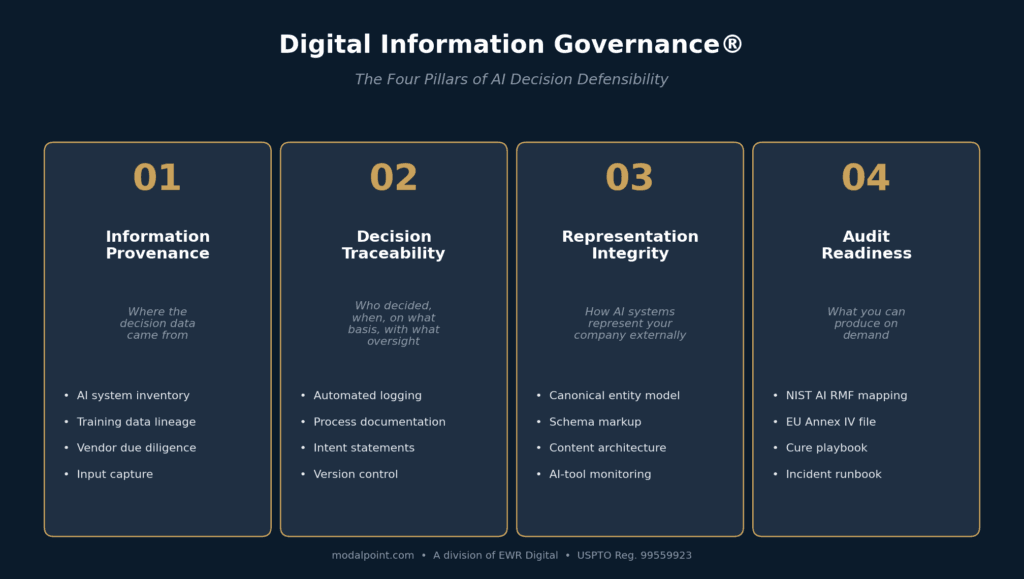
The engagement ran over three months. Below, EWR Digital’s work is mapped to the four pillars of the DIG framework. Most of it sat in the representation integrity pillar.
A note on what kind of governance this is. Most of the AI-governance market is currently sold as either (a) model security, tools that catch malicious prompts or filter harmful outputs (JetStream, Lakera, Protect AI), or (b) hyperscaler-native guardrails baked into the same platform running the model (Bedrock Guardrails, Gemini safety, Copilot Studio). Both have their place. Neither solves this operator’s problem.
That problem is upstream of both: which substrate is the AI allowed to draw from when it answers a question about your company? That is a decision-governance question, not an output-filtering question, and it has to be answered by a layer that is independent of the AI vendor and the hosting provider. ModalPoint operates at that layer. The unit of audit is a decision (which source got authorized, by whom, with what evidence), not an API call.
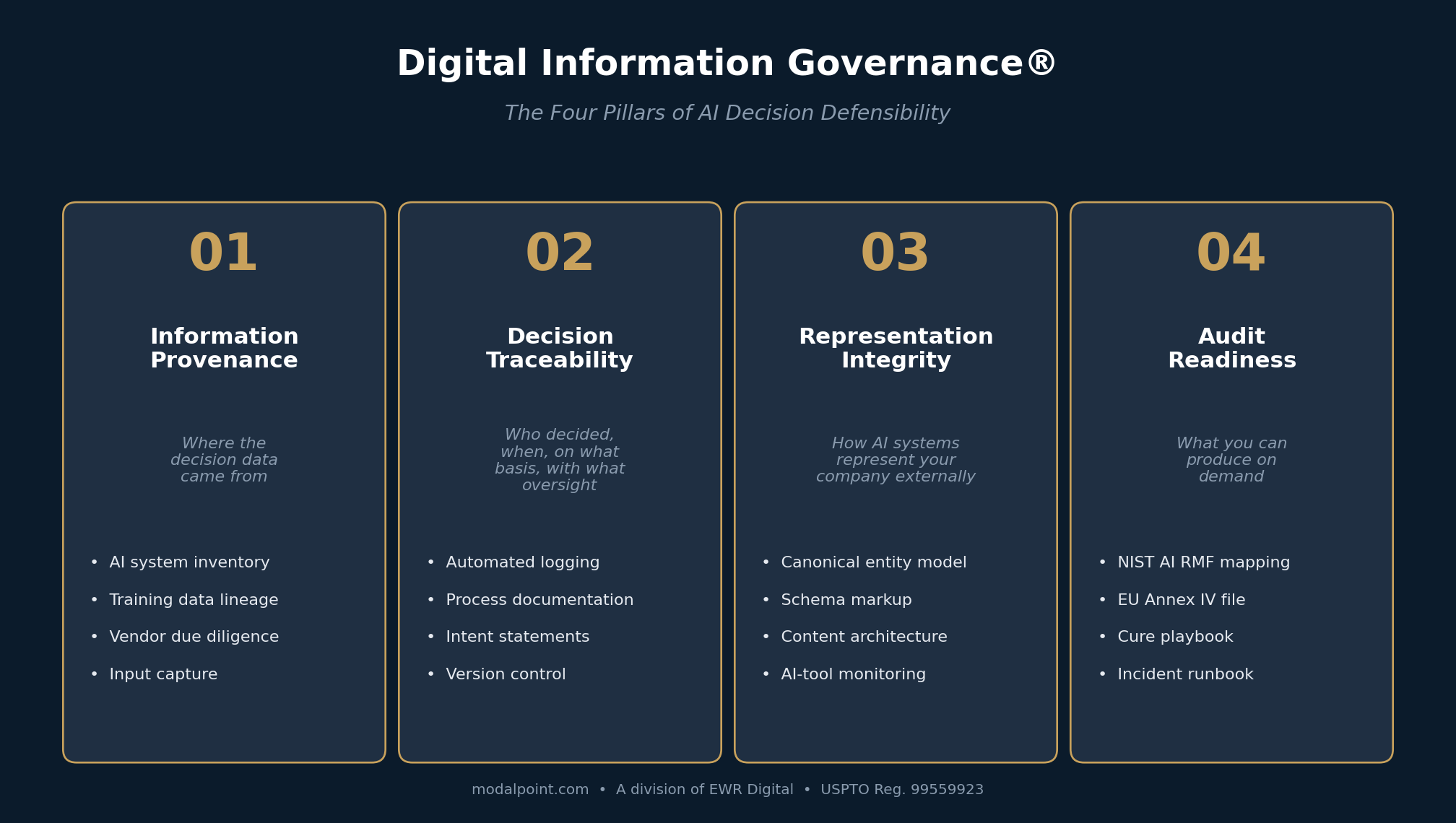
Pillar 1 · The Information Provenance Audit
EWR Digital inventoried the substrates the operator’s representation was being pulled from:
- The operator’s own web properties and the schema.org markup attached to them
- Wikipedia and Wikidata entries for the company and its leadership
- Press release distribution services and archived copies
- Financial data providers
- Third-party operator profiles, trade publication mentions, and industry databases
- Historical news coverage that still ranked
For each substrate, the team documented what it said, when it was last updated, whether it was contributing to inconsistency in AI outputs, and what the correction path was. In DIG terms, this is the provenance inventory, taken of the representation substrate rather than of AI systems.
Pillar 2 · The Decision Traceability Layer
For the changes EWR Digital recommended, the team documented the reasoning: what the substrate said, why an update was factually supported, and what the new authoritative source should be. This is the audit trail that matters if a regulator, a journalist, or a legal counterparty ever asks how the change was made, and why.
Pillar 3 · The Representation Integrity Operations
This is where the work actually happened. Across three months, EWR Digital:
- Updated the schema.org Person and Organization markup across the operator’s own properties so the current authoritative answers were the canonical, machine-readable record
- Republished and re-syndicated authoritative leadership and operational content through investor relations platforms, financial data providers, and structured press release services
- Aligned acreage and operational figures across the authoritative substrates: the operator’s own disclosures, the structured content on its operations pages, and the language on partner and joint-venture pages that was feeding downstream aggregators
- Published and indexed structured, fact-checked authoritative documents about the operator’s actual corporate status
- Monitored the AI surface during the engagement window, checking AI Overview outputs, ChatGPT summaries, Perplexity answers, and branded-search knowledge panels for the query patterns the program targeted
Pillar 4 · The Audit Readiness Deliverable
The engagement closed with:
- A documented baseline of the representation state at engagement start
- A documented remediation log of the substrate updates made, with dates
- A documented post-remediation state for the same queries
- A monitoring playbook for the internal team to run quarterly
This is the artifact that matters if anyone ever asks: how do you know the AI is representing your company accurately?
/06 · Results in Detail
Baseline captured February 4-7, 2026. Active reporting period April 16-21, 2026.
/ Measured outcome: three-month program
From misrepresented by 6 LLMs to cited as a primary authority by 3.
Baseline Feb 4-7, 2026 · Reporting Apr 16-21, 2026 · Subject: a dual-listed Australian gas operator (name withheld) · Mapped to: DIG Pillar 3 (Representation Integrity)
/ Metric 01
Overall AI brand visibility
+100% · doubled, baseline to reporting
/ Metric 02
Organic search impressions: 28-day trailing total, as of Apr 21, 2026
+61% · 14.8K more impressions per 28 days
Search Ranking: Google Positions, February vs April 2026
| Search term | Feb rank | Apr rank |
|---|---|---|
| [Company name] | #1.4 | #1 |
| [Company name] + [basin name] | Not Ranked | #1 |
| Where is the [basin name] | Not Ranked | #1 |
| [Basin name] companies | #3 | #1 |
| [Company name] CEO | Not Ranked | #1 |
| NYSE + [ticker] | #12 | #8 |
| [Company name] stock | #15 | #9 |
| [Basin name] alone | #16 | #10 |
| Natural Gas Companies ASX | #15 | #10 |
Search terms are generalized so the client is not named. Positions are as measured.
Top position: in April, 5 of 9 tracked searches ranked #1. Four of them had been #3 or unranked in February; the fifth, the company name, was already close to #1. Top 10: all 9 ranked in Google’s Top 10, up from 2 of 9.
AI Surface Visibility: The New Search Landscape
| Metric | February (Baseline) | April 2026 | Change |
|---|---|---|---|
| Frontier gas basin: AI topic visibility | ~0% | ~50% | +50pp |
| Overall AI brand visibility | ~5% | ~10% | +100% growth |
A measurable step-change occurred in early April 2026: ChatGPT, Gemini, and Perplexity began citing the operator as a primary authority.
Organic Search Impressions
In the 28 days to April 21, 2026, total search impressions grew +61% (24.3K → 39.1K), total clicks grew +45% (to 2,070), and average position improved from 7.9 → 6.6, a sign that Google was testing the company for a wider set of queries.
/07 · Outcome
This was a three-month joint engagement: the operator contracted EWR Digital, ModalPoint’s parent company. EWR Digital ran the search and AI visibility program, and the results are documented under ModalPoint’s Digital Information Governance® framework. The engagement is complete.
/08 · The Pattern: Why This Matters Beyond One Operator
For the last twenty years, the question “how is my company represented in search?” was answered by Google’s traditional ten blue links, a knowledge panel, and Wikipedia. You could manage it. If something was wrong, you’d update your website, fix your schema, push a press release, and the record corrected itself. That era is over. Google’s AI Overviews, ChatGPT, Perplexity, Gemini, and the enterprise LLMs your customers actually use now generate summaries on the fly, pulled from whatever sources the model ingested, weighted however the model decided, and presented as authoritative. You cannot manually correct an AI Overview. You can only influence the substrate it draws from.
Every publicly listed operator, and most mid-market private ones, has a representation integrity question they have not yet measured. The reason you have not noticed it is that:
- You are the last person to query your own company in an AI system. Your prospects, investors, regulators, and counterparties are querying it constantly. They are not telling you what they are finding.
- Your SEO agency is not watching this surface. Traditional SEO optimizes for ten blue links. AI Overview optimization, knowledge panel correction, and LLM substrate management are a different discipline.
- Your communications team assumes the corrections propagate automatically. They do not. AI systems retain cached representations for months, and retraining cycles reinforce old substrate unless you actively correct it.
This case shows the alignment is achievable, with a documented, auditable process behind it. DIG is a framework for running that process.
/ Find Out What AI Is Saying About Your Company
Start with the $1,500 AI Reputation Snapshot.
A fixed-fee read of how AI engines name and describe your company and up to three competitors, the sources behind those answers, and the first three fixes in priority order. See what it covers
The engagement was recognized as a 2026 AMA Houston Crystal Awards Finalist in the Artificial Intelligence category, submitted via EWR Digital.
ModalPoint is a Houston, Texas-based AI decision governance advisory owned by EWR Digital. Digital Information Governance® is a trademark of Matthew Bertram (USPTO Reg. No. 8147558). Not legal advice. ModalPoint is not a law firm and does not practice law.
Talk to ModalPoint
A 30-minute call to see if ModalPoint is the right firm and whether the timing makes sense. No obligation either way.