AI Vendor Shortlist Oil & Gas Framework: DIG & AI Risk
By Matthew Bertram | EWR Digital
Your website is no longer just a digital brochure. It is raw training material for machine learning systems that describe your organization without your permission. In the oil and gas sector, procurement has historically been a relationship-driven process. But a silent, systemic shift has occurred. Before a procurement manager ever schedules an exploratory call or registers on a vendor portal, they consult large language models (LLMs) like ChatGPT, Perplexity, and Gemini to filter their vendor options. If your enterprise is not accurately indexed, or if your AI-facing information layer is contradictory, your company is disqualified before the sales team is ever contacted.
This is the reality of AI Representation Risk. When energy companies use generative AI to construct an automated preliminary shortlist, they are not clicking through standard blue links. They digest synthesized, model-generated answers. If an LLM misrepresents your technical specifications, repeats outdated safety metrics, or displays entity confusion, you suffer competitive displacement in the dark funnel. Managing this risk requires more than traditional SEO. It demands a rigorous methodology for an AI vendor shortlist oil & gas framework, establishing a defensible information architecture that guarantees machines interpret your organization accurately.
How Large Language Models Influence the Modern Oil & Gas Shortlist
Within upstream exploration, midstream logistics, and downstream refining, operators depend on absolute technical precision. When evaluating potential technology or service providers, procurement teams use specialized AI assistants to crawl and analyze massive volumes of unstructured web data, industry reviews, corporate filings, and structured schemas. When an executive inputs a specific query to compile an AI search oil & gas vendors report, the model functions as an automated industry analyst, instantly comparing operational records, technological patents, and past project performance.
This paradigm radically changes B2B buyer behavior. The traditional marketing funnel has collapsed because buyers rely on AI engines to conduct initial filtering. According to a B2B buyer survey published by Gartner, buyers are rapidly adapting to this automated research environment:
“B2B buyers are more comfortable using digital channels and GenAI to navigate the purchase process on their own, but that does not eliminate the role of the seller. Buyers still turn to sales reps to validate AI-generated insights, and support decision-making at critical moments in the journey.”
For an oilfield services firm, this validation phase only occurs if your organization makes the initial automated cut. If an AI engine excludes your brand from its synthesized response, your business development team never has the opportunity to speak with the buyer. The automated shortlist has become the ultimate gatekeeper of modern energy procurement.
The Hidden Threats of AI Representation Risk in Capital-Intensive Sectors
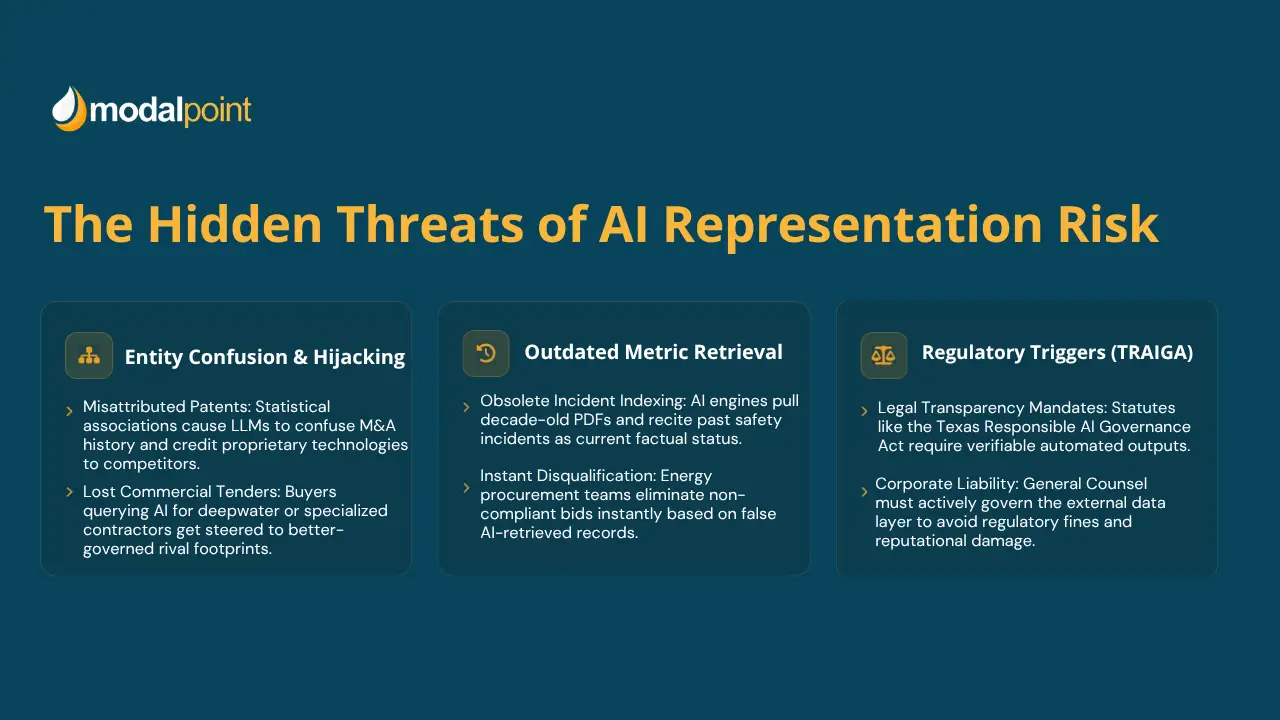
AI Representation Risk refers to the commercial and legal exposure that an organization faces when large language models summarize and describe its operations inaccurately. In the energy sector, where safety, environmental compliance, and technological reliability are paramount, these risks present severe liabilities. Without proactive governance of your digital footprint, your firm is exposed to several critical vulnerabilities:
- Entity Confusion and Competitor Hijacking: Because language models are trained on statistical associations, they are prone to entity confusion. If your organization has undergone recent mergers or acquisitions, public models often merge your capabilities with those of your competitors. When a buyer asks an AI engine for qualified deepwater drilling contractors, the model may attribute your specialized patents to a rival firm that has governed its digital footprint more effectively.
- Inaccurate Retrieval of Outdated Safety and Operational Metrics: Energy procurement is highly sensitive to compliance records. If an LLM indexes an outdated, unmonitored PDF from a decade ago and retrieves an obsolete safety incident, it will repeat that statistic as a current fact. This misrepresentation instantly disqualifies your firm from high-value tenders. This is a critical concern for your General Counsel and compliance officers, who must manage corporate liability and prevent unsupported claims from circulating.
- Regulatory Non-Compliance and Emerging Legal Triggers: Governance of digital information is rapidly becoming a legal mandate. With the implementation of frameworks like the Texas Responsible AI Governance Act (TRAIGA), organizations must ensure that their digital systems and automated outputs are transparent and verifiable. If your firm does not actively govern the external information layer that these systems consume, you risk severe regulatory penalties and reputational damage.
The DIG Methodology: Establishing Control Over the Machine-Facing Layer
To mitigate these liabilities, Matthew Bertram, a leading authority on AI discoverability, developed the Digital Information Governance® (DIG) methodology. DIG is an executive-level strategic framework that sits directly between your corporate footprint and the LLMs consuming it. This is not simple content cleanup or standard SEO. It is a comprehensive system designed to ensure your digital presence is accurate, trusted, and defensible in an AI-dominated market.
The DIG framework systematically optimizes your organization’s digital footprint using the EWR 25% Rule. This rule ensures your content is precisely balanced across four distinct tactical categories: Transactional, Commercial, Informational, and Navigational. By maintaining this strict ratio, you ensure that AI scrapers can easily retrieve, categorize, and verify your core business entities, regardless of whether they are conducting a broad industry search or a highly specific, transactional vendor evaluation.
To successfully transition from risk diagnosis to market growth, organizations must bridge the gap between strategy and execution. ModalPoint operates as the elite advisory layer, conducting deep risk audits and defining the governance roadmap. Once the vulnerabilities in your AI-facing layer are identified, EWR Digital serves as the technical execution partner, implementing advanced schema markups, cleaning up unstructured historical data, and driving high-authority digital PR to reinforce your brand’s validity across the entire digital ecosystem.
Critical B2B Procurement and AI Shortlist Statistic
Research on automated procurement indicates that 95% of won enterprise deals are awarded to vendors who were part of the buyer’s Day One shortlist, a list that is now heavily constructed and filtered using generative AI tools and conversational search engines rather than traditional sales interactions.
Reference and Source: The Geisheker Group B2B AI Purchase Analysis
Taking the Next Step: Protecting Your Valuation and Market Visibility
How does your company ensure it is consistently recommended during a high-stakes LLM procurement energy process? You must proactively govern your digital information layer. This requires strategic alignment across your entire C-suite, including the Chief Marketing Officer to prevent competitive displacement, the General Counsel to mitigate liability from ungrounded claims, and the CEO to defend institutional valuation as a core macroeconomic priority. Do not allow machine learning algorithms to rewrite your market position without your consent. By taking charge of your governable digital footprint with ModalPoint, you turn AI search engine visibility from an unmanaged risk into a highly profitable competitive advantage.