Measuring AI Visibility: KPIs That Replace SEO Dashboards
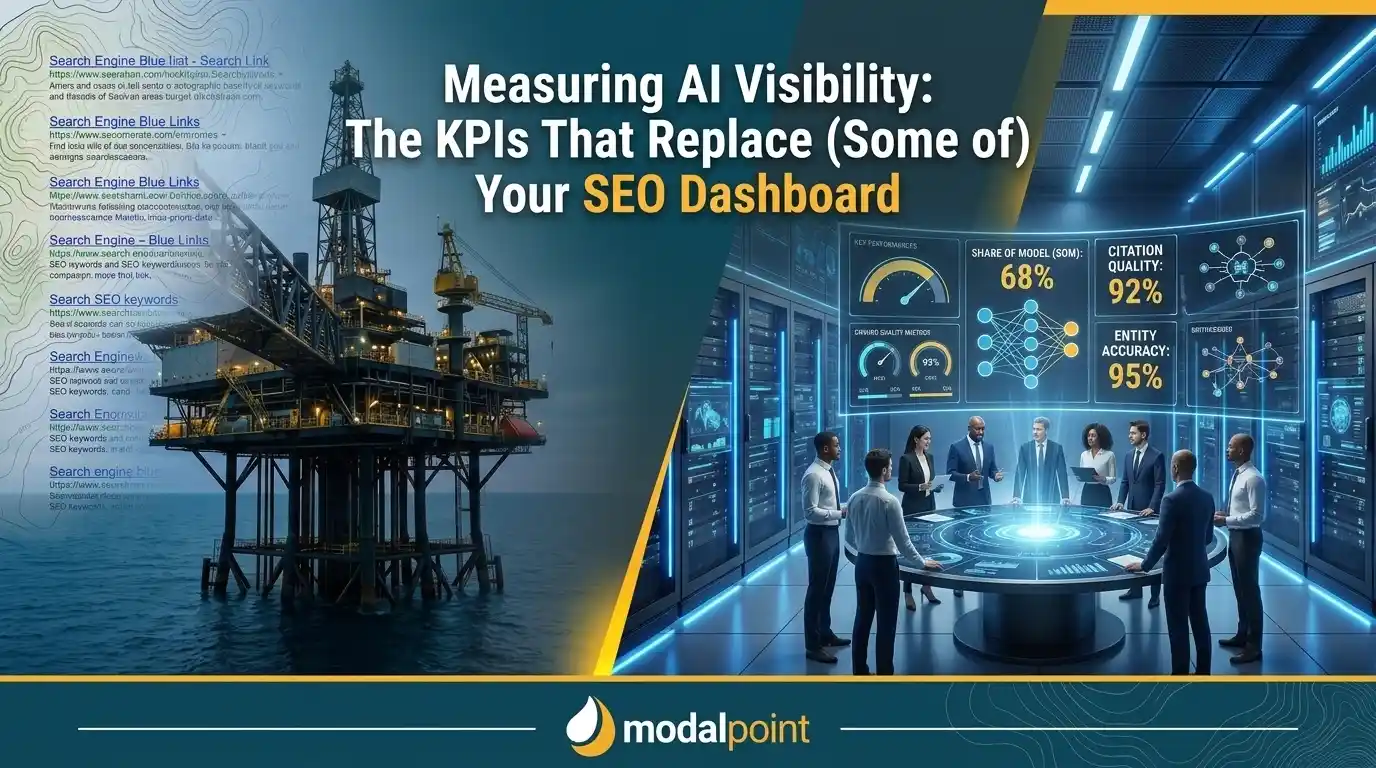
By Matthew Bertram | EWR Digital
For two decades, executive growth dashboards have relied on a predictable set of organic metrics: domain authority, keyword rankings, site traffic, and form fills. However, as enterprise buyers increasingly rely on Large Language Models (LLMs) such as ChatGPT, Perplexity, Gemini, and Google AI Overviews to evaluate vendors, traditional SEO analytics are failing to capture where market decisions actually occur.
When an enterprise buyer asks an AI engine to evaluate service providers, compare technical capabilities, or assess compliance standards, the engine does not present a list of ten blue links. It synthesizes millions of data points into a single, direct recommendation. If your organization is omitted, miscategorized, or cited with outdated metrics, you suffer invisible loss of consideration long before a user ever hits your website homepage.
To capture market share in an AI-first ecosystem, executive leadership must transition from traditional web tracking to evaluating the AI-facing information layer through Digital Information Governance (DIG). This transition requires a modernized set of metrics specifically engineered to measure LLM visibility, manage AI interpretation risk, and protect your brand’s digital presence.
Beyond Keyword Rankings: The Core Metrics to Measure LLM Visibility
Traditional SEO measures whether your web pages index for targeted search queries. Measuring AI visibility, however, evaluates how generative engines synthesize your enterprise footprint across public databases, unstructured content, third-party media, and technical documentation.
Replacing or supplementing your legacy marketing reporting requires implementing concrete AI visibility KPIs that reflect how large language models discover and process your brand identity.
1. Share of Model (SoM) & Share of Voice in Generative Engines
Unlike Share of Voice (SoV) in classic organic search, which tracks blue link impressions, Share of Model measures how frequently your organization is synthesized and recommended by LLMs when a prospective buyer inputs category-level commercial prompts. If an executive asks Perplexity for the top supply chain advisors, Share of Model tracks whether your firm appears in the primary summary compared to key competitors. The AI Reputation Snapshot measures it for your company and up to three competitors.
2. Entity Retrieval & Categorization Accuracy
Generative AI engines organize information around recognized real-world entities. Entity retrieval accuracy evaluates whether LLMs correctly identify your core business, operational scope, primary executive leadership, and proprietary technologies. If an LLM misidentifies your enterprise software as an off-the-shelf point solution, your commercial positioning is compromised at the source.
3. Citation Quality & Source Attribution Depth
AI search models do not merely generate text; Answer Engines cite reference sources. Tracking citation quality involves auditing where LLMs source their facts about your brand. High-value source attribution stems from structured data, verified press releases, governed technical papers, and authoritative third-party references. Low-value citations stem from outdated blog posts, scrapers, or unverified employee forums.
4. Machine Sentiment & Fact-Checking Coherence
Machine sentiment tracks the qualitative tone and risk profile embedded in synthesized AI summaries. Fact-checking coherence measures the factual accuracy of the output text. If ChatGPT repeatedly cites a five-year-old revenue metric, misstates regulatory compliance status, or attributes retired product capabilities to your business, your company faces immediate commercial and legal exposure.
AI Search Metrics in Capital-Intensive Sectors like Oil & Gas
The impact of unmonitored AI synthesis is acutely felt in complex B2B sectors. In capital-intensive industries, executive decision-makers use AI search engines to evaluate high-stakes vendor relationships, technical capabilities, and safety records.
Monitoring the AI search metrics that oil & gas and industrial enterprise leaders rely on requires evaluating how machines interpret complex operational parameters, regulatory requirements, and technical capabilities.
Search engine volume will drop 25% by 2026, with search market share lost to AI chatbots and other virtual agents as natural language search begins replacing traditional search queries.
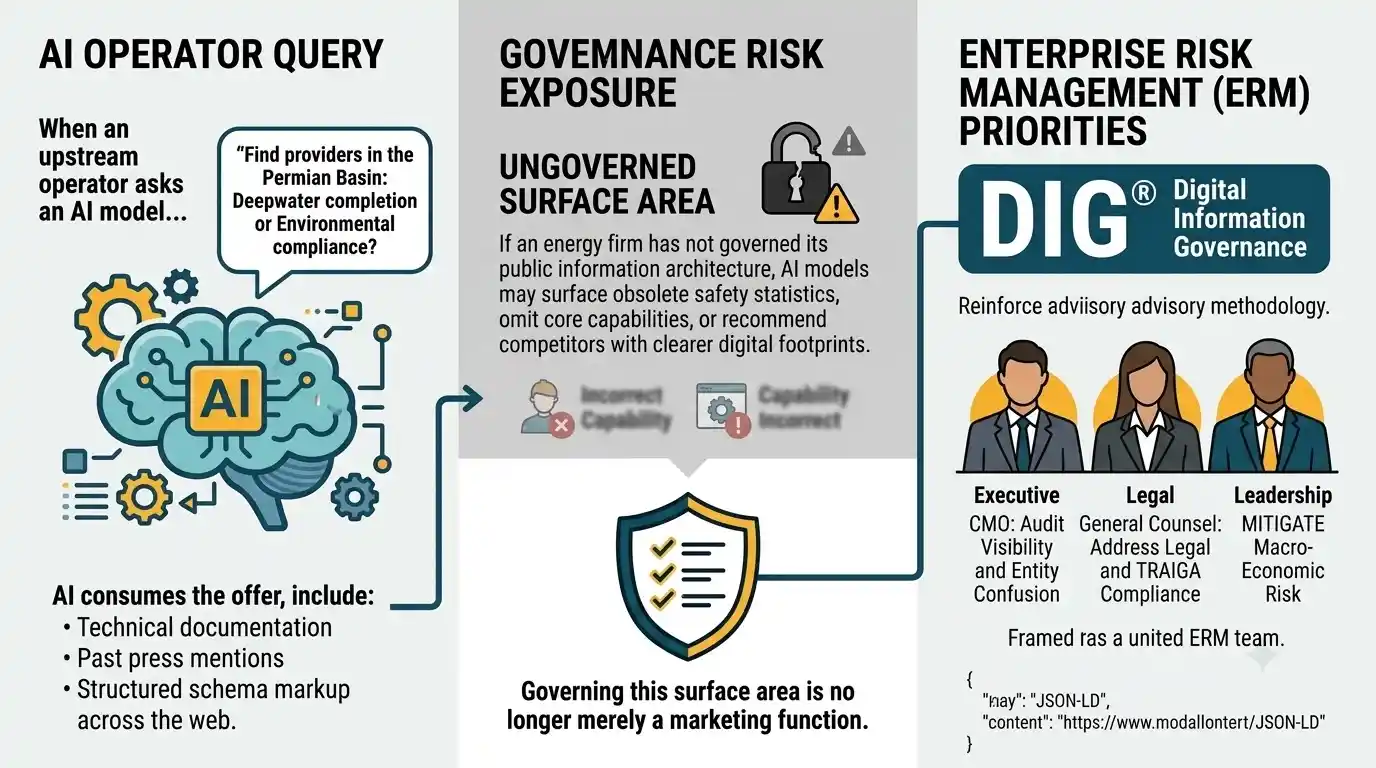
When an upstream operator asks an AI model to identify service providers specializing in deepwater completion or environmental compliance in the Permian Basin, the model references technical documentation, past press mentions, and structured schema markup across the web. If an energy firm has not governed its public information architecture, AI models may surface obsolete safety statistics, omit core capabilities, or recommend competitors with clearer digital footprints.
Governing this surface area is no longer merely a marketing function; it is an enterprise risk management priority spanning the CMO, General Counsel, and CEO.
The AI Representation Risk Audit: Strategic Framework
To operationalize these new metrics, organizations must establish a systematic evaluation process. Below is a structured framework contrasting traditional SEO reporting with modern Digital Information Governance® (DIG) audits:
| Measurement Axis | Legacy SEO Dashboard | ModalPoint DIG Audit Framework |
|---|---|---|
| Primary Focus | Page-level web rankings & clicks | Organization-level AI representation & synthesis |
| Target Audience | Human search engine users | LLMs, Answer Engines, & AI Agents |
| Primary Metrics | Keyword position, CTR, Organic Traffic | Share of Model (SoM), Citation Quality, Entity Accuracy |
| Data Source | Google Search Console / Analytics | ChatGPT, Perplexity, Gemini, Google AI Overviews |
| Executive Ownership | Marketing / SEO Specialist | CMO, General Counsel, CIO, CEO |
| Core Risk Identified | Loss of organic web traffic | Commercial, legal, & regulatory liabilities |
By mapping these operational variables, leadership can identify information gaps, trace inaccurate AI summaries back to their root sources, and implement technical remediation before brand misrepresentation leads to lost market opportunity.
Frequently Asked Questions About AI Visibility Metrics
What is the difference between SEO keywords and AI visibility KPIs?
Traditional SEO keywords track rank positions for specific user search strings on Search Engine Results Pages (SERPs). AI visibility KPIs measure how large language models extract, synthesize, categorize, and cite an organization’s overall digital footprint when answering complex, conversational prompts in Answer Engines.
How do answer engines like Perplexity and Google AI Overviews decide which sources to cite?
Answer engines prioritize sources based on entity authority, information clarity, structured data (JSON-LD schema), external backlink validation, and source factual coherence. Organizations that implement structured information governance are significantly more likely to be cited as authoritative references.
Industry Benchmark Metric: According to data published by McKinsey & Company, 72% of organizations have adopted AI in at least one business function, accelerating the demand for structured enterprise data and verifiable online entity representation.
To protect your organization’s digital positioning and ensure your AI-facing information layer remains accurate, defensible, and trusted, request a specialized audit from ModalPoint today.