AI Workforce Training Oil & Gas: Build Policy First
By Matthew Bertram | EWR Digital
Field engineers are already asking ChatGPT to summarize regulatory filings. Landmen are using AI tools to draft lease language. Procurement teams are pasting vendor contracts into public chatbots to get a quick summary before a meeting. None of this is happening because a company rolled out an official program. It is happening because the tools are free, fast, and already on everyone’s phone. Most energy companies do not have a real AI policy for their energy company yet, and that gap is where the real risk lives.
This post looks at why AI workforce training in oil and gas needs to start with governance and policy, not just tool adoption, and what a practical first step actually looks like.
Why AI Workforce Training in Oil & Gas Is Already Behind
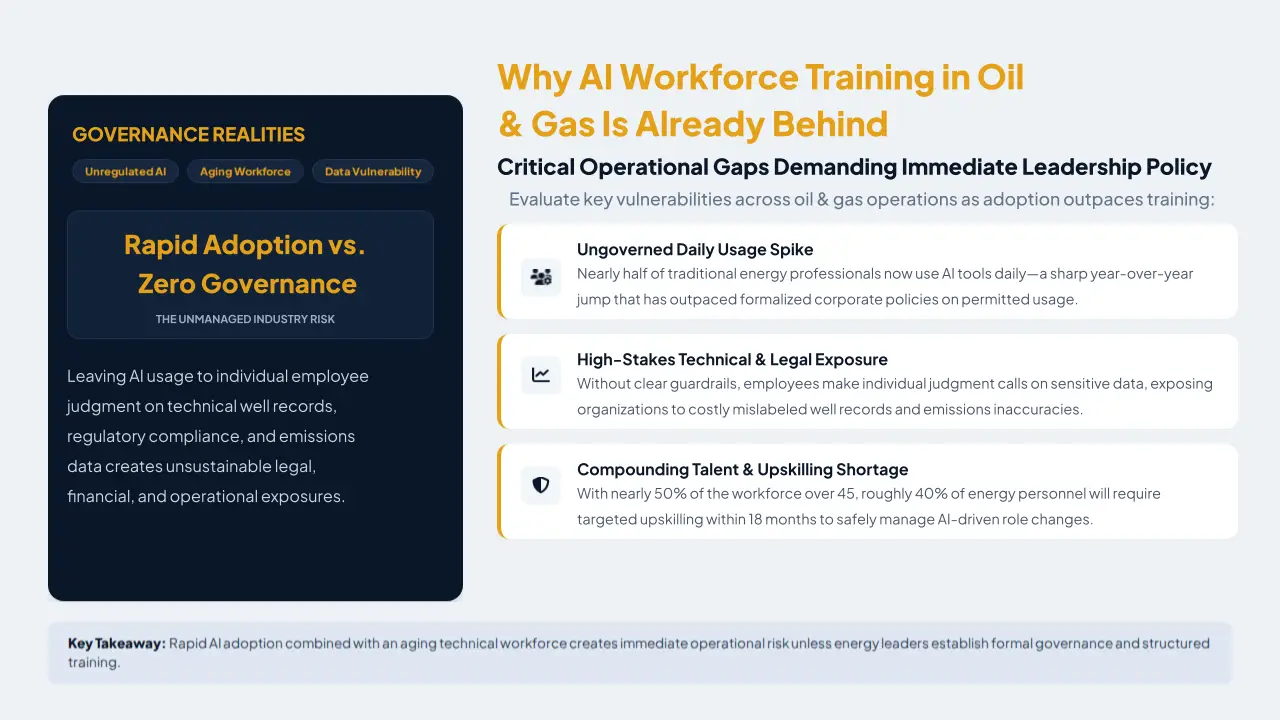
Adoption has moved faster than most companies expected. Nearly half of traditional energy professionals now report using AI tools in their day to day work, a sharp jump from just a year earlier. That number alone should be a wake up call for any leadership team that has not yet formalized how AI can and cannot be used across the organization.
The Gap Between AI Use and AI Governance
Usage climbing this fast without a policy in place means employees are making individual judgment calls about what is safe to paste into a chatbot, what data can leave the building, and which outputs can be trusted for a technical or regulatory decision. In an industry where a mislabeled well record or an inaccurate emissions estimate carries real financial and legal consequences, leaving those judgment calls to individual employees is not a sustainable position.
Why the Skills Gap Makes This Worse, Not Better
Oil and gas already faces a well documented workforce shortage, with nearly half the workforce over 45 and a shrinking pipeline of younger technical talent. Layer rapid AI adoption on top of that gap and you get a workforce that is reaching for new tools faster than most companies can train, supervise, or govern their use. Roughly 40 percent of energy company staff are expected to need upskilling within the next year and a half just to keep pace with AI powered changes to their roles.
Energy sector research has found that while nearly all energy companies plan to hire AI specific roles, more than half of those same companies believe their existing workforce lacks the skills to deploy generative AI effectively, according to EPAM’s analysis of energy workforce transformation.
What Oil & Gas AI Governance Training Actually Needs to Cover
Training is not the same thing as governance, and this is where a lot of well intentioned programs miss the mark. A single lunch and learn on prompt writing does not address who is accountable when an AI generated summary is wrong, or what happens when a contractor uploads proprietary well data into a public tool.
Data Classification Before Tool Access
Before any employee gets access to an AI tool, the company needs a clear answer to a simple question. What categories of data, whether that is well data, reserve estimates, safety incident reports, or vendor contracts, are allowed anywhere near a public or third party AI system, and what has to stay inside approved, governed platforms. Without this classification done first, training on how to use the tools well is training people to use them well on the wrong data.
Role Based Policy, Not a Single Company Wide Rule
A landman, a process safety engineer, and a marketing coordinator do not carry the same risk profile when they use AI tools, and a single blanket policy usually ends up either too restrictive for the low risk roles or too loose for the high risk ones. Effective oil and gas AI governance training separates guidance by function, so technical and regulatory roles get stricter guardrails around data handling and output verification, while lower risk roles get lighter, more practical guidance.
Verification Requirements for High Stakes Outputs
Any AI generated content that touches safety, regulatory reporting, reserve estimates, or public facing claims about the company needs a defined human verification step before it goes anywhere. This is not about slowing teams down for the sake of caution. It is about making sure the speed AI provides does not quietly introduce errors into documents that carry legal or financial weight.
Building an AI Policy Energy Company Leadership Can Actually Defend
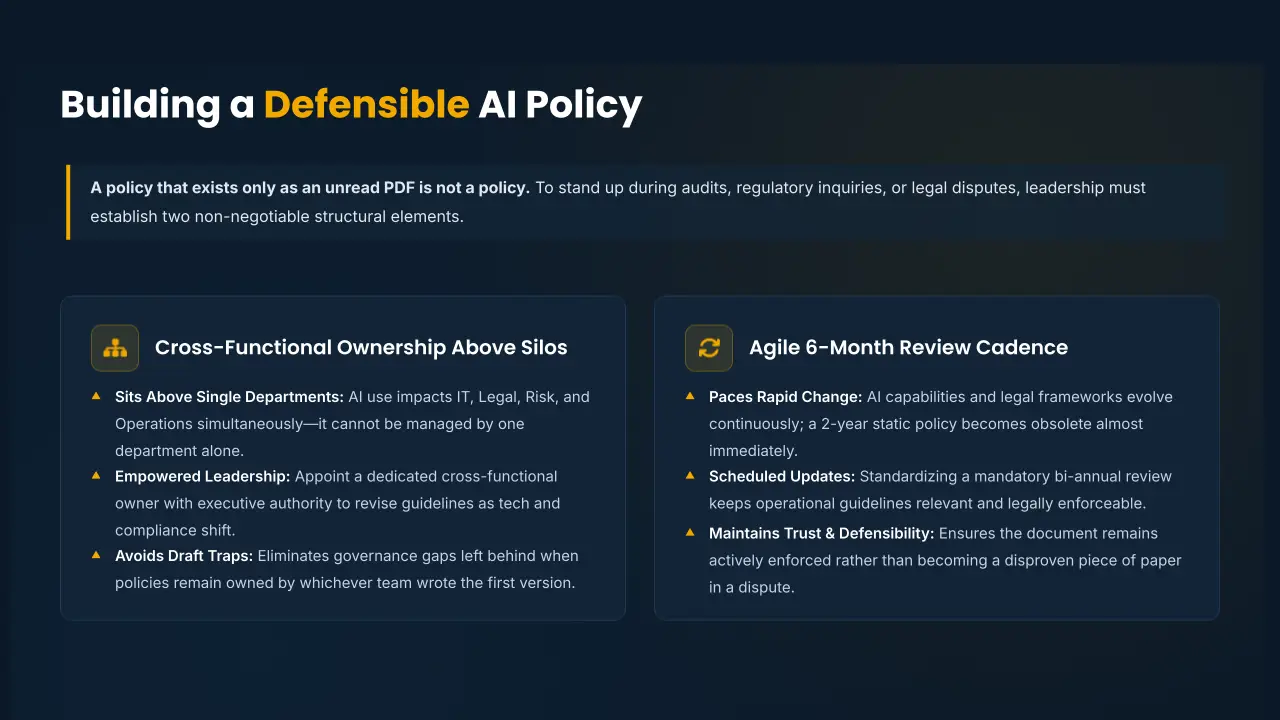
A policy that exists only as a PDF nobody reads is not a policy. For it to hold up when it actually matters, whether in an audit, a regulatory inquiry, or a legal dispute, it needs a few specific elements in place.
Ownership That Sits Above a Single Department
AI policy cannot live solely with IT, solely with legal, or solely with a single business unit, because AI use touches all of them at once. Leadership teams that put a cross functional owner in charge of the policy, someone with the authority to update it as tools and regulations change, are in a far stronger position than those who leave it to whichever department happened to write the first draft.
A Review Cycle That Keeps Pace With the Technology
AI tools and the regulatory landscape around them are both moving quickly, and a policy written once and left untouched for two years will be outdated well before then. Building in a scheduled review, ideally every six months, keeps the policy relevant instead of becoming a document nobody trusts.
Why This Matters More Now Than It Did a Year Ago
AI adoption inside energy companies grew faster in the past year than almost anyone forecasted, and that growth is not slowing down. Waiting for a visible incident, whether that is a data leak, an inaccurate report submitted to a regulator, or a public facing error traced back to an ungoverned AI tool, before building a policy is a reactive posture that costs far more than a proactive one. Companies that put structure in place now are the ones that will be able to scale AI use safely instead of scrambling to contain a problem after it has already happened.
Final Thoughts on AI Workforce Training and Policy
The tools are already inside your organization whether there is a policy or not. The only real choice leadership has is whether that use is governed and defensible, or informal and exposed. Building AI workforce training around a real governance framework, rather than treating it as a one time onboarding topic, is what separates energy companies that can scale AI safely from those that are simply hoping nothing goes wrong. Learn more about how ModalPoint helps energy companies build the governance structure AI adoption actually requires.