Approved Vendor List (AVL) Strategy for Oil & Gas
By ModalPoint | An EWR Digital Company
For service providers, technical equipment manufacturers, and digital technology firms, breaking into major energy operations requires passing through an invisible gate. That gate is the corporate approved vendor list oil & gas operators maintain to mitigate technical, financial, and operational exposure. Without placement on an approved vendor list, even world-class engineering solutions or cutting-edge software platforms remain entirely non-actionable to enterprise procurement teams.
Securing an approved vendor list oil & gas spot is not merely a matter of traditional enterprise sales or business development outreach. Modern energy procurement operates as a strict risk mitigation mechanism. Today, as procurement departments integrate automated discovery and AI-assisted qualification engines into vendor management systems, the hurdles to gaining vendor approval have fundamentally shifted. Understanding the structural architecture of vendor qualification and ensuring your organization maintains a governable digital footprint are the essential dual requirements for commercial growth in the modern energy landscape.
Understanding the Architecture of an Approved Vendor List Oil & Gas Strategy
An approved vendor list represents a centralized, pre-vetted index of commercial contractors, equipment suppliers, and specialized service firms authorized to do business with an energy operator, engineering firm, or master contractor. Operating within major basins like the Permian, Eagle Ford, or offshore deepwater environments requires compliance with complex health, safety, environmental, and financial criteria long before a purchase order is ever issued.
When enterprise procurement managers evaluate potential partners for Digital Information Governance services and operational contracting, they categorize risk into four primary quadrants:
- Technical Competency and Verification: Proof that your equipment, engineering methodology, or software infrastructure meets precise API, ISO, or proprietary operational specifications.
- Health, Safety, and Environmental (HSE) Compliance: Verified track records through platforms such as ISNetworld, Avetta, or PEC Safety, ensuring compliance with strict safety parameters.
- Financial and Operational Stability: Comprehensive audits verifying liability coverage, financial liquidity, balance sheet health, and corporate structure reliability.
- Digital Entity and Information Architecture: Defensible, structured corporate data that allows internal procurement systems and automated search models to accurately verify claims, credentials, and regulatory filings.
If your company fails to meet standards in any single quadrant, the qualification process halts completely. Major operators simply cannot take on unvetted commercial liabilities.
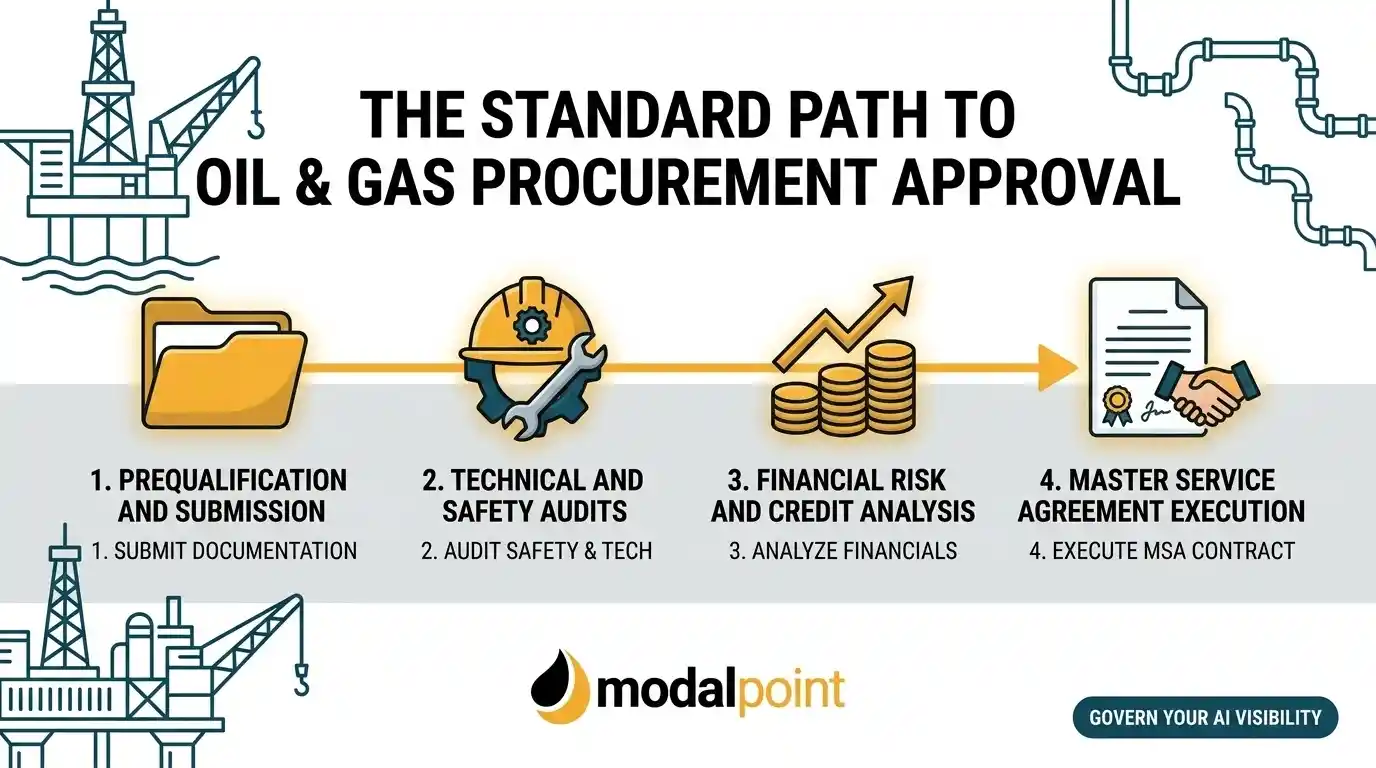
The Standard Path to Oil & Gas Procurement Approval
The operational roadmap toward securing oil & gas procurement approval follows a structured, multi-stage governance process. While requirements vary between independent exploration firms and global supermajors, the structural framework remains consistent across the industry.
Step 1: Prequalification and Information Submission
The entry point requires submitting comprehensive documentation through operator-specific procurement portals or third-party compliance networks. Vendors submit tax documentation, insurance certificates, safety metrics, quality management manuals, and executive ownership details.
Step 2: Technical and Safety Audits
Following initial administrative review, operator technical specialists evaluate your operational history. For physical service providers or hardware manufacturers, this often includes on-site facility audits, equipment inspections, and rigorous engineering reviews. For software or advisory providers, technical evaluation focuses heavily on data security, regulatory risk mitigation, and corporate governance compliance.
According to research from CAPS Research and the Institute for Supply Management, supplier evaluations require comprehensive cross-functional alignment:
“The supplier assessment and onboarding process requires evaluating such factors as quality, cost, technological capabilities and financial status, as well as weighing layers of risk, including operational, reputational, data security and compliance.”
Step 3: Financial Risk and Credit Analysis
Procurement teams conduct deep-dive financial health evaluations to ensure a vendor will not face bankruptcy or operational failure during a multi-year project lifecycle. Credit ratings, bank references, and cash flow statements undergo thorough scrutiny.
Step 4: Formal Master Service Agreement Execution
Once all technical, HSE, and financial benchmarks are cleared, the operator executes a Master Service Agreement (MSA). With an active MSA in place, your organization gains official vendor status and becomes eligible to bid on active tenders, field work, and enterprise software contracts.
Why Traditional AVL Oilfield Services Onboarding Is Failing
Historically, securing an AVL oilfield services position depended almost exclusively on direct field relationships, trade show networking, and executive introductions. While human relationship-building remains vital, the modern buyer journey has evolved dramatically. Today, procurement officers and supply chain executives consult automated risk databases, internal intelligence tools, and generative search engines long before contacting a sales representative.
This reality creates severe commercial risk for companies with an unmanaged digital footprint. If an AI engine or procurement research tool synthesizes outdated, inaccurate, or unsupported claims about your company’s service lines, equipment capabilities, or regulatory history, your firm can be quietly disqualified before an evaluation even begins.
To navigate this shift, leading contractors utilize a structured oil and gas buyer behavior playbook to map how modern procurement teams discover, evaluate, and verify new vendors. When commercial and technical claims are inconsistent across public registries, press announcements, and structured web data, automated systems flag entity confusion or compliance risk, effectively blocking your path to vendor approval.
Governing Your Digital Footprint for AI-Driven Procurement
Modern supply chain intelligence systems continuously scrape the web to monitor vendor risk, corporate entity relationships, and legal exposures. If your external AI-facing information layer is ungoverned, inaccurate summaries generated by large language models can directly undermine your credibility during vendor audits.
Establishing digital information governance ensures that search engines, corporate crawlers, and AI discovery platforms receive precise, verified, and defensible facts about your enterprise. Ensuring entity clarity requires four specific actions:
- Structured Schema Implementation: Deploy explicit JSON-LD schema across your digital presence to clearly define your legal entity, leadership team, service categories, and operational locations.
- Claim Alignment and Fact Grounding: Audit all external technical claims, metrics, and safety stats to guarantee 100 percent alignment across trade publications, corporate sites, and regulatory filings.
- Active Entity Management: Eliminate ambiguous service descriptions or outdated corporate names that cause AI engines to confuse your firm with unrelated entities.
- Continuous AI Visibility Auditing: Periodically analyze how major answer engines interpret and summarize your capabilities to catch misrepresentations before procurement teams do.
By governing how AI engines and procurement systems interpret your company, you protect your enterprise reputation and ensure that your technical capabilities are accurately represented during vendor qualification reviews. To establish long-term market authority and secure your place on strategic operator rosters, align your digital strategy directly with ModalPoint.
Key Procurement Benchmark:
According to empirical supply chain research published by CAPS Research and the Institute for Supply Management, 57 percent of industrial and enterprise organizations have standardized their supplier assessment criteria across all functional departments to streamline onboarding and enforce rigorous risk management.