Oil & Gas Rebrand: When Service Companies Should Reposition
By Matthew Bertram | EWR Digital
A lot of oilfield service companies are still walking into tenders wearing a logo drawn up fifteen years ago, back when they ran three trucks out of a single yard. Today they run multi-basin operations, hold safety certifications a Fortune 500 operator would recognize, and compete for contracts against companies twice their size. The identity never caught up. If you have felt that gap between what your company actually is and what your brand says it is, an oil & gas rebrand is not vanity. It is closing a credibility gap that is quietly costing you contracts.
This post breaks down when a rebrand is actually warranted in oilfield services, what oilfield services repositioning should and should not touch, and how to approach it without disrupting the customer relationships you have already built.
When an Oil & Gas Rebrand Is Actually Warranted
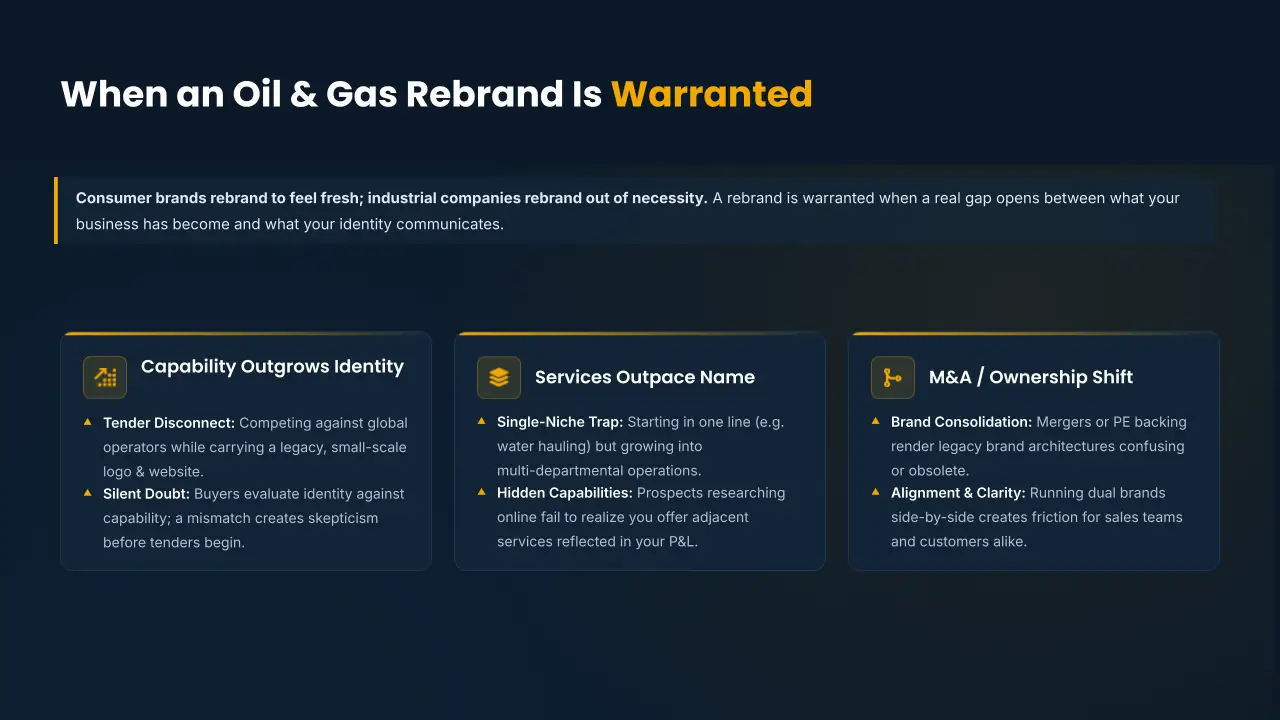
Not every company needs a rebrand, and chasing a fresh look because a competitor just launched one is a poor reason to start. The companies that genuinely need to reposition usually show one or more of a few specific signals.
Your Capability Has Outgrown Your Identity
This is the most common trigger in oilfield services. A company starts as a regional operator, wins larger contracts, expands into new basins, and eventually finds itself bidding against multinational competitors while still carrying a logo, tagline, and website built for a much smaller operation. Buyers evaluating a tender are silently comparing your identity to your capability, and a mismatch there creates doubt before a single conversation happens.
You Have Expanded Into Services Your Name No Longer Reflects
Companies that started in one niche, water hauling, sand logistics, pressure pumping, and have since added adjacent service lines often carry a name or brand that only describes the original business. If your name still signals a single service line while your P&L reflects three or four, prospects researching you online may not even realize you offer what they need.
A Merger, Acquisition, or Ownership Change Has Occurred
When two service companies combine, or private equity ownership brings a new growth strategy, the old brand architecture rarely survives the transition cleanly. Trying to run two legacy brands side by side after a merger creates confusion for both customers and your own sales team.
Industrial rebrand experts have noted that consumer brands often rebrand to feel fresh, but industrial companies typically rebrand because a real gap has opened between what they have become and what their identity communicates, according to Jamie Stewart Design’s analysis of industrial repositioning.
Building an Energy Company Brand Strategy That Reflects Reality
Once the decision to reposition is made, the work is not a logo refresh. A credible energy company brand strategy starts with research and positioning before a single design element gets touched.
Start With What Buyers Actually Believe About You Today
Before changing anything, it is worth understanding how current customers, lost prospects, and even internal sales teams currently describe your company. This baseline matters because it tells you exactly where the perception gap sits, whether that is capability, geography, safety record, or service breadth, so the new positioning solves a real problem instead of a guessed one.
Define What Should Change and What Should Stay
Not every rebrand needs a new name. In many oilfield services cases, the safest and most effective path keeps the legal name and reputation intact while updating the visual identity, messaging, and website to reflect current capability. A full name change carries more risk, particularly with existing contracts, safety certifications, and vendor relationships tied to the original entity, and should only be considered when the old name is actively working against the business.
Align Messaging to the Buyers You Actually Want Now
A company that has moved upmarket into larger, more technical contracts needs messaging that speaks to that buyer, not the smaller operators it served five years ago. This is where oilfield services repositioning earns its value. It is not about sounding bigger for the sake of it. It is about making sure the language, case studies, and proof points on your website match the tier of buyer you are actually trying to win now.
How to Execute an Oilfield Services Repositioning Without Losing Existing Business
The biggest risk in any B2B rebrand is not the new logo. It is disrupting the relationships and reputation that are already generating revenue.
Sequence the Rollout Instead of Flipping a Switch
Update internal materials and sales collateral before the public facing brand changes, so your own team can explain the shift confidently when a customer asks about it. A phased rollout, website first, then sales materials, then broader marketing, gives the organization time to adjust the story before it reaches the market at scale.
Communicate Directly With Key Accounts Before They Notice on Their Own
Your largest customers should hear about a name, logo, or positioning change directly from your team, not stumble across it on a renewed contract or an updated invoice. A short, direct communication explaining why the change is happening protects the relationship and reinforces stability rather than raising questions.
Give the Rebrand Time Before Judging Results
A rebrand in a long sales cycle industry like oil and gas does not produce an overnight spike in leads or revenue. Most credible timelines for measurable pipeline impact run several quarters, since decision makers need time to encounter and internalize the new positioning before it changes their evaluation of your company.
Why This Matters More in a Consolidating Energy Services Market
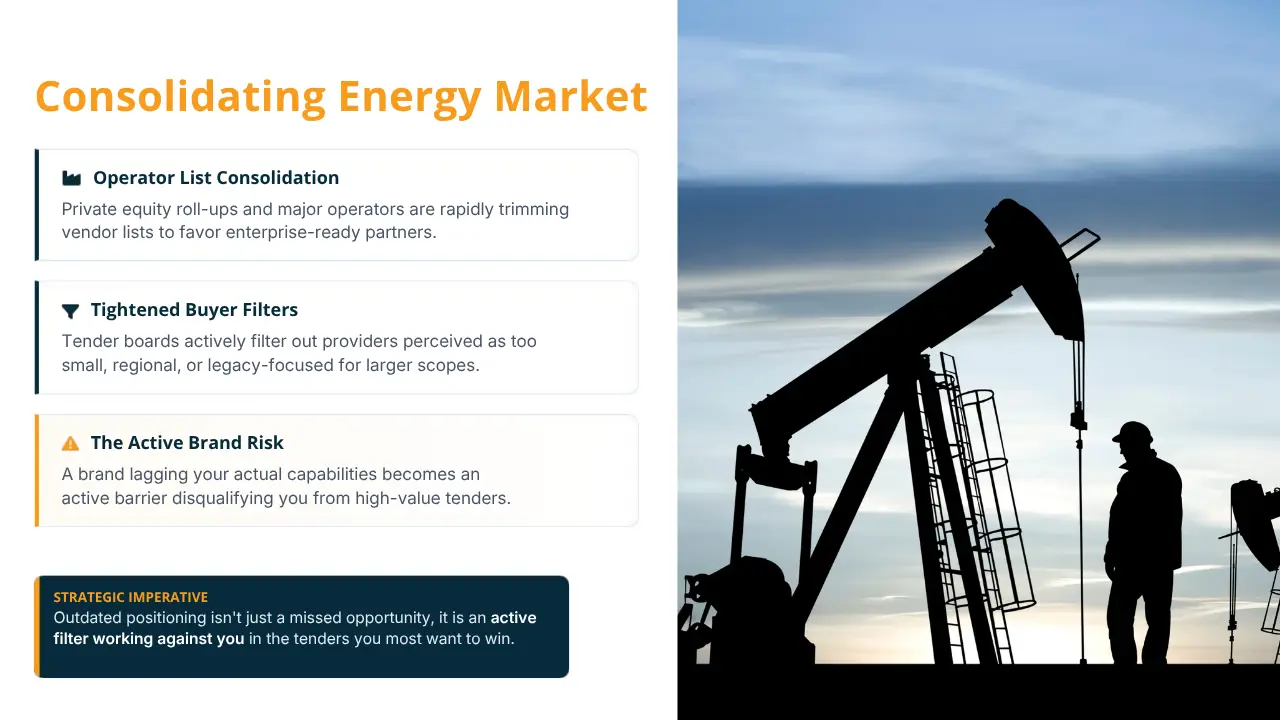
As private equity continues to roll up smaller oilfield service providers and larger operators consolidate their vendor lists, buyers are increasingly filtering out companies that look too small, too regional, or too outdated to trust with larger scopes of work. A brand that has not kept pace with your actual capability is not just a missed opportunity. It is an active filter working against you in exactly the tenders you most want to win.
Final Thoughts on Repositioning in Oil & Gas
A rebrand is not the right move for every oilfield services company, but for the ones whose capability has quietly outgrown their identity, waiting rarely fixes the problem on its own. The companies that treat repositioning as a strategic decision, backed by real research into how buyers currently perceive them, are the ones who come out the other side winning larger, more technical work instead of just looking different. Learn more about how ModalPoint helps energy companies build a brand strategy that matches where the business is actually headed.