By Modalpoint | An EWR Digital Company
If you are waiting until Q4 to present your solutions to energy sector leadership, your commercial strategy is already dead in the water. In the energy industry, capital allocation does not align with traditional calendar cycles. By the time October hits, operational allocations are finalized, capital expenditures are locked, and discretionary spending is frozen. To secure capital allocation in the upstream, midstream, or oilfield services sectors, your commercial team must position your value proposition while corporate decision-making units are actively mapping their future expenditures.
Today, getting into energy budgets requires more than traditional corporate networking. Modern energy sector budget planning is driven by how digital systems evaluate vendor credibility, operational risk, and long-term compliance. As artificial intelligence platforms increasingly curate vendor landscapes for corporate procurement teams, securing budget approval requires aligning your high-value solutions with both executive strategic priorities and machine-readable proof of performance.
If you want to win preferred partner status for 2027, you must understand the new rules of energy sector capital allocation, optimize your organizational footprint for decision-makers, and take immediate action before October locks you out. To ensure your company is positioned for growth before fiscal planning closes, get into oil & gas budgets with guidance from our executive advisors today.
Understanding the Real Capital Allocation Lifecycle for Energy Sector Budget Planning
Most service providers, technology vendors, and consultants misjudge how capital flows inside major energy organizations. Strategic corporate planning operates on a strict timeline designed to mitigate risk and optimize capital expenditure across global assets.
By late summer, asset managers, operational leaders, and procurement directors consolidate their operational expenditure (OpEx) and capital expenditure (CapEx) requests. These field-level requests move upward through corporate review panels long before board approval occurs in December. If your solution is not already integrated into those field-level proposals by September, you are not competing for current fiscal dollars; you are fighting for scraps in an emergency discretionary fund.
“The key principles … disciplined capital allocation, customer and core operations centricity, and strategic technology adoption, proved to be steady anchors amid uncertainties.”
Deloitte Insights, 2026 Oil and Gas Industry Outlook
Winning allocation during oil & gas budget season 2027 requires embedding your value proposition directly into the operational goals that asset managers are submitting right now. These goals prioritize reducing operational downtime, fulfilling environmental mandates, and improving capital efficiency.
Decoding the Oil & Gas Decision-Making Unit in 2027
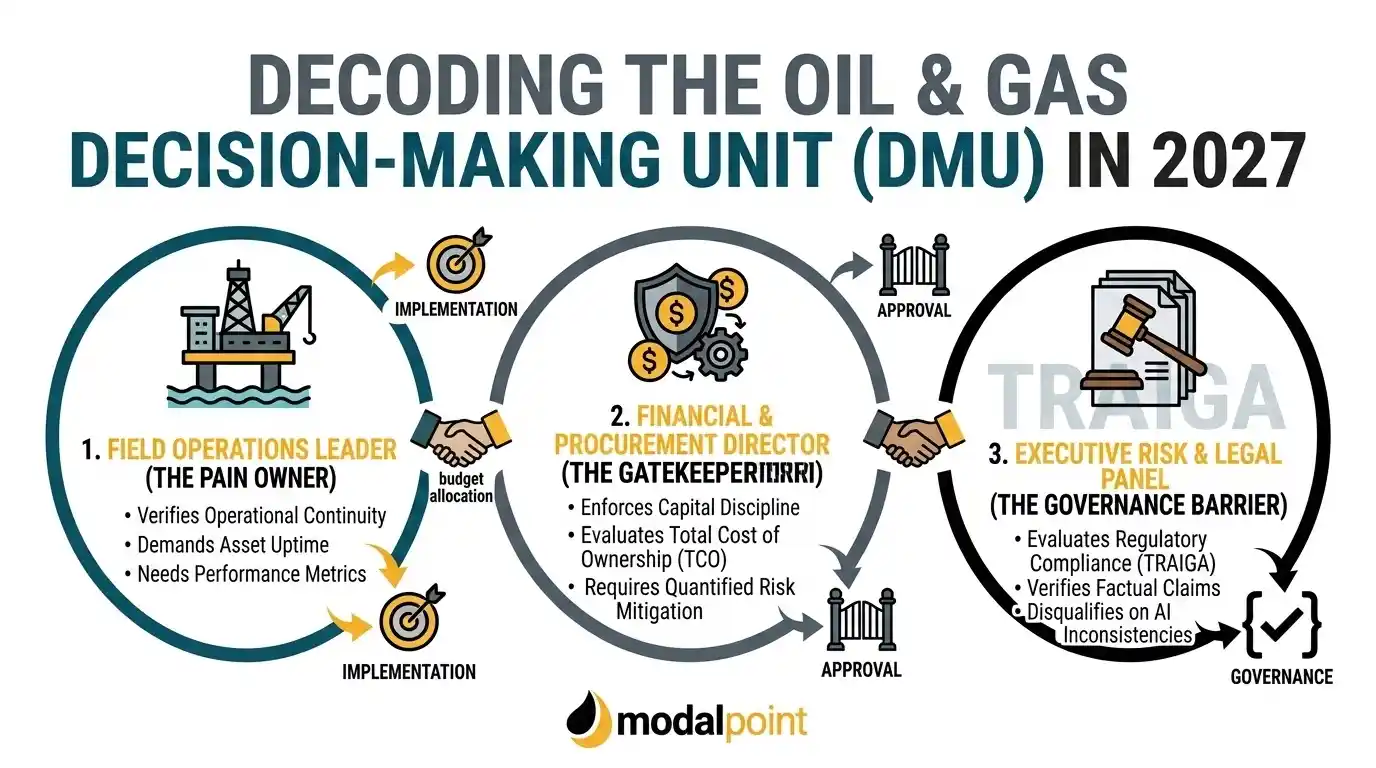
Securing a spot in corporate budgets requires navigating a complex Decision-Making Unit (DMU). Unlike traditional B2B sales, purchasing decisions in oil and gas rarely rest with a single executive. They involve a cross-functional panel that evaluates technical, financial, and regulatory risk.
1. The Field Operations Leader (The Pain Owner)
Field superintendents, asset engineers, and facility managers care about operational continuity and uptime. They do not buy abstract promises or marketing buzzwords. They demand solutions that integrate seamlessly with existing field infrastructure without introducing operational drag. To gain their backing, present field-tested case studies and immediate performance metrics.
2. The Financial & Procurement Director (The Gatekeeper)
Procurement teams exist to enforce capital discipline and manage supply chain exposure. They evaluate total cost of ownership (TCO) rather than simple upfront pricing. If your proposal does not clearly quantify cost avoidance, efficiency gains, or risk mitigation, procurement will mark your line item as discretionary and defer it indefinitely.
3. The Executive Risk & Legal Panel (The Governance Barrier)
Modern energy companies operate under strict regulatory standards and corporate risk mandates. Today, legal and compliance teams evaluate how vendors present their data, verify technical claims, and execute operational protocols. If your digital footprint or technical documentation reflects inconsistencies, executive risk panels will quietly disqualify your company before your proposal reaches the executive committee.
The New Mandate: How AI Representation Risk Impacts Budget Allocation
A major shift in how energy sector buyers evaluate vendors lies in the digital information layer. Enterprise procurement teams, technical committees, and executives no longer rely solely on sales decks or trade show meetings. They utilize enterprise AI engines, automated market intelligence platforms, and large language models (LLMs) to perform vendor discovery, comparative analysis, and risk assessments.
This shift creates AI Representation Risk. When an AI system evaluates your organization across public databases, structured data, and digital footprints, what does it report to procurement executives? If search engines and AI engines mischaracterize your capabilities, present outdated technical specifications, or fail to associate your firm with critical industry categories, you face immediate competitive displacement.
Digital Information Governance® (DIG) ensures your external, machine-facing information layer is accurate, structured, and defensible. When corporate research tools evaluate your capabilities during budget reviews, a governed digital footprint ensures your organization is accurately identified, cited, and recommended as an industry authority.
4-Step Roadmap to Position Your Organization Before October
To capture capital during oil & gas budget season 2027, execute this targeted operational roadmap over the next 30 to 60 days:
- Audit Your Technical & Digital Representation: Assess how your enterprise is indexed across search platforms and enterprise AI engines. Eliminate outdated service descriptions, contradictory technical claims, and unverified data that create legal or commercial risk during vendor evaluations.
- Align Commercial Proposals with OpEx and CapEx Triggers: Frame your solution as an operational necessity rather than an optional upgrade. Tie your pricing model directly to measurable cost reductions, safety improvements, or regulatory risk containment.
- Engage Field Operators and Executive Sponsors Simultaneously: Secure technical endorsement from field engineers while equipping executive champions with board-ready risk mitigation metrics. A bottom-up request backed by top-down governance support survives budget cuts.
- Publish Defensible Proof Assets: Replace generic marketing collateral with authoritative technical documentation, verified client outcomes, and structured data standards that can be ingested by both human decision-makers and automated research systems.
Secure Your Spot in the 2027 Energy Sector Budgets
The window for entering 2027 energy sector budgets is rapidly closing. Waiting until Q4 guarantees competing for diminished funds or being pushed into the next fiscal cycle. By auditing your commercial strategy, governing your digital information footprint, and mapping your solutions to the core risks facing energy leaders, you ensure your firm secures preferred vendor positioning before October.
At ModalPoint, we advise enterprise leadership on navigating complex commercial landscapes, mitigating AI representation risk, and establishing defensible market authority. Partner with ModalPoint to audit your market positioning and capture growth in the upcoming fiscal year.
Frequently Asked Questions About Energy Sector Budget Planning
When does oil & gas budget season start for 2027?
Oil & gas budget season for 2027 begins in mid-to-late summer, typically between July and September. Field-level asset managers and operational teams submit their CapEx and OpEx requests long before corporate boards review and approve final numbers in November or December.
How can vendors get into oil & gas budgets before October?
Vendors can enter oil & gas budgets by aligning their value proposition with field-level operational pain points, presenting clear total cost of ownership (TCO) metrics to procurement, and establishing a governed, defensible digital footprint that passes executive risk and AI-driven procurement evaluations.