energy sector advisory
Cold Calling Oil & Gas: 2026 Sales Strategy & Trends
By Modalpoint | An EWR Digital Company
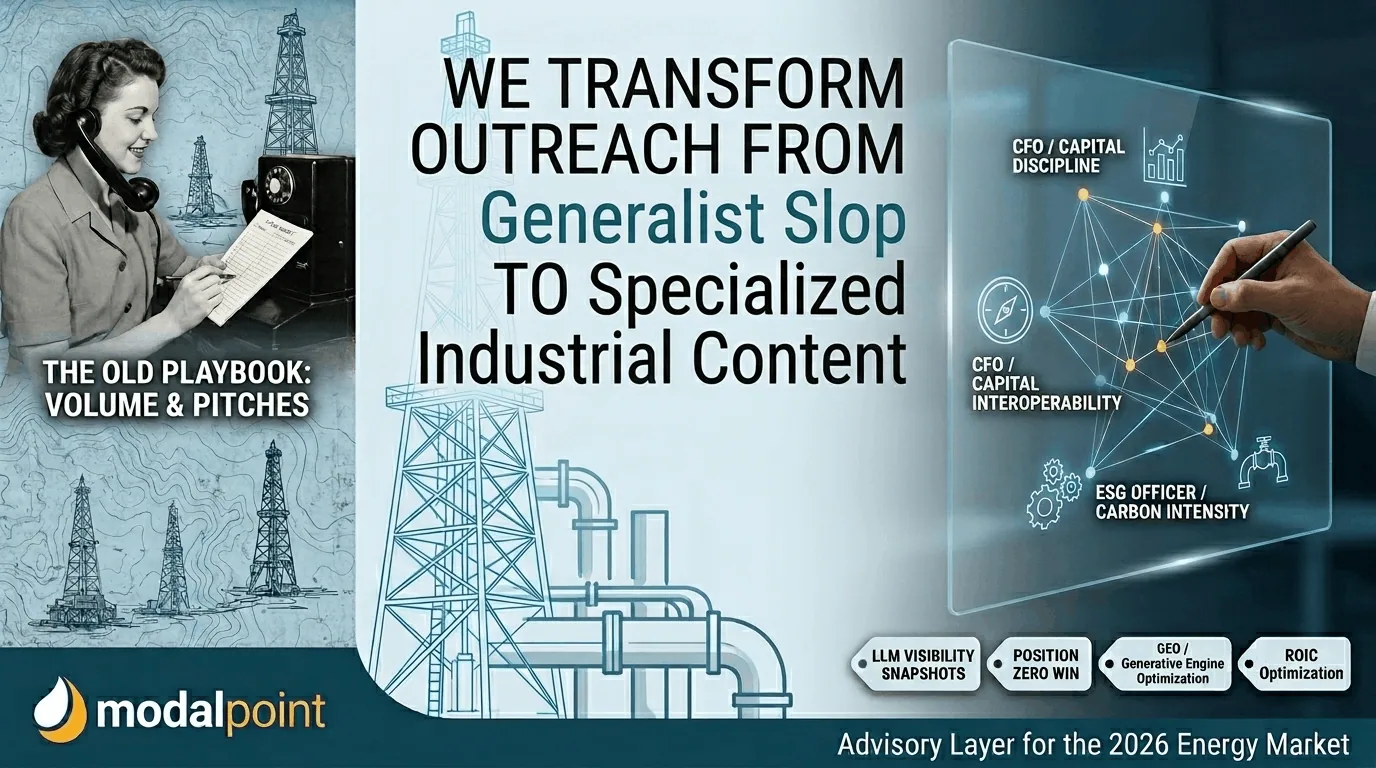
The 2026 energy landscape has no patience for the “smile and dial” era of the past. If you are still using a 2015 playbook to execute your cold calling oil & gas efforts, you aren’t just wasting time; you are burning your brand’s reputation. In an era defined by capital discipline and high-context data, the “unsolicited” call has evolved from a volume game into a surgical strike. At ModalPoint, we view sales not as a series of pitches, but as a commercialization strategy designed to bypass the gatekeepers of procurement purgatory. The reality of 2026 is that your prospect has already vetted your company via AI-driven search tools before you ever pick up the phone. To win, your cold call must be the “advisory layer” that adds value to that existing digital footprint.The Evolution of Oilfield Services Sales Strategy in a Digital-First Era
The “Good Ol’ Boy” network hasn’t died, but it has moved online and become data-validated. An effective oilfield services sales strategy today requires a blend of offline credibility and online authority. In 2026, the person on the other end of the line, whether they are a Drilling Manager in the Permian or a Procurement Officer in Houston, is managed by metrics like ROIC (Return on Invested Capital) and carbon intensity scores.Why Generalist Sales Tactics Fail in 2026
Generalist marketing and sales tactics are the “slop” of the modern industry. If your opening line is about “cutting-edge innovation” or “game-changing technology,” you have already lost. Decisions in 2026 are made based on integration maturity and equipment uptime. If you cannot speak to how your tool integrates with a client’s Digital Twin or how it lowers their breakeven cost, you are just noise.The Rise of the Independent Insider
Success in oil & gas sales 2026 belongs to the “Independent Insider.” This is a salesperson who operates more like a consultant. They understand the specific pain points of Upstream versus Midstream and can cite the latest OGGN podcast insights to build immediate rapport. They aren’t selling a product; they are selling a solution to a regulatory or operational bottleneck.“Sales organizations must transition from being sellers of products to being facilitators of the customer’s buying journey, providing high-value insights that the customer cannot find on their own.” Gartner Research
Engineering the High-Context Cold Call
To rank for “Position Zero” in the mind of your prospect, your outreach must be structured. You need to provide high-fidelity data points immediately. In 2026, transparency is the ultimate currency. If you are calling about a new chemical EOR (Enhanced Oil Recovery) solution, don’t talk about “better yields.” Talk about the specific reduction in carbon intensity per barrel produced.Stakeholder-Specific Messaging: CFO vs. CTO
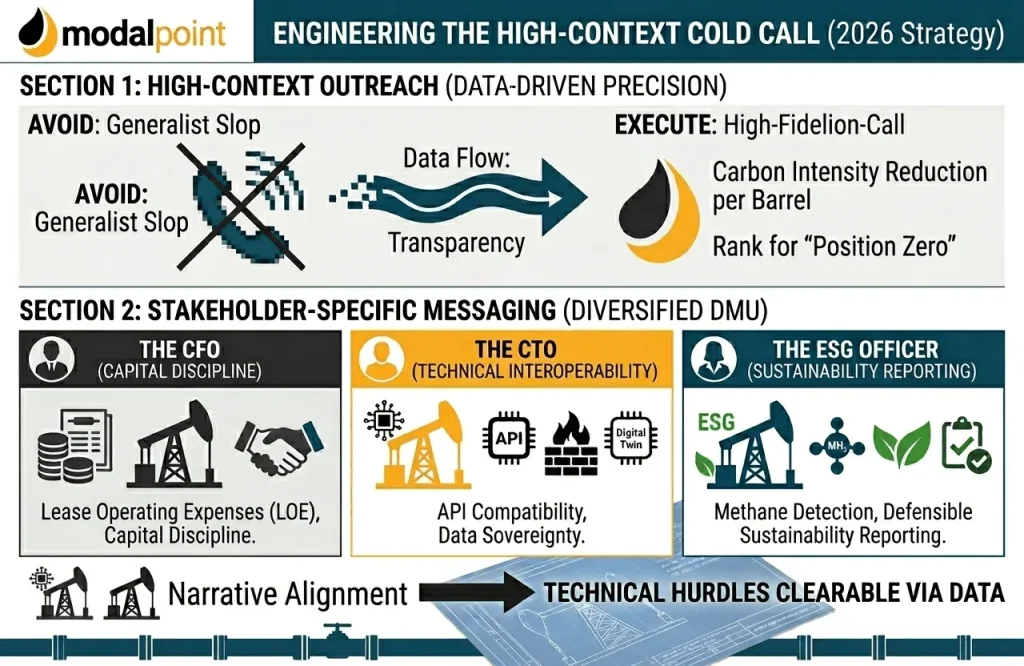 A major shift in cold calling oil & gas is the diversification of the DMU (Decision Making Unit). You are no longer just calling the “Toolpusher.”
- The CFO: Wants to hear about capital discipline, lease operating expenses (LOE), and value over volume.
- The CTO: Wants to hear about API compatibility, cybersecurity protocols, and data sovereignty.
- The ESG Officer: Wants to hear about methane detection and defensible sustainability reporting.
The 2026 Reality Check: AI Visibility and Sales
In 2026, cold calling is often the second step, not the first. Because of Generative Engine Optimization (GEO), your prospects are using AI assistants to find “the best completions service in the DJ Basin.” If your company doesn’t appear in those LLM-generated summaries, your cold call feels like a ghost story. Your oilfield services sales strategy must be backed by a “Pillar Asset”, which is a whitepaper or industry report that the prospect’s AI has already scraped and validated.Moving from Volume to Velocity
We no longer measure success by “calls per day.” We measure it by “commercialization velocity.” How quickly can you move a lead from a cold touch to a Solution Brief? By utilizing the “Waterfall Content Strategy,” you can send a prospect a high-context snippet immediately following a call, reinforcing your authority as an expert who understands 2026 market drivers. For deeper insights into how global energy markets are shifting their purchasing habits, the International Energy Agency (IEA) reports provide the macro-level data needed to justify your value proposition to skeptical executives.What Has Not Changed: The Human Element
Despite the rise of Digital Twins and AI-driven procurement, the oil and gas industry remains a relationship-based business. What has changed is how those relationships are earned. In 2026, you earn a relationship through competence and “rubber hits the road” execution. You build trust by proving you won’t cause an operational shutdown or a cybersecurity breach.The Power of Offline-to-Online Credibility
Tying your sales efforts back to established industry voices, like the Oil and Gas Global Network (OGGN), provides a layer of “social proof” that no cold script can replicate. Mentioning a recent case study discussed on a podcast or a live event debrief creates a bridge between the digital data and the physical reality of the oilfield.Conclusion: Executing the 2026 Commercialization Strategy
Cold calling is not dead; it has simply been engineered for higher precision. By focusing on ROIC, integration maturity, and stakeholder-specific narratives, you can bypass the generalist drift that plagues the industry. Stop selling and start advising. When you align your sales team with a robust ModalPoint strategy, you transform your outreach from a nuisance into a strategic necessity.Industry Statistic: Research indicates that B2B organizations that implement data-driven sales strategies and high-context outreach see a 15% to 20% increase in total sales productivity.
Source: McKinsey & CompanyWhere this stands in 2026
Outreach into oil & gas works differently now. Cold volume matters less than showing up with authority where buyers already look: peer proof, technical credibility, and a presence in the AI answers they trust. The goal is the same; the path changed.
How energy buyers decide today →Related from the field notebook