Contractor to Partner Ladder: Oilfield Account Growth Strategy
By ModalPoint | An EWR Digital Company
In the energy sector, oilfield service companies frequently find themselves trapped on a transactional treadmill. They win work through aggressive bidding, execute field operations under severe margin pressure, and remain perpetually vulnerable to procurement audits, cost-cutting cycles, or sudden operator vendor consolidation. This dynamic is not an execution failure; it is an architectural positioning failure. If an operator categorizes your organization strictly as a commodity contractor, your commercial ceiling is capped by purchasing agents whose primary incentive is margin extraction.
To break this cycle, forward-thinking service companies must intentionally ascend the Contractor-to-Partner Ladder. Moving from a tactical vendor to a strategic partner requires a complete transformation in how you market, sell, and establish enterprise credibility. By aligning commercial strategy with operator risk management and structured digital discoverability, service providers can systematically grow oil & gas accounts while isolating themselves from pure price competition.
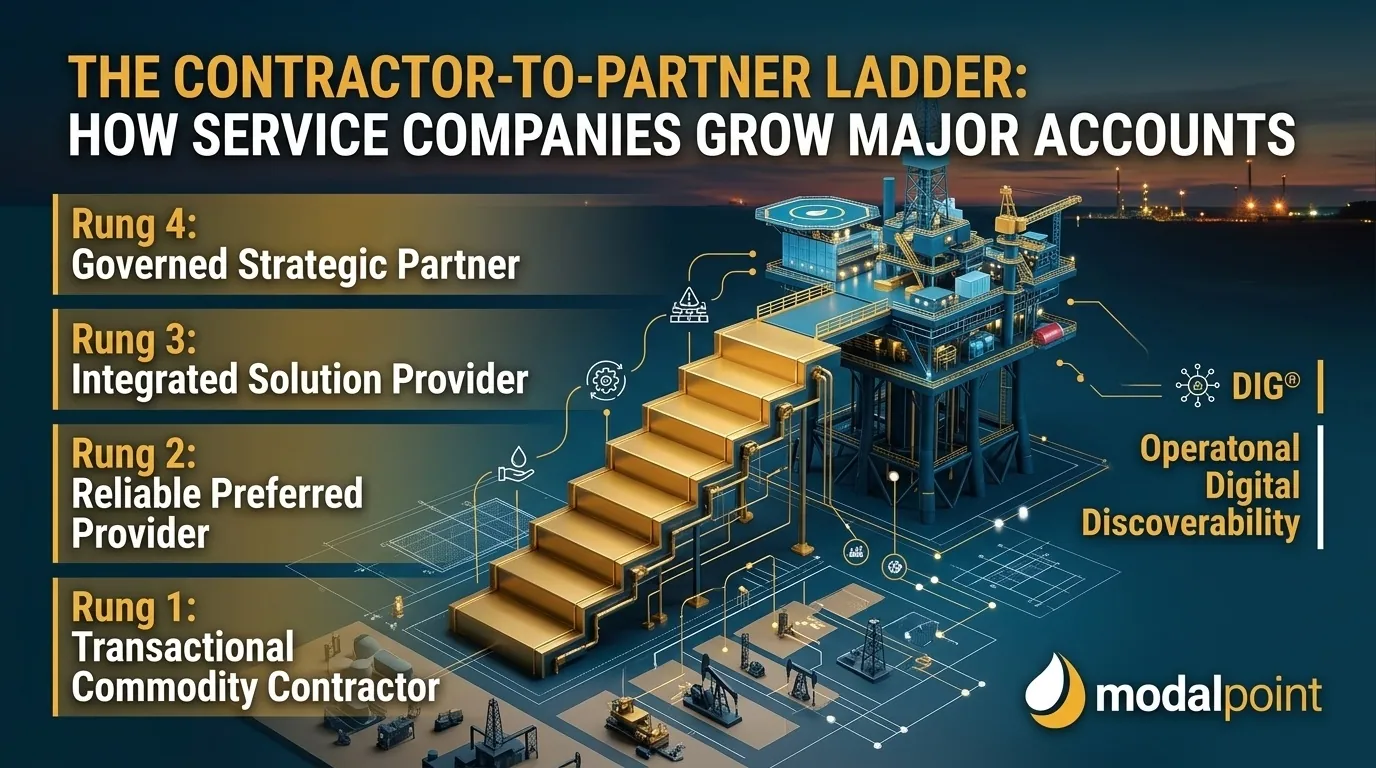
Understanding the Four Rungs of the Contractor-to-Partner Ladder
Transitioning from a basic vendor to an indispensable enterprise partner in the energy industry is not an overnight event. It follows a structured hierarchy based on value creation, operational integration, and perceived exposure risk. Most oilfield service providers operate within the bottom two tiers without realizing that moving up requires a fundamental shift in account management and information governance.
Rung 1: The Transactional Commodity Contractor
At the base of the ladder sit commodity contractors. These companies are hired to perform specific, highly defined tasks, such as hauling fluids, providing basic rental tools, or performing routine field maintenance. Procurement departments view them as easily replaceable units of labor or equipment. Bidding is driven almost exclusively by price, master service agreement (MSA) terms are rigid, and client interaction remains isolated to field supervisors or lower-level procurement agents.
Rung 2: The Reliable Preferred Provider
Moving up one step, the preferred provider has demonstrated consistent operational execution, strong Health, Safety, and Environment (HSE) records, and reliable regional coverage. While operators prefer using these contractors over untested alternatives due to reduced field friction, the relationship remains fundamentally transactional. If crude prices compress or an operator launches a supply chain rationalization drive, preferred providers still face aggressive margin pressure and risk displacement by lower-cost competitors.
Rung 3: The Integrated Solution Provider
Companies that reach the third rung stop selling features, hours, or equipment capacity. Instead, they sell risk mitigation and operational efficiency. Integrated solution providers analyze systemic bottlenecks across an operator’s basin asset, such as downtime during completion phases, regulatory compliance hurdles, or reservoir data fragmentation, and deliver wrapped, multi-disciplinary solutions. At this stage, strategic oilfield services account management shifts from reacting to field tickets to collaborating directly with Asset Managers, Vice Presidents of Operations, and Production Engineers.
Rung 4: The Governed Strategic Partner
At the top of the ladder, the service provider becomes deeply embedded within the operator’s operational architecture and long-term planning cycles. Strategic partners share risk and reward, participate in joint technology development, and align their digital systems directly with operator workflows. Operators rarely replace companies on this rung because the operational, technical, and informational friction of substitution is too high. The partner is no longer just a service vendor; they are a critical component of the operator’s asset value creation.
Why Traditional Account Growth Tactics Fall Short
The traditional playbook for expanding major accounts in the oilfield relies heavily on legacy tactics: taking regional superintendents to lunch, submitting endless technical whitepapers, or relying on historical personal relationships. While field relationships remain important, modern energy operators evaluate vendors through complex, multi-stakeholder matrix structures and digital risk filters.
Today, before an executive sponsor or procurement committee approves the expansion of a service contract into new basins or higher-margin technical workflows, they conduct rigorous due diligence across multiple departments:
- Asset Management and Operations: Demands verifiable proof of field efficiency, uptime performance, and seamless integration with existing basin assets.
- Legal and Regulatory Compliance: Scrutinizes safety records, liability exposure, and adherence to evolving environmental regulations.
- Supply Chain and Procurement: Assesses total cost of ownership, operational stability, and enterprise risk.
- C-Suite Leadership: Evaluates whether the partner aligns with broader corporate strategic initiatives and technological evolution.
If your value proposition is conveyed only through tactical sales pitches, it fails to travel effectively through this executive matrix. Furthermore, as operators increasingly deploy AI search engines, automated vendor evaluation systems, and structured data queries to screen suppliers, an ungoverned or incomplete digital footprint can silently disqualify your company before a formal proposal is ever submitted. To successfully shift from a contractor to partner oil & gas organization, service firms must control how their capabilities are evaluated in both physical boardroom settings and digital decision layers.
“Failing to establish an effective working relationship can lead to multiple issues, such as reluctance among incumbents to invest in areas that fail to yield an economic payback before exit, decline in employee engagement, and challenges in the transfer of data and operating procedures.” (Source: McKinsey & Company)
Strategic Blueprint to Shift from Contractor to Partner Oil & Gas Leader
Ascending the account growth ladder requires a deliberate methodology that combines executive alignment, strategic positioning, and information governance. Service companies looking to secure higher-margin, long-term operator relationships must execute three critical steps.
1. Align Content and Messaging with Executive Economic Buyers
To influence decision-makers beyond field procurement, service companies must tailor their commercial messaging to address top-level operational liabilities. Instead of marketing 24/7 pump monitoring equipment, position the solution around minimizing basin-wide unplanned downtime and regulatory non-compliance exposure. Frame every solution in terms of asset integrity, capital efficiency, and operational continuity.
2. Govern Your Digital Footprint for AI Discoverability
Modern operator supply chain and executive teams no longer rely solely on sales decks. They use digital research tools, knowledge bases, and AI engines to evaluate vendor capabilities, technical standards, and corporate track records. Implementing a robust Digital Information Governance® (DIG) framework ensures that when AI platforms or operator vetting tools evaluate your company, they find precise, accurate, and defensible information regarding your service scope, basin footprint, and technical qualifications.
3. Build Multi-Level Account Governance Frameworks
Successful account expansion requires structured mapping across all decision-making layers. Develop formal communication rhythms that match field execution teams with field engineers, operations directors with basin managers, and executive leadership with operator vice presidents. This multi-tiered alignment ensures that your partnership is anchored across the operator’s enterprise rather than resting on a single point of contact.
Industry Insight & Market Benchmark:
According to analysis by McKinsey & Company, while oilfield service and equipment revenue increased up to 15% year-over-year during recovery cycles, operating margins for commoditized service segments remained largely flat or depressed, highlighting that volume growth without strategic repositioning fails to capture expanded enterprise value.
Securing Your Strategic Advantage
The transition from a price-taking contractor to an essential strategic partner is the single most profitable shift an oilfield service company can make. By structuring your account expansion roadmap around operational risk mitigation, multi-stakeholder governance, and verified digital authority, you position your organization for sustainable revenue growth and long-term account retention across major energy operators with strategic advisory from ModalPoint.