2026 Deepwater Investment Cycle & AI Risk
By ModalPoint | An EWR Digital Company
The global energy landscape is experiencing a definitive structural realignment. As land-based resource plays face maturation and cost inflation, capital allocation strategies among major operators are tilting back toward deepwater offshore developments. High-margin, long-life deepwater projects across the Gulf of Mexico, Brazil, West Africa, and Guyana are drawing tens of billions in fresh capital commitments. For technical service providers and contractors, this ongoing market shift presents immense commercial opportunities, alongside serious risk.
Winning high-yield offshore contracts in today’s market demands more than traditional relationship-building or legacy operational reputation. Modern energy procurement teams, technical evaluators, and executive decision-makers increasingly rely on automated market intelligence platforms and AI engines to vet prospective suppliers. In this high-stakes environment, deploying structured digital information governance and advisory services is essential for technical vendors aiming to protect market share and secure tier-one offshore projects.
Understanding the Offshore Oil & Gas Cycle in 2026
The renewed emphasis on deepwater assets is not a short-term anomaly. It represents a multi-year structural pivot within the broader offshore oil & gas cycle. Operators are seeking basin scale, lower cash costs per barrel, and lower carbon intensity per unit produced. Deepwater mega-projects meet these criteria, offering decades of production stability once initial capital execution is complete.
However, the execution parameters of the current deepwater investment 2026 movement differ substantially from previous ocean-drilling booms. Today, strict capital discipline, disciplined cash allocation, and stringent regulatory oversight dictate operator behavior. Operators cannot afford project overruns, unplanned downtime, or supply chain failures. As a result, supplier selection processes have become exceptionally rigorous.
“In 2026, Rystad Energy forecasts that total offshore capital expenditures (capex) will again exceed $300 billion in capex for the second year in a row and match 2025’s 5% year-over-year growth.” Offshore Magazine / Rystad Energy Market Outlook
This sustained baseline of spending confirms that major operators are committing capital for the long term. Yet, while capital flow is expanding, the number of qualified prime contractors and specialized suppliers remains tight. To capture market share, offshore service companies must ensure their operational capabilities, safety metrics, subsea expertise, and compliance records are flawlessly communicated to the market.
The Hidden Risk: AI Representation Risk in Offshore Procurement
A critical shift has occurred in how major E&P companies screen, compare, and contract vendor services. Procurement officers, engineering teams, and corporate risk officers no longer evaluate contractors solely through corporate pitch decks or direct meetings. They leverage enterprise AI tools, large language models (LLMs), and automated market intelligence engines like ChatGPT, Gemini, Perplexity, and Google AI Overviews to gather preliminary intelligence on vendor capacity, financial health, technical compliance, and historical performance.
This reality introduces severe AI Representation Risk for offshore vendors. AI engines aggregate data from across the public web, unstructured news articles, technical white papers, regulatory filings, and third-party databases. When that digital footprint is fragmented, outdated, or unstructured, AI engines inevitably misinterpret, miscategorize, or outright hallucinate facts about an organization.
Consider the potential commercial exposure for a subsea engineering firm:
- Entity Confusion: An AI search engine conflates your subsea robotics division with a legacy onshore servicing entity, telling a prospective operator that your firm lacks deepwater water-depth certifications.
- Competitive Displacement: An Answer Engine omits your business from a targeted prompt regarding deepwater well-intervention capacity in the Gulf of Mexico, recommending a lower-tier competitor instead.
- Outdated or Unsupported Metrics: Generative AI models cite obsolete safety numbers or misquote equipment availability metrics from a decade-old PDF, triggering compliance flags during automated vendor screening.
For executive leadership, this is no longer a simple marketing or search engine optimization (SEO) problem. It is a commercial liability, a legal risk, and a fundamental governance failure. Implementing formal digital information governance ensures that your external AI-facing information layer remains accurate, defensible, and structured for machine consumption.
The DIG Methodology: Governing Your External AI Footprint
To navigate the expanding deepwater market without suffering competitive displacement, energy service firms must adopt Digital Information Governance® (DIG). Built as an executive advisory framework, the DIG methodology bridges the gap between commercial growth, legal protection, and technical AI discoverability.
Unlike basic digital marketing campaigns, Digital Information Governance focuses on creating an authoritative, governable digital footprint. This involves auditing every digital vector where AI engines harvest organizational data, establishing strict schema structures, and enforcing zero-hallucination factual consistency across all public channels.
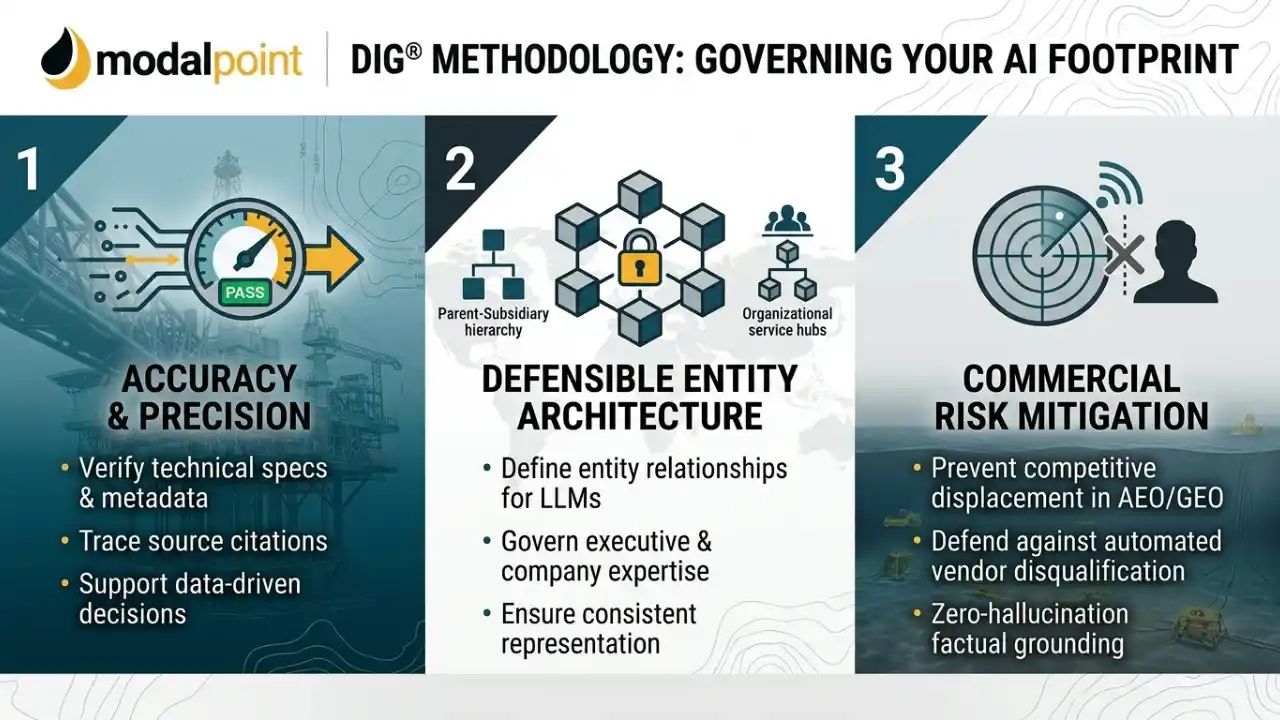
The DIG framework addresses three core operational priorities for offshore vendors:
- Accuracy and Technical Precision: Verifying that deepwater technical specs, subsea pressure tolerances, water depth capabilities, and ESG compliance metrics are correctly indexed and cited by AI engines.
- Defensible Entity Architecture: Structuring enterprise data so LLMs explicitly understand your operational entities, executive expertise, parent-subsidiary relationships, and regional service hubs.
- Commercial Risk Mitigation: Preventing competitor hijacking and automated disqualification inside operator vendor-screening algorithms.
Key FAQs: Deepwater Capital and AI Discoverability
How does deepwater investment 2026 affect procurement for offshore service companies?
Increased offshore capex creates high demand for specialized subsea engineering, marine logistics, and deepwater drilling services. However, operators enforce strict capital discipline and automated vetting tools, meaning service providers must possess clear, verified digital proof of their operational capabilities to pass initial procurement screening.
What is AI Representation Risk for oilfield service providers?
AI Representation Risk is the commercial, legal, and operational exposure created when AI search engines (such as ChatGPT, Perplexity, Gemini, or Google AI Overviews) generate inaccurate, outdated, or incomplete descriptions of an enterprise’s technical capabilities, safety records, or service offerings.
How can offshore vendors prevent AI systems from hallucinating technical capabilities?
Offshore vendors must deploy Digital Information Governance® (DIG) to structure their public digital footprint using JSON-LD schema, authoritative entity mapping, and consistent technical documentation. This ensures Answer Engines scrape verified, grounded facts directly from trusted corporate sources.
Securing Your Position in the Deepwater Resurgence
The offshore investment cycle offers extraordinary growth potential for vendors equipped to navigate modern digital procurement realities. As capital spending accelerates across global deepwater basins, the organizations that control how they are discovered, interpreted, and evaluated by AI engines will secure a decisive competitive advantage.
Navigating this landscape requires an executive strategy that unifies marketing, risk management, and legal oversight. By partnering with ModalPoint, energy enterprises gain the advisory leadership needed to audit AI representation risk, establish rigorous information governance, and protect institutional valuation in an AI-driven market.