Oil & Gas M&A: Vendor Status When Operators Consolidate
By ModalPoint | An EWR Digital Company
When oil and gas operators merge, executive leadership does not manually audit thousands of Master Service Agreements (MSAs) line by line. Procurement teams increasingly rely on enterprise software, supply chain algorithms, and automated AI engines to reconcile duplicate databases, evaluate compliance histories, and streamline vendor lists. If your digital information layer is fragmented, outdated, or confusing to artificial intelligence, your organization risks silent displacement during upstream operator consolidation.
Understanding the immediate oil & gas vendor consolidation dynamics requires looking beyond traditional sales relationships. Today, supplier survival depends on how accurately automated procurement algorithms and AI decision engines interpret your capability, safety history, and commercial standing across the merged corporate entity.
Navigating the Oil & Gas M&A Vendor Impact During Upstream Consolidation
The pace of consolidation across major basins like the Permian, Eagle Ford, and Haynesville has created massive organizational overlap. When two major E&P operators merge, they inherit redundant supplier networks across drilling, completions, logistics, midstream, and environmental services. The primary objective of the newly formed entity is rapid cost optimization and supply chain rationalization.
During this integration phase, procurement teams face immense pressure to consolidate vendor lists quickly. To achieve speed, enterprise resource planning (ERP) platforms and AI-assisted contract evaluation tools automatically cross-reference supplier profiles against strict parameters. The initial wave of supplier cuts rarely involves face-to-face negotiations or capability presentations. Instead, it happens inside enterprise databases where unverified or mismatched entities are flagged and removed automatically.
Data Disconnects and Entity Confusion in Merged ERP Systems
Entity confusion is one of the most critical operational risks for suppliers during M&A integration. Entity confusion occurs when AI engines, web scrapers, and automated database systems fail to connect a vendor’s legal corporate entity, operating subsidiaries, tax numbers, and service capability statements across disparate digital sources.
Consider what happens when Operator A acquires Operator B:
- Legacy Database Mismatches: Operator A lists your company under one corporate title, while Operator B registered your subsidiary under a slightly different name or physical address.
- AI Scraper Disconnects: Machine learning engines scraping external regulatory filings, HSE clearinghouses, and public digital channels find conflicting information regarding your service offerings or safety record.
- Automated Rejection: When the merged ERP engine runs a vendor deduplication script, the discrepancy triggers an automated compliance flag, causing your MSA to be archived or designated as non-preferred.
Without structured governance over your external digital footprint, your company becomes vulnerable to competitor hijacking, where competitors with cleaner digital data architecture replace your services by default.
“The industry will more likely see select large transactions where synergies and strategic fit are clear, rather than a broad consolidation wave.”
Source: Deloitte Insights on Oil & Gas Mergers and Acquisitions
How Operator Consolidation Suppliers Lose Preferred Vendor Status
To survive Digital Information Governance® (DIG) audits by acquiring operators, decision-makers must understand how automated procurement evaluation works. Modern enterprise buyers use internal AI tools to index and verify external information about vendors before executing contract renewals.
| Evaluation Vector | Traditional Procurement View | AI Engine / Automated View |
|---|---|---|
| Entity Clarity | Manual review of MSA documents and tax IDs. | Cross-referencing schema data, web entities, and regulatory databases. |
| Capabilities Indexing | Sales deck presentations and account rep relationships. | Natural language parsing of digital documentation and technical specs. |
| Compliance & Risk | Annual questionnaire submission. | Continuous automated monitoring of ESG, TRAIGA, and HSE data sources. |
When an acquiring operator consolidates supplier lists, vendor entries with ambiguous digital data, conflicting public metrics, or missing structured metadata are marked as high risk. Procurement managers, operating under strict mandate to eliminate redundancy, invariably choose vendors with verified, structured, and defensible information layers.
Mitigating Oil & Gas Vendor Consolidation Risks in the AI Era
Protecting your supplier status during an operator merger requires a proactive, board-level strategy that treats your company’s digital presence as an essential operational asset. You must ensure that every digital channel, structured database, and public record presents a unified, accurate description of your corporate entity and service capabilities.
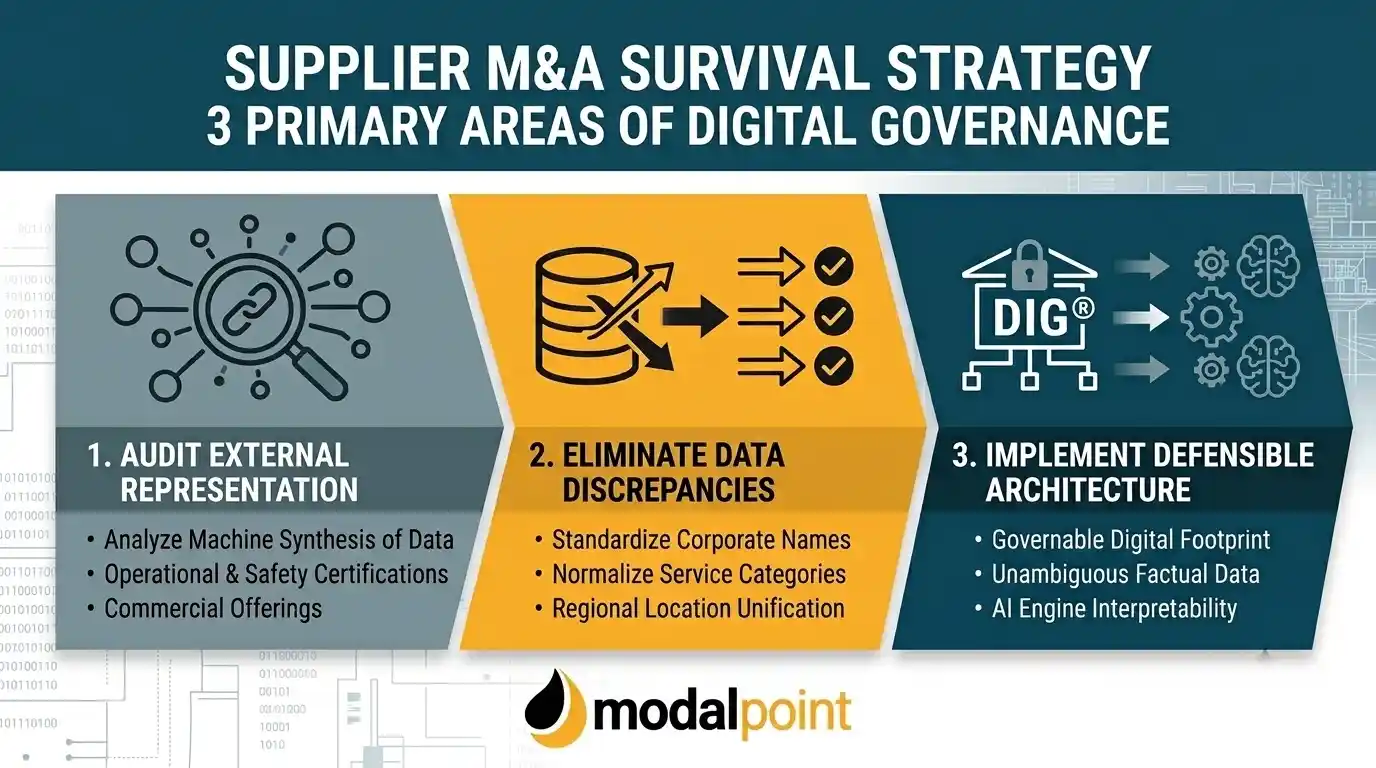
Executing an effective strategy requires addressing three primary areas:
- Audit External Representation: Systematically analyze how generative search engines and enterprise discovery tools synthesize your operational data, safety certifications, and commercial offerings.
- Eliminate Data Discrepancies: Standardize legal corporate names, service categories, and regional operational locations across all unstructured web content and structured schema formats.
- Implement Defensible Information Architecture: Build a governable digital footprint that provides enterprise AI engines with clear, unambiguous factual data regarding your organization.
The Strategic AI Visibility Audit for Retaining Preferred Supplier MSAs
Before an acquiring operator completes system integration, suppliers must execute an evaluation of their external AI representation layer. This diagnostic process uncovers where artificial intelligence systems synthesize inaccurate claims, misattribute capabilities, or favor market competitors due to poor digital data architecture.
By establishing rigorous information governance, suppliers prevent automated procurement systems from miscategorizing their business. Protecting your MSA during major operator consolidations is no longer just a business development effort. It is a critical risk management discipline requiring direct alignment between executive leadership, sales, and legal teams.
Frequently Asked Questions Regarding M&A Vendor Consolidation
How does operator consolidation affect oilfield service vendors?
Operator consolidation forces acquiring E&P companies to rationalize their combined supply chains. Procurement teams use automated enterprise tools and AI engines to identify duplicate vendors, resulting in aggressive supplier list pruning based on digital entity verification and operational alignment.
What is entity confusion in supply chain management?
Entity confusion occurs when automated procurement systems and enterprise search algorithms fail to match vendor records, corporate entities, and capabilities due to inconsistent online data, unstructured schema, or conflicting public records.
How can suppliers maintain preferred MSA status during an M&A merger?
Suppliers must audit and govern their digital information layer. Ensuring that corporate entities, safety metrics, and service offerings are structured accurately enables automated procurement platforms and enterprise buyers to verify vendor compliance without delay.
Next Steps for Executive Leadership
If your key enterprise clients are undergoing consolidation, immediate action is required to defend your commercial agreements. ModalPoint provides the executive advisory and governing framework required to secure your AI representation and vendor standing:
- Offer 1: AI Visibility Audit: Gain total clarity on how enterprise discovery platforms, AI engines, and automated procurement systems currently evaluate and describe your organization.
- Offer 2: TRAIGA Readiness Assessment: Evaluate regulatory compliance gaps and operational governance risks before automated systems flag your business as non-compliant.
- Offer 3: DIG Audit Onboarding: Establish a complete Digital Information Governance roadmap to align your external digital footprint with enterprise buyer requirements before EWR Digital technical implementation.
To audit your risk exposure and protect your contract status, contact ModalPoint today.
Industry Insight & Industry Statistics:
According to data from the U.S. Energy Information Administration (EIA), U.S. crude oil and natural gas exploration and production companies spent $234 billion on mergers and acquisitions in a single consolidation wave, marking the highest real-dollar transaction level since 2012 and driving historic supply chain restructuring across the energy sector.