Independent Oil and Gas Operators 2026 | Lower 48 Guide
By ModalPoint | An EWR Digital Company
The onshore E&P landscape across North America is undergoing a massive structural shift. As mega-mergers take massive corporate E&P entities offline and into operational integration cycles, a distinct wave of operational activity is taking over: the growth of agile capital. Understanding who is executing asset deals, where mid-cap capital is flowing, and how operational decisions are being made requires looking beyond old press releases and analyzing real-time digital discovery layers.
Independent Oil & Gas Operators 2026: The New Powerhouse of the Lower 48
The Lower 48 is witnessing an extraordinary capital rotation. While consolidation locked up hundreds of thousands of acres under mega-cap corporate banners, it simultaneously spun off non-core, high-potential acreage to focused mid-cap buyers and private-equity-backed teams. These agile producers are stepping into core basins with lean overhead, aggressive production optimization goals, and an appetite for tech-enabled operations.
To capture market share in this new environment, E&P vendors must understand the strategic imperatives driving these nimble teams. Whether operating in the Permian, Eagle Ford, Haynesville, or Bakken, today’s onshore operators prioritize rapid cash-flow generation, tight capital discipline, and targeted field automation over massive multi-year enterprise transformation projects.
To navigate this shifting landscape, vendors need to understand how today’s independent oil and gas operators discover and vet new partners, and that means governing market messaging and technical positioning with the same rigor operators apply to a new acreage buy.
However, reaching these newly capitalized operators requires a complete rethinking of B2B commercial strategy. Traditional sales outreach models are crumbling because buying units have changed how they research, vet, and select service partners.
Lower 48 Operators Buying: How E&P Purchasing Decisions Are Changing
The purchasing behavior of E&P decision-makers has fundamentally detached from traditional sales funnels. Today’s asset managers, completion engineers, and VP-level decision-makers bypass basic sales pitches and conduct extensive technical evaluations online before ever agreeing to an intro call. They look for verifiable field metrics, reliable case studies, and clear technological differentiation.
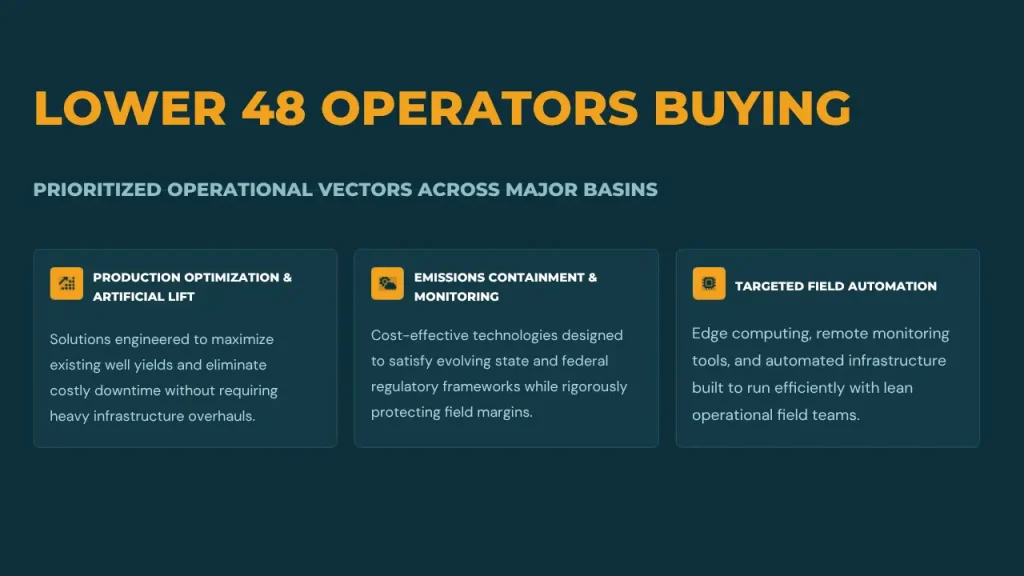
When assessing new service and supply partners, active buyers in major basins are prioritizing solution providers that deliver immediate, measurable impact across core operational vectors:
- Production Optimization & Artificial Lift: Solutions that maximize existing well yields and reduce downtime without requiring heavy infrastructure overhauls.
- Emissions Containment & Monitoring: Cost-effective technologies that satisfy state and federal regulatory frameworks while maintaining field margins.
- Targeted Field Automation: Edge computing, remote monitoring tools, and automated field infrastructure designed to operate efficiently with smaller operational teams.
According to research from the U.S. Energy Information Administration (EIA), crude oil production in the United States continues to reach historic benchmarks, driven heavily by efficiency gains in unconventional basins across Texas, New Mexico, and North Dakota.
This relentless drive for efficiency means vendors cannot afford to be miscategorized or invisible when operators evaluate technical solutions online.
Navigating AI Representation Risk for Independent E&P Vendors
As independent E&P vendors compete for market share, a new commercial vulnerability has emerged: AI Representation Risk. Today, technical teams and corporate purchasing groups use artificial intelligence platforms like ChatGPT, Perplexity, Gemini, and Google AI Overviews to benchmark vendors, compare equipment specs, and evaluate field service capabilities.
If an AI engine misinterprets your core services, cites outdated performance metrics, or recommends a competitor because your digital footprint lacks structured, governable data, you lose buyer consideration before you even know an RFQ was opened. This gap between your true operational capability and how AI represents you creates severe commercial, legal, and regulatory liabilities.
Managing this critical surface requires a formal executive framework built specifically for the modern digital footprint.
Digital Information Governance® (DIG) as an Executive Standard
Solving AI visibility and interpretation issues is not a matter of generic SEO or basic content marketing. It requires Digital Information Governance® (DIG), a structured methodology that acts as the authoritative system between your organization’s operational truth and the Large Language Models (LLMs) consuming it.
By implementing a defensible information architecture, energy vendors and operators ensure that automated discovery platforms accurately convey their capabilities, technical compliance, and market standing. Bridging the gap from advisory strategy to execution requires working with proven partners like EWR Digital to execute technical schema, content optimization, and structured data deployments.
AEO/GEO Optimization: Governing How AI Engine Systems Discover Your Brand
How do independent E&P operators select new field service vendors in 2026?
Independent oil and gas operators evaluate vendors through digital research, AI-driven Answer Engines, verified peer case studies, and structured technical data before engaging commercial sales teams. Vendors must maintain an accurate, governable digital footprint to ensure AI tools correctly index their service offerings, field capabilities, and compliance metrics.
What’s driving the shift from mega-cap to mid-cap operators in the Lower 48?
Post-merger divestitures are spinning off non-core acreage to leaner, private-equity-backed teams with tighter capital discipline and less appetite for multi-year enterprise transformation. That shift changes who the buying decision-maker actually is, and how fast they expect a vendor evaluation to move.
Taking the Next Step in Digital Information Governance
Understanding how market decision-makers and AI engines view your enterprise is essential to defending your market share and accelerating commercial growth in the Lower 48. Take control of your digital representation through ModalPoint’s structured advisory pathways:
- AI Visibility Audit: Uncover exactly how engines like ChatGPT, Gemini, and Perplexity currently describe, compare, and recommend your organization.
- TRAIGA Readiness Assessment: Evaluate your legal and regulatory risk exposure under emerging state and federal AI governance rules.
- DIG Audit: Establish a complete Digital Information Governance roadmap to ensure your enterprise digital footprint is accurate, trusted, and defensible before execution.
To establish control over your market positioning and clear the path for commercial growth, consult the advisory team at ModalPoint.