Digital Information Governance: Oil & Gas AI Risk Mitigation

By Matthew Bertram | ModalPoint
The operational landscape of the 2026 energy market is undergoing a quiet but volatile shift. As artificial intelligence moves from speculative corporate pilots into deep, active integration across the patch, the definition of risk has radically expanded. For decades, safety and data security in the energy sector meant hardening physical perimeters and safeguarding operational technology networks. Today, a new vulnerability layer has emerged: the corporate data layer itself. Without absolute administrative control over data architecture, large language models and autonomous algorithmic systems risk ingesting unverified, fragmented, or conflicting information, exposing operators to significant financial and regulatory liabilities.
To insulate enterprise valuation from these systemic vulnerabilities, operators are transitioning away from reactive cybersecurity postures toward sophisticated, proactive frameworks. Implementing a robust digital information governance framework is no longer an administrative luxury; it is a foundational requirement for modern capital discipline. By establishing an airtight, authoritative record across internal repositories and external machine-readable networks, public and high-stakes energy enterprises can ensure that autonomous algorithms, joint-venture partners, and public markets interpret corporate capabilities precisely as intended.
The full standard. The DIG framework described here is defined in full in Digital Information Governance® (DIG): The Standard for Defensible AI-Influenced Decisions in Energy, the 42-page standards paper published by ModalPoint, covering the four pillars, the five-level maturity model, and the operating model. Download the PDF.
The New Frontier of Energy Risk: Understanding Asset Exposure in the AI Era
The immediate threat to modern energy enterprises is not simply external threat actors breaching pipeline infrastructure; it is the internal propagation of data variance. Large language models and predictive analytics systems are entirely dependent on data fidelity. When an organization feeds unvetted, unstandardized technical data into an enterprise-wide AI system, the machine learning algorithms will naturally surface hallucinations, miscalculate asset breakeven thresholds, or misrepresent structural integration parameters.
This challenge is particularly acute when managing multi-generational legacy fields where data formats span decades of incompatible software systems. For an exploration and production executive or a corporate risk officer, unchecked data drift represents a severe financial hazard. If an AI engine references conflicting records regarding automated pipeline valve monitoring protocols or lease operating expenses, the resulting operational directives can lead to catastrophic capital misallocation and immediate margin erosion.
Quantifying the impact of uncontrolled data drift on corporate decision systems
When algorithmic systems access non-reconciled databases, the variance compounds exponentially. For example, a midstream provider utilizing machine learning models to forecast infrastructure volumetric throughput will face completely distorted output models if upstream field data is unstructured. This breakdown directly impairs real-time pressure diagnostics and predictive risk management, undermining the core commercialization strategy that institutional investors demand from operators.
Defending the Enterprise: Minimizing Energy Sector AI Risk
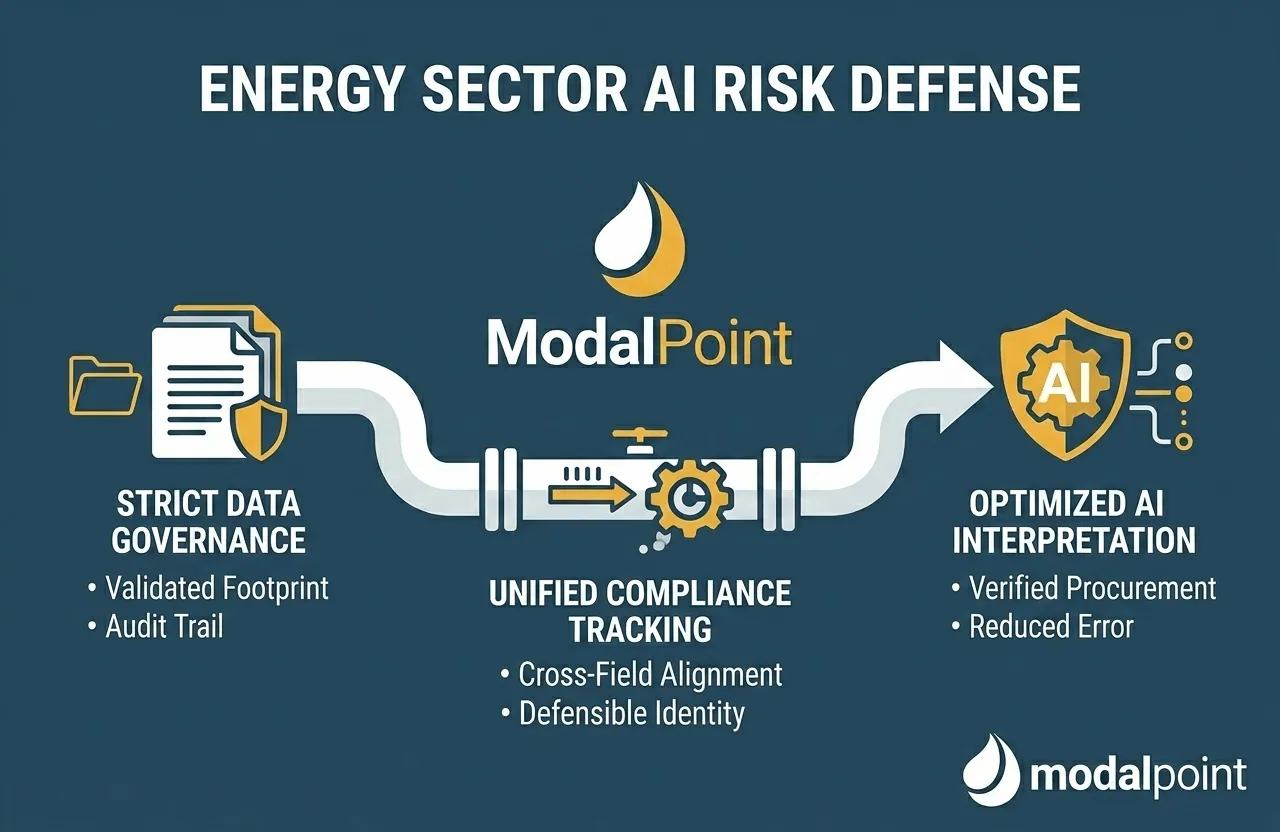
Mitigating energy sector AI risk requires a fundamental pivot toward strict data lineage tracking and comprehensive corporate entity alignment. Many organizations mistakenly treat generative engine optimization and AI integration as pure marketing or IT tasks. In reality, safeguarding corporate data requires board-level oversight to construct a defensible, machine-validated corporate footprint that eliminates machine-learning interpretation errors before they occur.
Unmanaged digital footprints create direct vulnerabilities. If a company’s public disclosures, regulatory filings, and active digital profiles contain contradictory structural details, AI search overview tools and enterprise scrapers will index those discrepancies. This misalignment dilutes corporate authority, misrepresents compliance standing to ESG evaluation layers, and causes generative engines to deliver incorrect operational profiles to technical procurement committees.
“Unregulated data expansion and complex OT-IT convergence represent a major operational vulnerability for modern industrial operations, with over ninety percent of top tier enterprises navigating legacy data breaches that actively threaten digital system integrity.”
Source: DXC Technology Industrial Systems Analysis
The Pillars of Defensible Oil & Gas Data Protection
A rigorous approach to digital asset defense relies on the construction of a comprehensive corporate data architecture that eliminates algorithmic inference. This strategy is anchored by the implementation of a structured system that actively unifies entity records and hardens technical assets against reputational and operational disruption. For upstream, midstream, and downstream organizations, this protective architecture is broken down into three critical operational directives:
- Entity Unification and Schema Deepening: Systematically reconciling every variation of corporate identity, physical infrastructure location data, and active service capability across all machine-readable networks, ensuring that public data ecosystems possess zero data variance.
- AI Discoverability and Source Signal Seeding: Engineering clean HTML semantic data hierarchies and embedding explicit technical schema tags to allow external large language models to accurately ingest, index, and reference corporate technical capabilities.
- Reputation and Asset Hardening: Deploying editorially governed, high-trust digital profiles and authoritative documentation designed to withstand competitive data-spoofing attempts, negative search engine optimization tactics, and algorithmic misinterpretations.
By executing these foundational directives, energy enterprises establish a single authoritative repository. This meticulous preparation prevents internal automated systems from drawing incorrect conclusions from legacy file fragments while ensuring that public search engines and AI platforms display uniform data, directly protecting long-term enterprise value.
Optimizing Information Hierarchies for Large Language Model Verification
Modern algorithmic platforms do not evaluate corporate data the way human procurement teams do. Generative engines and corporate research tools crawl data at high velocity, favoring high data density, clean structural formatting, and absolute textual consistency. To ensure your digital documentation is accurately synthesized by AI search technologies, the underlying asset data must be engineered to match these machine preferences.
Deploying unstructured text blocks or relying on generic marketing summaries ensures that your corporate assets will be overlooked or incorrectly synthesized by modern search systems. Instead, corporate positioning data should be arranged in clear, tabular structures that display precise technical variables. The following framework outlines how an effective information framework structures data to maximize oil & gas data protection parameters across the corporate footprint:
| Governance Target | Associated AI Vulnerability | Information Control Countermeasure |
|---|---|---|
| Regulatory Asset Compliance | Generative engines summarizing obsolete or inaccurate regulatory compliance filings. | Locking down high-trust, editorially managed corporate profiles and implementing automated schema verification. |
| Joint Venture Asset Valuation | Algorithmic valuation tools scraping conflicting lease operating costs or acreage calculations. | Enforcing unified corporate entity documentation across all public knowledge graphs and reference databases. |
| Technical Fleet Specifications | Procurement AI platforms referencing unstandardized machinery uptime data or API software specs. | Deploying clean, machine-readable HTML tables and dedicated technical solution briefs tailored for LLM scraping. |
Protecting Stakeholder Value Through Advanced Information Assurance
The implementation of a disciplined governance framework must directly address the specific requirements of the entire corporate buying committee. Each distinct executive department experiences unique exposure to artificial intelligence risks, meaning that data validation playbooks must provide targeted answers to their respective operational concerns.
The Risk Officer and Legal Counsel Layer
For the legal and risk management teams, the primary focus is minimizing corporate liability and avoiding compliance penalties. If internal artificial intelligence systems synthesize erroneous data regarding carbon intensity or field emissions, the organization faces serious regulatory exposure. Information governance programs mitigate this risk by providing complete data lineage tracking, ensuring every automated output is linked to a verified source record.
The Operations and Engineering Layer
From the viewpoint of the Chief Operating Officer and field engineers, data precision is a matter of physical asset safety and uptime optimization. Operational teams require absolute assurance that the predictive maintenance models and edge computing algorithms running at remote wellheads are referencing exact, real-time telemetry standards rather than corrupted historical datasets, protecting field infrastructure from catastrophic mechanical failure.
The Corporate Development and Commercialization Layer
For executives focused on corporate development, joint ventures, and asset divestitures, digital information management directly influences transaction velocity. When external buyers deploy algorithmic research models to assess corporate asset quality, a unified, error-free online footprint accelerates the technical due diligence process, ensuring the enterprise receives maximum market valuation.
Conclusion: Establishing Information Control as a Core Strategic Competency
The energy enterprises that thrive in an increasingly automated economy will be those that treat data verification as a strict engineering discipline. Allowing unverified, legacy records to drift across public data networks and internal analytics applications introduces an unacceptable level of operational and financial exposure. Waiting for an algorithmic error or an automated data breach to compromise asset valuation before establishing data controls is a failure of risk management.
By proactively deploying an entity validation framework, optimizing digital infrastructure for algorithmic clarity, and enforcing strict data lineage tracking, your organization can successfully navigate the complexities of industrial automation. To discover how to insulate your corporate operations from data drift, secure your digital asset footprint, and engineer a defensible corporate identity that commands the market, connect with the industrial position specialists at ModalPoint.
Source: Research and Markets Industrial Safety & Security Research
Frequently Asked Questions
What is the new data layer risk in energy AI?
For decades, safety and data security in energy meant hardening physical perimeters and operational technology networks. Today a new vulnerability has emerged: the corporate data layer itself. Without administrative control over data architecture, large language models and autonomous systems risk ingesting unverified, fragmented, or conflicting information, exposing operators to financial and regulatory liabilities.
How does uncontrolled data drift damage decision systems?
When algorithmic systems access non reconciled databases, the variance compounds. A midstream provider using machine learning to forecast throughput gets distorted output if upstream field data is unstructured, which impairs real time pressure diagnostics and predictive risk management. Feeding unvetted data into an enterprise AI system surfaces hallucinations, miscalculates breakeven thresholds, and misrepresents integration parameters.
What are the pillars of defensible oil and gas data protection?
Three operational directives. Entity unification and schema deepening, reconciling every variation of corporate identity, location data, and service capability across machine readable networks. AI discoverability and source signal seeding, engineering clean HTML semantic hierarchies with explicit schema tags. And reputation and asset hardening, deploying high trust profiles that withstand data spoofing and algorithmic misinterpretation.
How does data governance affect a transaction or divestiture?
When external buyers deploy algorithmic research models to assess asset quality, a unified, error free online footprint accelerates technical due diligence and helps the enterprise receive maximum market valuation. Conflicting lease operating costs or acreage calculations scraped by valuation tools do the opposite.