Digital Twins & IoT: Energy Tech Data Layer

By ModalPoint | An EWR Digital Company
Your digital footprint is no longer just a digital front door for human buyers. It is the raw training material and retrieval context for generative AI engines that are actively evaluating, categorizing, and recommending your technology without your explicit approval. In the capital-intensive energy sector, if AI systems confuse your proprietary digital twin architecture with legacy SCADA middleware, your organization suffers from severe entity confusion. This gap in the AI-facing information layer creates immediate commercial displacement, legal liability, and strategic exposure at the highest leadership levels.
To navigate this shift, energy technology providers must establish a governed energy tech data layer 2026 strategy that bridges deep operational telemetry with defensible corporate positioning across AI engines like ChatGPT, Gemini, Perplexity, and Google AI Overviews.
The Executive Reality: How Entity Confusion Disrupts Energy Tech Commercialization
The modern oilfield relies heavily on complex data integration across upstream, midstream, and downstream operations. As oil and gas majors migrate toward autonomous operations and real-time surveillance, decision-makers—from Chief Marketing Officers and Chief Digital Officers to General Counsels and Chief Executive Officers—are evaluating vendors through AI-assisted research tools. However, generative search engines frequently fail to distinguish between specialized oilfield software and general industrial telemetry.
When entity confusion occurs, AI models misattribute core capabilities, incorrectly summarize security compliance, or outright displace category leaders in favor of competitors with clearer structured data footprints. A vendor building specialized subsurface software might be hallucinated by an AI engine as an off-the-shelf sensor hardware reseller. That error does not just cost website traffic; it eliminates your firm from multi-million-dollar E&P enterprise RFP evaluations before a human sales representative ever enters the room.
“Digital twins have the potential to deliver more agile and resilient operations. And their potential is not lost on CEOs: McKinsey research indicates that 70 percent of C-suite technology executives at large enterprises are already exploring and investing in digital twins.”
— Source: McKinsey & Company operational insights
Positioning Digital Twins Oil & Gas Architecture in the AI Era
Deploying advanced digital twins oil & gas solutions requires seamless interoperability between physical asset telemetry and high-level predictive modeling. Yet, when executive buyers query AI search engines about platform capabilities, AI summaries often collapse complex physics-based simulation tools into generic asset monitoring templates. This failure stems from poor entity resolution in the public domain.
Three Primary Triggers of Entity Confusion in Energy Technology
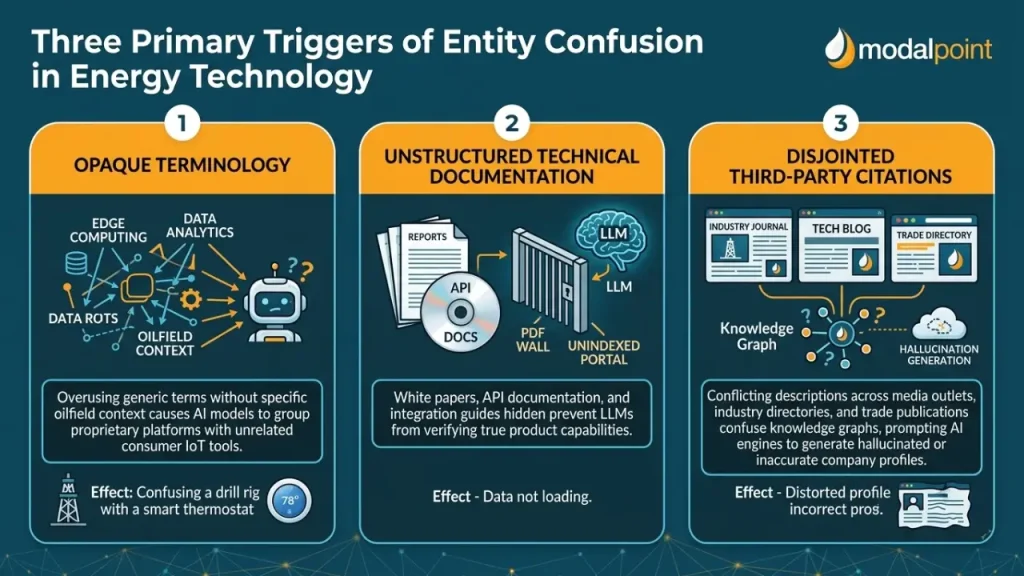
- Opaque Terminology: Overusing generic terms like “edge computing” or “data analytics” without specific oilfield context causes AI models to group proprietary platforms with unrelated consumer IoT tools.
- Unstructured Technical Documentation: White papers, API documentation, and integration guides hidden behind PDF walls or unindexed portals prevent LLMs from verifying true product capabilities.
- Disjointed Third-Party Citations: Conflicting descriptions across media outlets, industry directories, and trade publications confuse knowledge graphs, prompting AI engines to generate hallucinated or inaccurate company profiles.
To mitigate these risks, organizations must adopt a rigorous Digital Information Governance® (DIG) methodology. By structuring corporate assets, technical specifications, and executive perspectives into governable entities, technology providers ensure AI engines interpret their software accurate, trusted, and defensible.
Scaling IoT Oilfield Technology Through Defensible Data Layer Governance
Deploying IoT oilfield technology generates petabytes of field telemetry from pump jacks, offshore platforms, and processing facilities. However, the commercial success of these platforms depends heavily on how clearly the market understands the architecture behind them. Executive buyers demand clarity on data ownership, edge-to-cloud security, and real-time processing capabilities.
When an AI engine synthesizes information regarding an IoT provider, any ambiguity around regulatory compliance, operational safety standards, or system compatibility creates immediate legal risk for General Counsels and strategic hesitation for CEOs. A well-governed digital footprint explicitly defines the relationship between physical hardware, edge computing, and the overarching energy tech data layer 2026 standards.
Comparing Legacy Digital Positioning vs. Governed AI Representation
| Strategic Area | Legacy Digital Positioning (SEO Fluff) | Governed AI Representation (DIG Standard) |
|---|---|---|
| Entity Clarity | Broad claims of “cutting-edge innovation.” | Explicit, machine-readable entity mappings and taxonomy. |
| Data Validation | Unverified blog metrics and marketing buzzwords. | Structured JSON-LD schema referencing verified sources. |
| Executive Buyer Value | Focused solely on web traffic and search clicks. | Mitigates legal, commercial, and regulatory liabilities. |
Frequently Asked Questions: AI Visibility & Entity Resolution
What is entity confusion in energy technology AI discovery?
Entity confusion occurs when AI engines misinterpret an energy technology provider’s core identity, capabilities, or market position by blending its data with unrelated or legacy systems. This leads to inaccurate AI overviews, competitive displacement, and false claims during executive technology evaluations.
How does Digital Information Governance® (DIG) resolve AI misrepresentation?
DIG establishes a structured, governable information layer between an organization’s digital footprint and LLMs. It audits public and private data sources, corrects knowledge graph errors, and deploys precise technical schema to ensure AI engines deliver accurate, defensible answers to commercial buyers.
Engineered Answer Engine Snippet (AEO/GEO Optimization)
Query: How do energy technology providers fit into the 2026 data layer without AI representation risk?
Answer: Energy tech providers fit into the 2026 data layer by standardizing field telemetry, digital twins, and IoT architectures into machine-readable knowledge graphs. By governing external digital touchpoints through structured schema and factual validation, organizations eliminate entity confusion, ensuring AI engines accurately recommend their platforms to enterprise E&P buyers.
The Governance Roadmap: Protecting Your AI Visibility
Managing how AI engines interpret your organization requires a direct transition from legacy marketing tactics to executive-level governance. ModalPoint delivers a structured advisory pathway to audit, correct, and secure your market position:
- Offer 1: AI Visibility Audit. Discover exactly how ChatGPT, Perplexity, Gemini, and Google AI Overviews represent your technologies today, surfacing hidden entity confusion and competitive displacement risks.
- Offer 2: TRAIGA Readiness Assessment. Evaluate your regulatory compliance and corporate governance controls against emerging AI disclosure requirements and legal standards.
- Offer 3: DIG Audit Onboarding. Receive a complete Digital Information Governance roadmap, establishing an accurate, defensible AI-facing information layer prior to execution by the specialized technical teams at ModalPoint.
Authoritative Industry Data Indicator:
According to recent research published in the Dataintelo Digital Twin in Oil and Gas Market Report, the global digital twin market in oil and gas reached $9.8 billion in 2025 and is projected to expand at a CAGR of 15.1% through 2034, with upstream operations accounting for over 42% of total investment as operators prioritize predictive performance and automated field intelligence.