Information Governance for Downstream Oil & Gas Assets
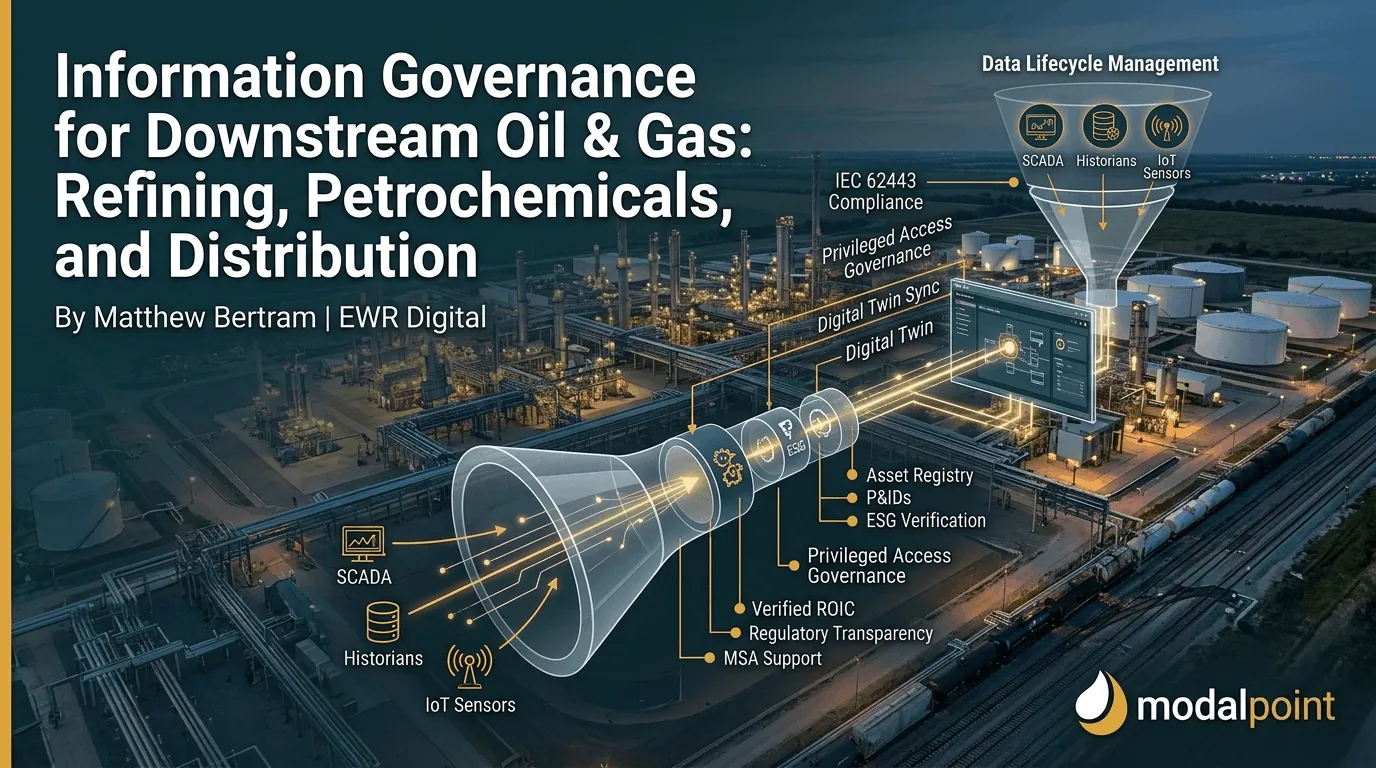
By Matthew Bertram | ModalPoint
The downstream sector operates on the thinnest margins in the energy value chain, where asset profitability depends entirely on continuous, optimized runtime and predictable supply chain execution. As industrial plants transition to fully automated operations, the volume of data generated by process control systems, edge sensors, and enterprise databases has scaled exponentially. Managing this information requires moving past simple file storage models and adopting a structured framework designed specifically for complex industrial environments.The Hidden Cost of Fragmented Data in Refining and Petrochemical Facilities
Most downstream operators fail to recognize that poor data architecture directly diminishes Return on Invested Capital (ROIC). When plant engineers spend hours cross-referencing unstandardized piping and instrumentation diagrams (P&IDs) during an unplanned turnaround, or when maintenance teams lack instant access to historical equipment telemetry, asset utilization rates drop immediately. Implementing an enterprise-grade downstream oil & gas information governance framework ensures that critical engineering, operational, and financial data assets are preserved, verified, and accessible across the corporate footprint. In high-stakes manufacturing environments, regulatory compliance and operational safety are deeply linked with information integrity. For facilities managing volatile chemical processes, an unverified asset registry or an unmapped data pipeline represents an unacceptable operational risk. Developing a specialized framework for petrochemical governance eliminates data silos between plant operations and corporate offices, allowing executives to make rapid, defensible decisions during market fluctuations or unexpected supply chain bottlenecks. To establish long-term market authority and protect complex industrial supply chains, downstream technology and operational leaders must balance day-to-day processing performance with rigorous corporate oversight. Modern regulators and insurance underwriters are increasingly critical of unverified industrial data systems. A comprehensive approach to refining data compliance ensures your facility maintains absolute regulatory transparency, matches global cybersecurity standards, and optimizes full-cycle production costs per barrel.“The complexity of securing legacy Operational Technology (OT) infrastructure remains a primary challenge. Many upstream and downstream facilities still rely on decades-old Industrial Control Systems (ICS) and Supervisory Control and Data Acquisition (SCADA) networks that lack basic security features, such as encryption, authentication, and patching. Integrating modern cybersecurity solutions into these environments is challenging due to risks of operational disruption and downtime.” Source: Fortune Business Insights Oil & Gas Cybersecurity Outlook
Three Core Pillars of Downstream Data Architecture
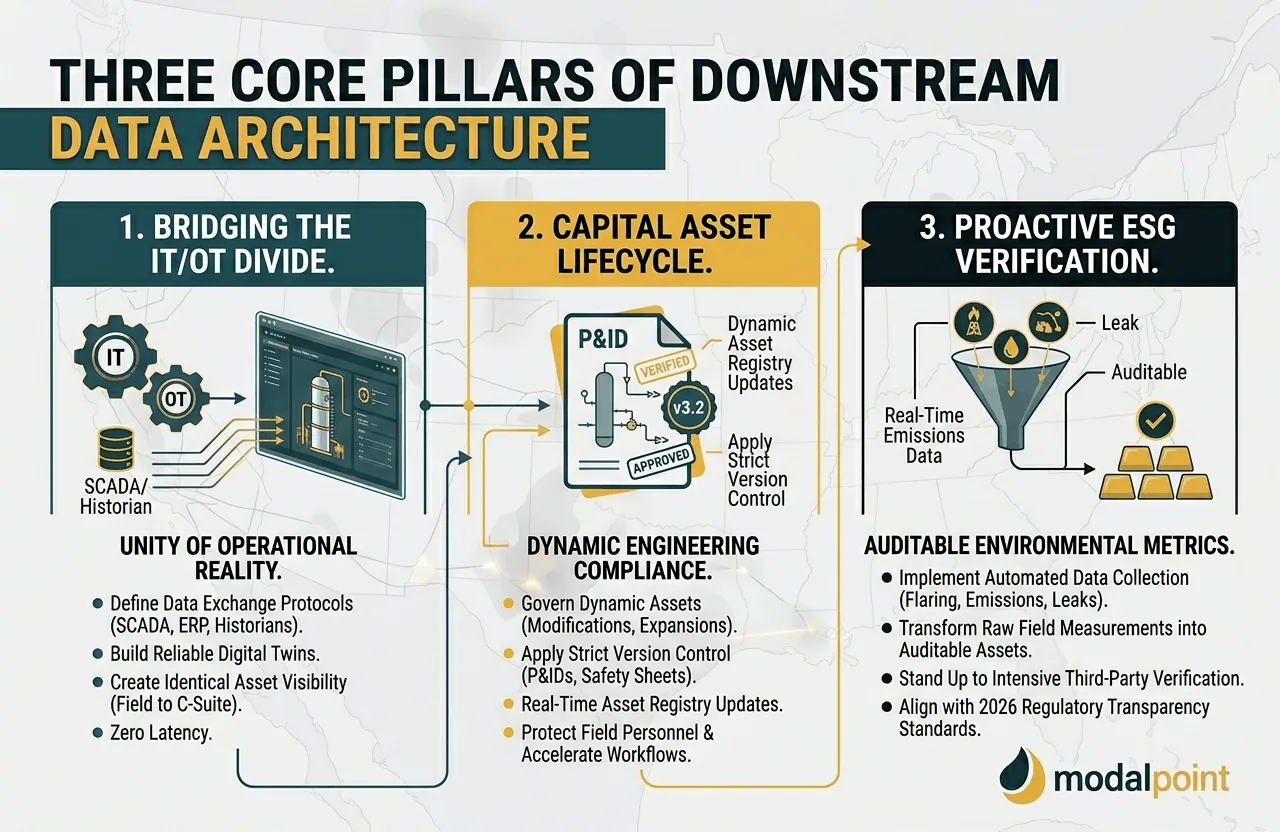
1. Bridging the IT/OT Divide via Digital Twin Integration
The greatest point of friction in any refining or petrochemical plant is the systemic disconnect between Information Technology (IT) systems and Operational Technology (OT) networks. Your governance framework must explicitly define data exchange protocols between real-time SCADA systems, industrial historians, and corporate enterprise resource planning software. Standardizing these inputs allows operators to build a reliable Digital Twin architecture, providing identical asset visibility to field technicians and executive decision makers without introducing latency or operational risk.2. Capital Asset Lifecycle Documentation and P&ID Governance
Refineries and petrochemical complexes are dynamic assets that undergo continuous modifications, emergency repairs, and multi-million dollar capital expansions. If your engineering documents, safety data sheets, and P&IDs are not governed under strict version control protocols, compliance failures are inevitable. Information governance ensures that every physical change made to a valve, compressor, or catalytic cracking unit is immediately updated within the digital asset registry, protecting field personnel and accelerating maintenance workflows.3. Proactive Methane Intensity and ESG Data Verification
Environmental compliance in 2026 is no longer a backward-looking reporting exercise; it is an active variable in corporate capital allocation and global product distribution. Downstream operators must design automated data collection pathways that capture real-time flaring metrics, stack emissions, and volatile organic compound leaks. Your information architecture must transform raw field measurements into auditable, high-fidelity data assets that stand up to intensive third-party verification and evolving regulatory transparency standards.Streamlining Procurement and Bypassing System Sandboxes
When technology vendors or internal project teams attempt to deploy new analytics tools within a downstream asset, they frequently stall during vendor onboarding. To bypass procurement purgatory, your information governance blueprint must explicitly solve the specific structural friction points that enterprise risk managers look for before approving new software contracts:- Data Lifecycle Management: Establish absolute clarity on how long operational records are retained, archived, or permanently deleted to control enterprise data liability.
- API Compatibility and Interoperability: Ensure all incoming data solutions utilize open-architecture APIs that interface seamlessly with existing plant systems without requiring expensive custom code.
- Privileged Access Governance: Enforce strict role-based access controls across all distributed cloud networks and on-premises control rooms to completely eliminate internal security risks.
Critical Industrial Cost Benchmark:
According to data published in the IBM Cost of a Data Breach Industrial Analysis, the average cost of a data breach within the industrial sector has reached 5.56 million dollars, representing an 18 percent increase year-over-year. This premium is driven by extreme sensitivity to operational interruptions, where unplanned plant downtime caused by ransomware or system failures costs operators up to 125,000 dollars per hour.
Frequently Asked Questions
Why does fragmented data quietly reduce a refinery’s return on invested capital?
When plant engineers spend hours cross referencing unstandardized piping and instrumentation diagrams during an unplanned turnaround, or maintenance teams lack instant access to historical equipment telemetry, asset utilization rates drop immediately. Poor data architecture directly diminishes ROIC in the downstream sector, which already runs on the thinnest margins in the energy value chain.
What are the core pillars of downstream data architecture?
Three. Bridging the IT and OT divide through digital twin integration with defined data exchange protocols, capital asset lifecycle documentation with strict version control over engineering documents and P&IDs, and proactive methane intensity and ESG data verification that transforms real time field measurements into auditable data assets.
Why do new analytics tools stall during vendor onboarding at downstream plants?
They stall in procurement because enterprise risk managers look for specific structural controls before approving software contracts: clear data lifecycle management, open architecture API compatibility with existing plant systems, and privileged access governance with role based controls across cloud and on premises control rooms. An information governance blueprint that answers these upfront bypasses procurement delays.
How does information governance protect a plant during a cyber incident?
Legacy OT infrastructure, decades old ICS and SCADA networks, often lacks encryption, authentication, and patching. Governance standardizes data exchange and enforces access controls so modern security can be integrated without operational disruption. It matters because unplanned plant downtime from ransomware or system failure can cost operators up to 125,000 dollars per hour, according to IBM’s industrial data breach analysis.