Downstream Oil & Gas Marketing Strategy for 2026

By Modalpoint | An EWR Digital Company
The downstream sector is not searching for generic digital transformation or aesthetic agency rebrands. Plant managers, refinery directors, and supply chain executives are navigating a highly volatile operational environment characterized by complex feedstock shifts, regional crack spread fluctuations, and rigid regulatory pressures. In this climate, generic marketing strategies that rely on industry buzzwords fail to deliver meaningful value to B2B decision-makers.
For industrial brands to effectively engage the modern refinery or petrochemical complex, generalist marketing approaches must be replaced by high-context, data-backed execution strategies. To establish true market authority and drive technical conversions, downstream organizations require partners who can translate complex plant physics into measurable business outcomes. Discover how a specialized approach can elevate your commercial execution by exploring downstream oil & gas marketing strategies that capture technical interest.
Why Generalist Downstream Oil & Gas Marketing Fails the Asset Level Test
The Death of Sameness in Refinery Communications
The business landscape is saturated with identical, AI-generated content that overuses empty terminology like “transformative,” “cutting-edge,” and “game-changing.” When a service provider or technology vendor targets a refinery manager with abstract promises of “operational excellence,” the message is immediately ignored. Downstream operators are focused on highly specific technical challenges: managing high-TAN crude slates, mitigating amine system corrosion, or reducing turnaround schedule creep.
Marketing partners who do not understand the functional differences between hydrotreating and fluid catalytic cracking cannot build market credibility. To communicate effectively with a technical audience, marketing assets must speak the precise language of the refinery floor, focusing on real-world constraints, engineering realities, and practical deployment.
Moving from Abstract Innovation to Plant Floor Realities
Downstream executives are highly cynical of technology pitches that lack a clear, quantifiable financial narrative. Generalist agencies frequently highlight features or vague concept designs while neglecting the fundamental financial metrics that drive capital allocation. For a plant manager or corporate engineering director, a new technical solution must directly impact the bottom line by improving equipment uptime, lowering carbon intensity, or optimizing the yield of high-value distillates over heavy residual fuels.
“Firms plan to restructure portfolios, optimize costs, and divest noncore assets. This could prompt some companies to exit early-stage low-carbon projects or ventures that are misaligned with their near-term return thresholds and capital deployment priorities.”
High-authority marketing must demonstrate a deep understanding of capital discipline, Return on Invested Capital (ROIC), and asset life-cycle management. If a marketing asset fails to explain how a technology minimizes unscheduled downtime or scales within a constrained maintenance budget, it will remain trapped in procurement reviews.
Aligning Your Downstream Operator Strategy with Key Technical Personas
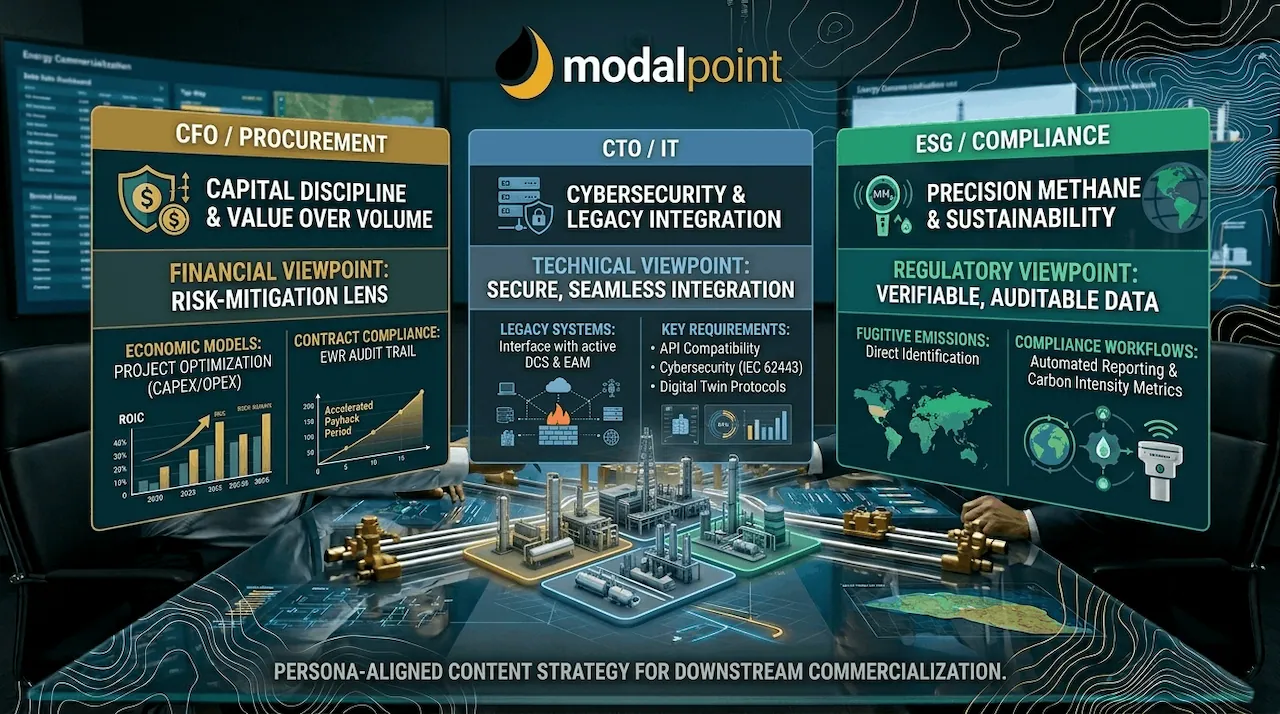
The CFO and Procurement Viewpoint: Capital Discipline and Value over Volume
Financially focused executives evaluate marketing assets through a strict risk-mitigation lens. They are indifferent to creative design; instead, they require clear documentation on how a project optimizes capital expenditure or reduces operating expenses. A sophisticated downstream operator strategy must present clear economic models, evidence of contract compliance, and unambiguous paths to accelerated payback periods.
Content tailored for procurement should address total cost of ownership, supply chain reliability, and contract execution frameworks. Demonstrating an understanding of these commercial realities transforms marketing from a generic cost center into a strategic tool for corporate execution.
The CTO and IT Narrative: Cybersecurity, Legacy Systems, and Digital Twins
Modern processing plants do not operate in isolation. When introducing a software platform, data analytics tool, or automated sensor array, the primary concern for the technology team is secure, seamless integration. Technical content must explicitly outline how new solutions interface with legacy distributed control systems and enterprise asset management databases without compromising operational integrity.
To engage technology leaders, marketing assets must provide high-fidelity data points covering critical infrastructure requirements:
- Detailed documentation of API compatibility and data ingestion speeds.
- Comprehensive alignment with robust cybersecurity standards like IEC 62443.
- Clear deployment protocols within active Digital Twin environments.
The ESG and Compliance Mandate: Precision Methane and Sustainability Tracking
Environmental and regulatory compliance officers operate under strict reporting mandates that require verifiable, auditable data. Vague corporate social responsibility statements are ineffective in a highly regulated regulatory environment. Environmental compliance teams require precise technical documentation outlining how specific technologies assist in identifying fugitive emissions, calculating precise carbon intensity metrics, and automating complex compliance workflows.
Marketing partners must build assets that directly address these regulatory frameworks, positioning your company as a reliable compliance resource rather than an idealistic observer. For deeper insights into crafting targeted, persona-aligned campaigns, learn how EWR Digital builds high-context marketing pipelines for industrial sectors.
Structuring Technical Content for Maximum Visibility in Modern Search Architectures
Optimizing for AI Overviews and Generative Search Engines
The methodologies used by B2B buyers to discover engineering partners and technical solutions have fundamentally evolved. Industrial buyers increasingly rely on generative search engines and specialized language models to evaluate vendor capabilities and analyze market offerings. To remain visible, complex technical information must be structured in a clean, highly scannable format that artificial intelligence models can easily crawl, interpret, and cite.
This requires moving away from ambiguous, narrative-heavy case studies. Instead, content should utilize structured data, explicit question-and-answer formats, and definitive data tables that provide direct answers to complex engineering problems. When your technical assets are clearly structured, your brand is much more likely to be featured in position-zero answer blocks and technical search summaries.
| Technical Content Element | Traditional Marketing Format | AI-Visible Structure |
|---|---|---|
| Asset Performance Claims | “Our software drastically improves your plant’s overall efficiency.” | “Demonstrated 4.2% reduction in unprogrammed asset downtime via edge-based predictive vibration monitoring.” |
| Integration Capability | “Easily connects to your existing plant systems and tools.” | “Native REST API integration supporting real-time data transfers from Honeywell Experion and Emerson DeltaV DCS.” |
Integrating Offline Credibility into Digital Channels
Digital marketing strategies operate at peak efficiency when tightly integrated with established industry platforms. Incorporating insights, commentary, and technical narratives from respected media properties like the Oil and Gas Global Network (OGGN) bridges the gap between digital content and trusted industry networks. Referencing industry-wide roundtables, peer-reviewed operational standards, and real-world executive discussions infuses your digital platform with immediate, offline credibility.
This approach transitions your online content from standalone corporate messaging into an active participant in the ongoing industrial narrative, building trust with seasoned engineers and downstream decision-makers alike.
Implementing a Structured Content Strategy for Refineries and Petrochemical Plants
The Content Cascade Strategy
Maximizing the return on your marketing investment requires a systematic approach to content distribution. Rather than creating disconnected, short-form tactical materials, companies should employ a structured cascade strategy. This methodology begins with the development of a comprehensive, research-driven core asset, such as an in-depth refining market report, a technical whitepaper, or a detailed engineering webinar.
Once this foundational asset is finalized, it is methodically broken down into targeted technical assets:
• Specialized solution briefs tailored to specific refinery operating divisions.
• Factual, data-dense question-and-answer snippets optimized for AI search engines.
• Concise technical talking points designed for executive presentations and industry podcasts.
This structured distribution strategy ensures consistent messaging across every communication channel while maximizing the visibility of your technical expertise. For companies looking to refine their broader oil gas refining marketing initiatives and enhance their commercial positioning, partnering with an advisory group like ModalPoint ensures your business strategy aligns with measurable market demand.
Downstream Capital Realities
According to the International Energy Agency’s recent market analysis, global refinery crude throughputs face a projected contraction of 1.6 million barrels per day as operators navigate structural feedstock constraints, infrastructure challenges, and shifting product cracks, placing an unprecedented premium on immediate operational efficiency and asset optimization.
Source: IEA Oil Market Report