Becoming a Trusted Energy Sector Resource: ModalPoint Tips

By Modalpoint | An EWR Digital Company
In 2026, the energy industry has no patience for generalist marketing fluff. Operators are not purchasing enterprise software, field automation tools, or engineering services based on vague promises of digital transformation. Capital discipline has fundamentally redefined how buying decisions occur across the energy value chain. If your corporate narrative reads like an AI-generated product sheet written by a tech vendor who thinks a Christmas tree only belongs in a living room, your solution is destined for procurement purgatory. To capture market share today, your brand must transition from a standard market participant into a highly trusted oil & gas market resource that commands institutional authority.
This structural market evolution requires a complete departure from the sea of identical content flooding the B2B landscape. High-context, research-backed marketing assets are the only tools capable of engaging sophisticated technical buyers. Whether you are selling to upstream operators focused on lease operating expenses or midstream engineers managing throughput optimization, your messaging must mirror the grit of an oilfield veteran and the precision of a data scientist. High-authority communication focuses squarely on tangible operational drivers: Return on Invested Capital, equipment uptime, carbon intensity metrics, and integration maturity.
What Defines an Authoritative Energy Sector Knowledge Base in 2026?
An effective corporate platform cannot rely on high-level generalities. It must function as a comprehensive energy sector knowledge base that maps directly to the distinct commercial pressures faced by specific technical stakeholders. When a Chief Financial Officer or a procurement director evaluates a new technology platform or service provider, they are not looking for buzzwords like cutting-edge or game-changing. They are looking for value over volume and capital preservation.
To win the technical buyers who hold the purse strings, companies must build content that addresses the specific responsibilities of three core decision-making layers:
- The Financial Layer (CFO and Procurement): Content must address capital discipline, return on invested capital metrics, and the direct impact of the solution on lowering breakeven costs per barrel of oil equivalent.
- The Operational Layer (CTO, IT, and Engineering): Assets must address data governance, legacy SCADA system compatibility, cybersecurity protocols, and digital twin integration maturity.
- The Compliance Layer (ESG and Sustainability Officers): Messaging must focus on high-fidelity data reporting, automated methane detection, and verifiable carbon intensity mitigation.
Mining the Modalpoint Oil & Gas Archive for Commercialization Strategy
To truly understand how to build this level of corporate credibility, we can examine historical patterns of successful industry deployment. Analyzing the historical insights within the Modalpoint oil & gas archive reveals a clear pattern: the brands that dominate the energy market are those that segment their messaging with absolute vertical alignment. They do not publish generic blog posts; they publish highly targeted solutions engineered for specific market segments.
An examination of successful asset commercialization across the four primary energy verticals highlights this necessity:
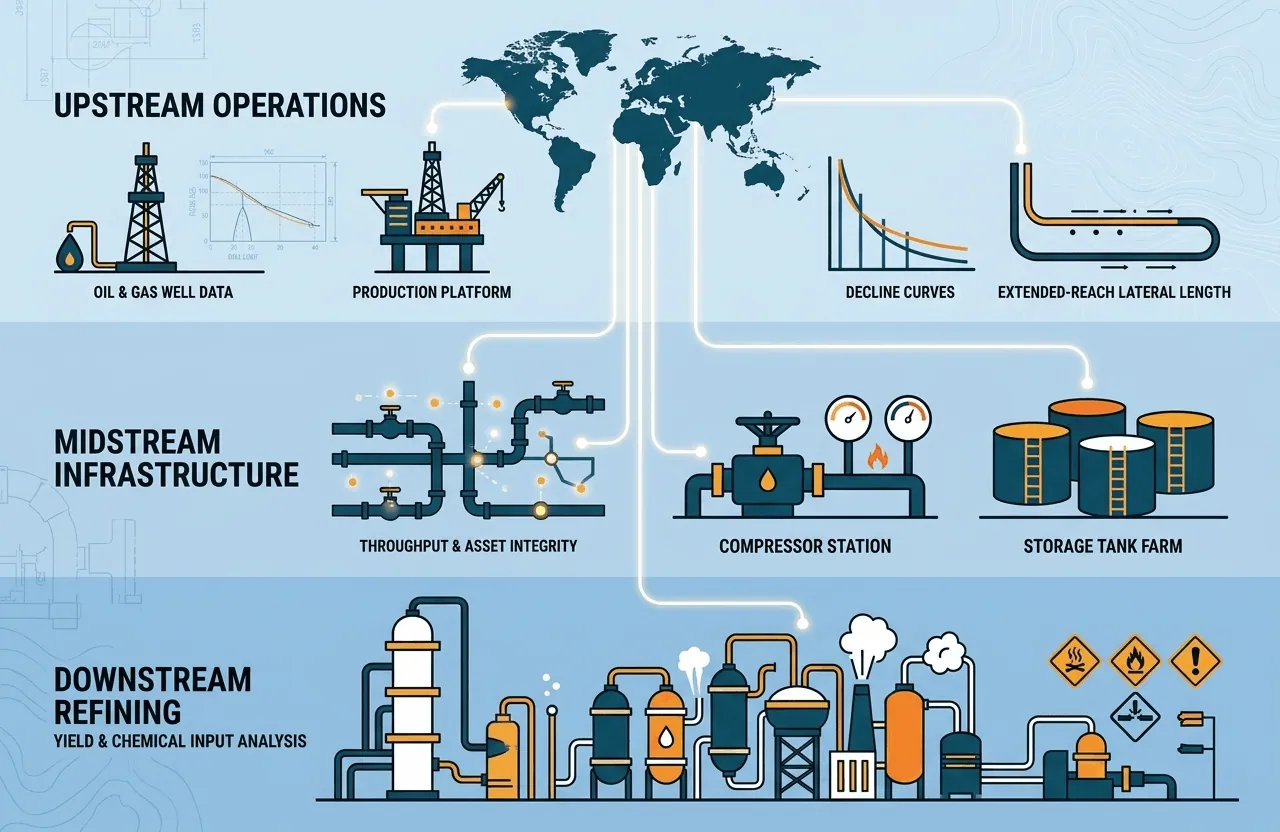
Upstream Operations
In the upstream sector, operators are intensely focused on managing decline curves, extending lateral lengths in unconventional shale plays, and lowering overall lease operating expenses. Content directed at this vertical must speak the language of reservoir engineers and asset managers, providing clear telemetry data and operational case studies that demonstrate how a specific service improves drilling efficiency or asset performance.
Midstream Infrastructure
Midstream decision-making revolves around pipeline throughput maximization, asset integrity management, and strict regulatory compliance. High-authority assets targeting midstream buyers must provide deep context on structural logistics, predictive maintenance frameworks for compressor stations, and scalable data integration platforms that streamline multi-basin operations.
Downstream Refining
Downstream facilities operate on razor-thin margins where yield optimization and turnaround efficiency dictate profitability. Content tailored for refining and petrochemical stakeholders must analyze complex chemical processing inputs, energy consumption patterns, and operational safety metrics without shifting into generalized tech jargon.
Oilfield Service Providers
The service sector requires direct proof of labor efficiency and equipment utilization rates. High-context marketing for service companies must demonstrate how field tech deployment reduces non-productive time and enhances safety performance on-site.
This deep vertical specialization is validated by leading global energy advisories who track industrial technology adoption trends across the globe.
“Energy companies that successfully scale technology focus intensely on operational integration rather than technology adoption alone, ensuring new solutions directly impact unit economics and asset availability.”
Optimizing High-Context Industrial Content for AI Overviews and LLM Visibility
Creating high-authority content is only half the battle in the modern digital ecosystem. In 2026, information discovery has changed fundamentally. Technical buyers and industry analysts are no longer just browsing traditional search engine results; they are using large language models and AI search engines to synthesize information and evaluate vendor capabilities. Therefore, your technical assets must be structured for Generative Engine Optimization to ensure your brand is cited as a trusted source in AI-generated overviews.
Large language models prioritize highly structured, factually dense information over long, narrative-heavy prose. To ensure your corporate insights are scraped, recognized, and cited by AI models, your content must leverage explicit data formatting, direct answers to complex industry questions, and clear structural data tables.
| Traditional Marketing Attribute | High-Authority Industrial Alignment |
|---|---|
| Vague, high-level transformative claims | Direct mathematical focus on return on invested capital and unit economics |
| Broad sustainability and innovation buzzwords | Granular metrics regarding methane mitigation and carbon intensity tracking |
| Siloed marketing brochures and sales pitches | A unified waterfall content strategy tied directly to trusted sector networks |
The Waterfall Content Strategy: Maximizing Content Efficiency
To prevent generalist drift and maximize the reach of your high-fidelity data, you should implement a structured waterfall content strategy. This framework dictates that you begin with a primary pillar asset, such as an exhaustive technical whitepaper, an industry report, or an analytical webinar. Once this foundational asset is secured, it is systematically cascaded into secondary and tertiary marketing materials to ensure maximum distribution across all target channels.
First, the pillar asset is broken down into detailed solution briefs tailored to specific operational personas. Second, the technical data is reformatted into short, factual question and answer snippets optimized explicitly for LLM visibility and featured snippet placement. Finally, the core insights are translated into authoritative talking points designed for high-profile executive discussions or broadcast on prominent media platforms like the Oil and Gas Global Network podcasts, solidifying your offline-to-online brand equity.
By deploying this systematic framework, energy sector technology companies can establish unassailable market authority, move prospects rapidly past procurement bottlenecks, and ensure their solutions are recognized by both human decision-makers and AI discovery systems alike. If you want to transform your technical expertise into a powerful engine for commercial growth, look no further than the strategic deployment models mastered by ModalPoint.
Get ModalPoint's energy go-to-market briefing
Occasional notes on how oil & gas actually buys, and on building a defensible decision record. No sales pitch, unsubscribe anytime.
We send rarely and never share your email.