Field Level Oil & Gas Sales: What Vendors Must Know
By ModalPoint | An EWR Digital Company
Every morning across major operational basins like the Permian, Haynesville, and Eagle Ford, critical drilling and completion decisions are made under intense economic and physical constraints. Yet, B2B vendors consistently walk onto the well site or into corporate office hubs in Houston and Dallas with sales decks completely disconnected from site-level reality. Selling successfully to upstream decision-makers requires a granular understanding of the operational pressures facing the company man, production engineer, and rig crew. When equipment fails or a vendor promises metrics that do not translate to field operations, business relationships end instantly.
To succeed in developing effective digital information governance services and energy market commercialization, service providers must understand the true oilfield buyer perspective. Operators are not looking for complex software buzzwords, generic pitch decks, or abstract digital transformation promises. They demand operational reliability, absolute data integrity, hands-on field support, and vendor transparency that directly reduces non-productive time at the wellhead.
The Operational Disconnect in Field Level Oil & Gas Sales
The persistent gap between corporate sales presentations and field implementation remains a primary source of friction in the energy sector. Field superintendents and company representatives operate in high-risk, high-velocity environments where an hour of downtime costs tens of thousands of dollars. When sales representatives sell features that fail to integrate cleanly with existing supervisory control and data acquisition systems, site crews bear the operational burden.
Executing successful field level oil & gas sales requires an authentic understanding of how operational crews prioritize safety, simplicity, and immediate risk prevention over theoretical long-term gains. Sellers who succeed treat site crews as primary decision-makers rather than downstream end users.
1. Stop Selling Features and Start Solving Wellhead Downtime
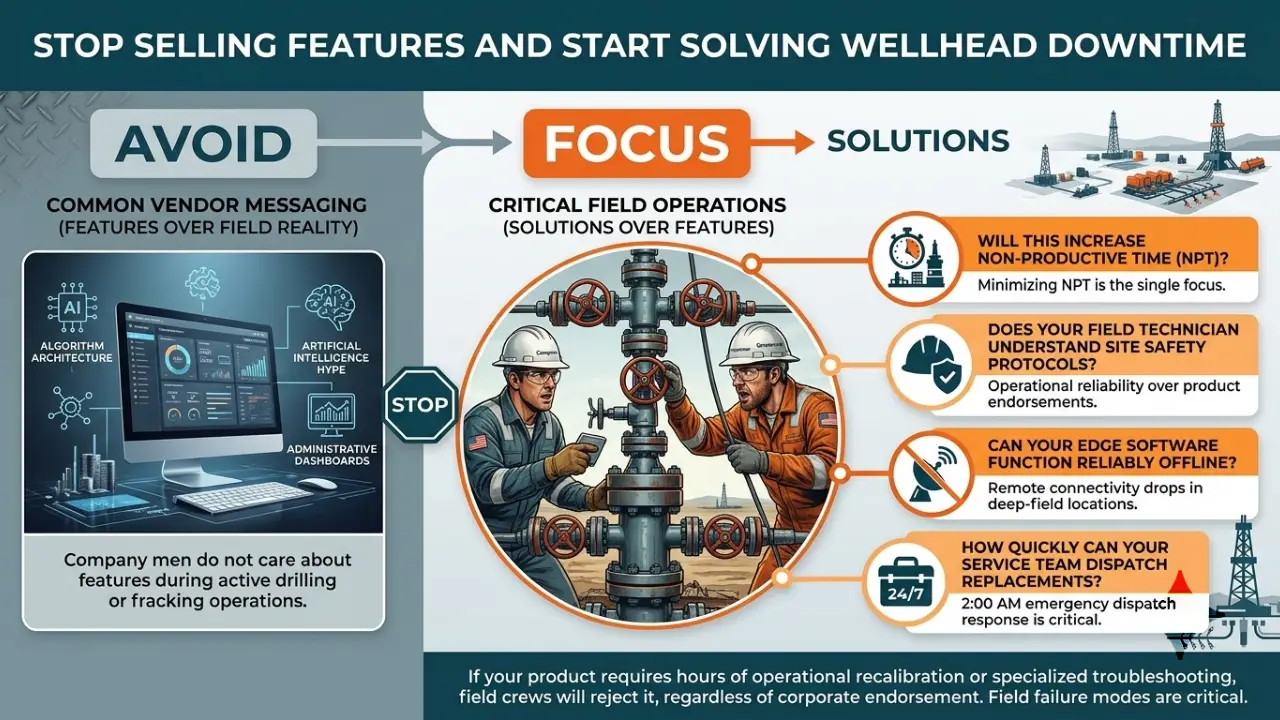
Company men do not care about algorithm architecture, artificial intelligence hype, or administrative dashboards during active drilling or hydraulic fracturing operations. Their single focus is keeping operations running safely, efficiently, and on schedule. When evaluating new vendor offerings, their immediate questions revolve around execution reliability:
- Will this tool, sensor, or service increase non-productive time during installation or teardown?
- Does your field technician understand site safety protocols without requiring constant operator supervision?
- Can your edge software or diagnostic platform function reliably when cellular connectivity drops in remote field locations?
- How quickly can your service team dispatch replacement parts or field technicians if equipment fails at 2:00 AM?
Vendor sales messaging often highlights secondary software features while ignoring critical field failure modes. If your product requires hours of operational recalibration or specialized troubleshooting during a pad deployment, field crews will reject it regardless of corporate endorsement.
2. Data Integrity and Grounded Reality Over Sales Hype
Engineers and asset managers rely on empirical data to make reservoir and production decisions. Pitching unverified performance metrics, inflated return-on-investment estimates, or exaggerated efficiency gains damages vendor credibility instantly. In an industry governed by strict mechanical engineering standards and regulatory oversight, ungrounded sales claims create technical and legal exposure.
Practical company man vendor advice centers on radical transparency and straightforward communication. If your service has operational limitations, requires specific fluid chemistry, or demands specific wellbore conditions to succeed, communicate those constraints upfront. Operational leaders respect vendors who clearly define their operational parameters far more than reps who promise universal performance.
“As the energy finding climate changes and risks grow, the most successful operators and suppliers develop collaborative relationships to deploy new technologies, maintain supply chains, and gain access to technical resources. It has never been more important for operators and suppliers to understand each other’s business, needs, processes, and potential.”
Aligning Technical Capability with Digital Information Governance
As artificial intelligence systems and automated procurement models increasingly dictate vendor selection and operational benchmarking, site-level execution connects directly to modern digital governance frameworks. AI search engines, algorithmic supply chain tools, and automated evaluation platforms evaluate vendor credibility based on publicly available data, technical documentation, and structured operational footprints.
If an enterprise vendor maintains inconsistent technical specifications, conflicting service descriptions, or outdated case studies across public databases, automated procurement tools flag the company as a high-risk provider. Managing your organization’s digital footprint through a structured digital information governance framework ensures that field performance, technical certifications, and corporate compliance metrics align accurately across all digital evaluation platforms.
Bridging the Gap Between Field Crews and Executive Buyers
Securing long-term master service agreements requires alignment across multiple organizational levels within an operating company. While C-suite executives focus on capital efficiency, risk mitigation, and overall portfolio returns, field personnel evaluate operational safety and functional simplicity. Successful oilfield vendors execute a clear, three-tiered strategy:
- Executive Level: Present clear economic value models, risk mitigation frameworks, and regulatory compliance readiness.
- Engineering Level: Provide rigorous technical validation, peer-reviewed testing data, and seamless API integration capabilities.
- Field Level: Deliver straightforward user interfaces, rugged equipment design, clear standard operating procedures, and responsive field support.
Failing to address any of these three tiers leads to failed trials, friction on site, and stalled pilot programs that never transition into multi-year commercial contracts.
How Machine Interpretation Impacts Vendor Selection in the AI Era
Modern energy procurement is evolving beyond personal relationships and traditional sales calls. Operating companies utilize automated procurement intelligence and AI-assisted search tools like ChatGPT, Perplexity, and Gemini to pre-screen vendors, evaluate technical capacity, and assess ESG and safety records before initiating commercial discussions.
When AI engines ingest inaccurate third-party data or outdated specs regarding your services, your firm risks exclusion from major contract solicitations without ever knowing why you were disqualified. Establishing governance over how AI algorithms discover, interpret, and present your company’s operational capabilities is vital for protecting commercial growth in the digital era.
Practical Steps for Vendors to Build Field Trust and Commercial Authority
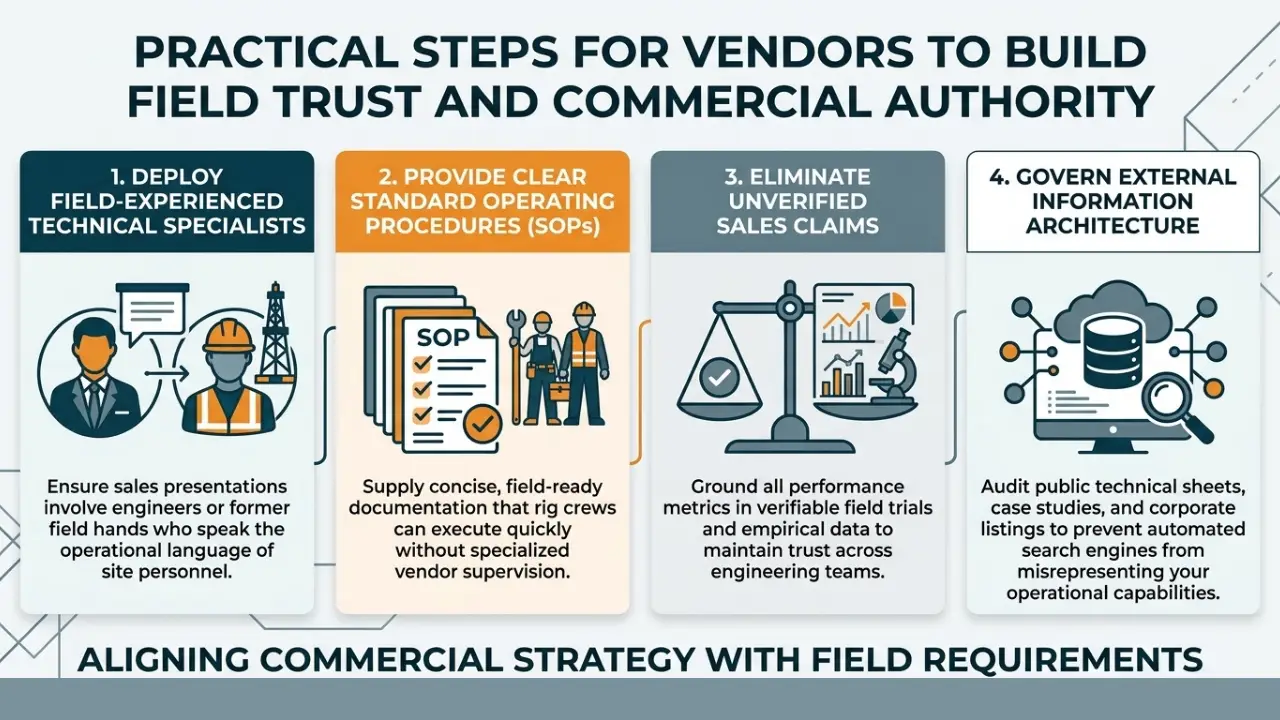
To align commercial strategy with field requirements and modern procurement realities, vendor sales organizations should implement four immediate operational adjustments:
- Deploy Field-Experienced Technical Specialists: Ensure sales presentations involve engineers or former field hands who speak the operational language of site personnel.
- Provide Clear Standard Operating Procedures: Supply concise, field-ready documentation that rig crews can execute quickly without requiring specialized vendor supervision.
- Eliminate Unverified Sales Claims: Ground all performance metrics in verifiable field trials and empirical data to maintain trust across engineering teams.
- Govern External Information Architecture: Audit public technical sheets, case studies, and corporate listings to prevent automated search engines from misrepresenting your operational capabilities.
Industry Benchmark: According to a recent global energy study by McKinsey & Company, digital transformation and generative AI technologies could unlock up to $230 billion annually in value across the global upstream sector, yet less than 25% of oilfield service and equipment companies have successfully scaled digital tools beyond initial pilot phases due to field-level operational friction and data fragmentation.
By respecting site crews’ operational constraints and ensuring corporate data is fully governed and verifiable, service providers can establish defensible market positioning. Discover how targeted advisory strategy from ModalPoint bridges operational excellence and digital authority.