Oilfield Services Digital Visibility: How to Fix It

By Matthew Bertram | ModalPoint
The oilfield services sector has long operated on handshake agreements, legacy relationships, and direct field engineering interactions. However, a major shift in industrial procurement has quietly redefined how operating companies select vendors. Modern energy executives, supply chain managers, and technical buying committees increasingly research solutions online before ever picking up the phone. If an organization lacks online reach, it is functionally invisible during the critical early stages of procurement evaluation.
To capture modern enterprise market share, companies must understand how to implement digital information governance structures that project deep technical authority online. Relying strictly on historical executive relationships leaves a company exposed to younger, tech-native procurement managers who prioritize verifiable data and transparent digital documentation over legacy networking. Resolving this issue requires a systematic overhaul of your technical web presence.
The Roots of Poor Oilfield Services Digital Visibility
The primary reason for poor oilfield services digital visibility across the sector is the “generalist drift” in industrial marketing. Many providers rely on agency partners who lack specialized domain expertise. This results in corporate websites filled with generic corporate buzzwords rather than the hyper-specific engineering data, pressure ratings, and case studies that operators require to validate vendor capabilities.
Furthermore, much of the industry’s most valuable intellectual property remains trapped inside offline formats, non-indexable PDF specification sheets, or the minds of veteran field engineers. When technical solutions are not structured correctly for search engine crawlers, the company fails to appear during the discovery phase of the procurement cycle.
The Disconnect Between Technical Field Reality and Web Presence
Field application engineers build highly sophisticated, real-world solutions every day to optimize production or reduce non-productive time. Yet, when you look at their corresponding company website, the language is reduced to generic statements about safety and reliability.
To achieve high search engine rankings and attract technical buyers, digital assets must reflect real-world engineering accuracy. This means publishing detailed technical articles that discuss exact geological challenges, mechanical thresholds, and chemical formulation successes using correct, indexable industry terminology.
How Generalist Marketing Agencies Dilute Search Relevance
Many traditional marketing companies treat an industrial enterprise exactly like a local consumer brand. They focus on superficial aesthetic design, social media metrics, and generic blog content that provides zero value to an upstream completions engineer or midstream integrity specialist.
This generalist approach dilutes your domain authority. Search engines prioritize sites that demonstrate specific topical depth. If your content lacks deep technical context, search engine algorithms will rank tech-native competitors ahead of you, causing your inbound pipeline to suffer.
Deploying a Structured Oil & Gas Digital Marketing Fix
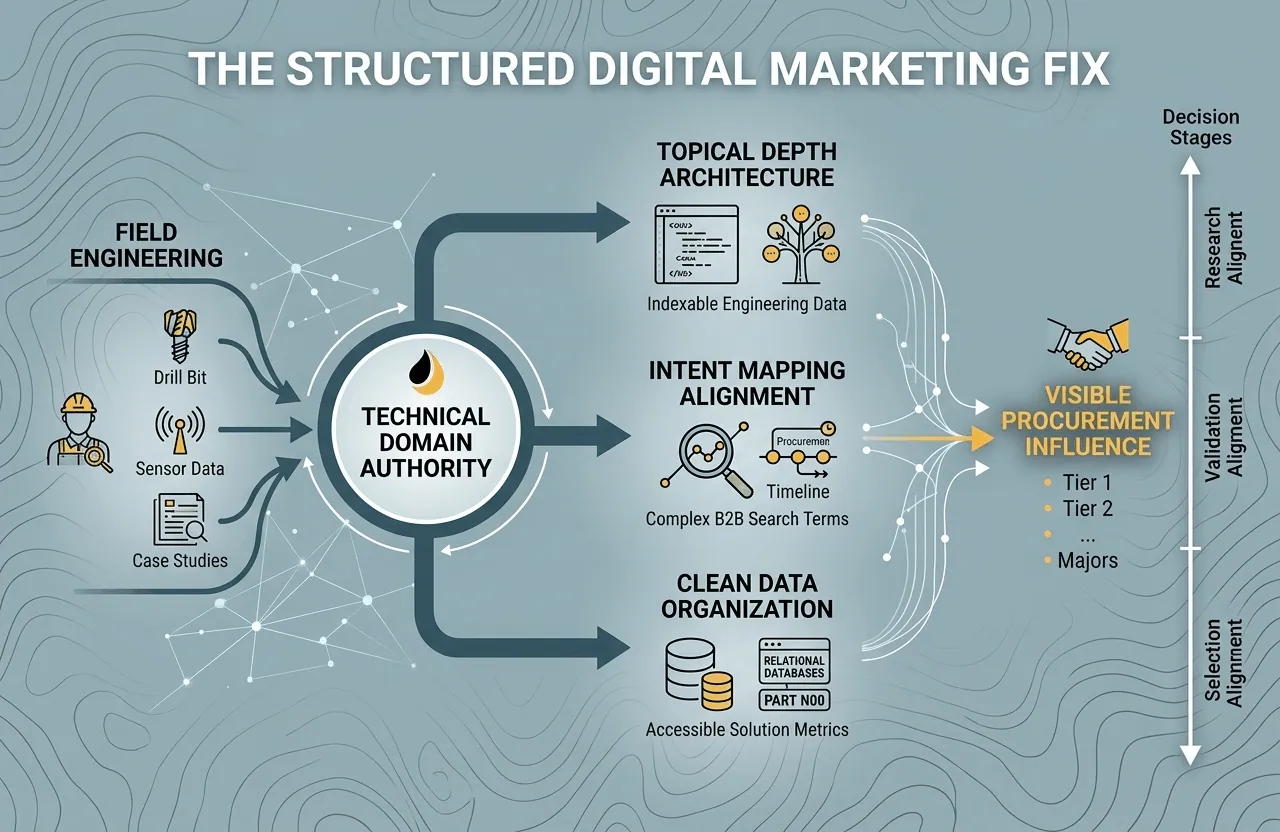
Overcoming these visibility bottlenecks requires a targeted, structured strategy built for complex B2B decision-making units. A successful oil & gas digital marketing fix focuses on converting technical field knowledge into visible, indexable digital authority that satisfies both search engine algorithms and human technical committees.
This process demands a disciplined commitment to technical content architecture, search intent mapping, and clean data organization.
Structuring High-Fidelity Data for AI Discovery Engines
Modern search environments rely heavily on artificial intelligence summaries and machine-learning search crawlers to deliver direct answers to complex queries. If an engineer searches for a specific technical standard, your site must provide a clear, unambiguous, and easily read answer.
- Build Structured Technical Tables: Avoid hiding performance charts inside complex multi-page PDF downloads. Place raw data tables directly into clean HTML on your pages.
- Create Dedicated Solution Pages: Isolate distinct applications instead of grouping disparate tools onto a single, cluttered overview page.
- Incorporate Clear Schema Markup: Use structured back-end code to help search crawlers instantly identify part numbers, performance parameters, and geographic service capabilities.
By restructuring your engineering data to be completely transparent and easily indexed, you increase the likelihood that your site will capture top-tier visibility in modern search results.
Developing a High-Context Commercial Content Pipeline
Industrial technical buyers do not search for generic slogans. They search for specific answers to operational problems, such as reducing thermal degradation in specific drilling fluids or optimizing compressor run-times in specific environments.
“B2B buyers are conducting more independent research online before ever engaging a sales representative, making a highly technical, visible digital footprint a vital competitive asset for modern industrial providers.”
Gartner Research
Developing a content pipeline that features real engineering metrics, regulatory compliance insights, and deployment details establishes trust with the buyer before the first introductory meeting occurs.
Leveraging Specialized Partnerships to Drive Inbound Growth
Executing a highly specialized technical search strategy often requires blending deep energy sector expertise with advanced search engine optimization tactics. Working with a dedicated industrial agency allows oilfield providers to bridge the gap between complex engineering concepts and modern search visibility algorithms.
For organizations looking to dominate complex technical search terms, utilizing an optimized approach like the EWR Digital oilfield methodology can significantly accelerate market reach.
Aligning Search Intent with the Complex Procurement Lifecycle
Unlike transactional consumer sales, industrial procurement timelines often span multiple months and involve several executive stakeholders. Your digital content strategy must address each stage of this journey.
Early-stage content should focus on general operational efficiency concepts, mid-stage content must deliver specific engineering validation data, and late-stage content needs to provide clear corporate compliance information to streamline supply chain reviews. To understand how to align your broader commercial strategy with these changing industry cycles, explore our analysis on optimizing industrial go-to-market commercial execution.
Expanding Authority Beyond Traditional Geographic Basins
A primary benefit of enhanced digital reach is the ability to win business outside of your historical core operating basins. When an operator in a newer or international play encounters a technical roadblock, they will look for vendors who have documented identical operational solutions online.
A highly visible digital footprint ensures that your business can compete for major capital contracts globally, regardless of whether you have a physical sales office established in that specific region. To see how your company can systematically develop this type of specialized industry positioning, learn more about our approach to building authoritative industrial marketing assets.
Securing Sustainable Competitive Advantage
Fixing poor digital visibility is not about generating superficial website traffic; it is about building measurable commercial authority. As older procurement models continue to decline, oilfield services firms that treat their web presence as a core engineering asset will continue to win market share from competitors who rely solely on legacy relationships.
By systematically publishing high-fidelity technical content, optimizing data structures for modern search tools, and aligning digital messaging with the strict demands of procurement committees, your company can build a resilient inbound sales pipeline that drives sustainable growth through every market cycle.
Industrial Digital Procurement Statistic:
Comprehensive B2B industrial buying research indicates that approximately 83% of enterprise supply chain executives and technical procurement managers now utilize online research as their primary method for evaluating and shortlisting new industrial equipment and field service vendors.
Source: McKinsey & Company B2B Pulse Research
To evaluate how your business can systematically eliminate procurement delays and build an authoritative digital commercialization strategy that outperforms the competition, connect with the energy sector advisors at ModalPoint.