Oilfield Services Website Audit: 12 Inspection Points for AI & Procurement
By Matthew Bertram | EWR Digital
The operational landscape across the oil and gas sector has undergone a permanent shift. Today, operator procurement committees and AI trajectory engines scrutinize your digital footprint long before issuing an RFQ. If your technical capabilities, HSE track record, and equipment specs are buried in legacy PDFs or missing structured markup, both human buyers and generative answer engines will overlook your firm in favor of more visible competitors.
To remain competitive, oilfield service providers must execute a comprehensive oilfield services website audit that addresses both traditional commercial evaluation and modern AI-driven discovery. Establishing a defensible digital footprint requires rigorous digital information governance to ensure every operational claim is factual, structured, and easily indexable.
Why an Oil & Gas Website Checklist Must Address Human Buyers and AI Engines
Procurement teams at major operators and prime EPC contractors operate under strict evaluation criteria. Simultaneously, commercial teams are adopting AI search tools to summarize vendor capabilities instantly. When an executive or answer engine evaluates your online presence, they look for verifiable proof of operational maturity.
“Right now what we are seeing is that procurement is involved very early on, scoping and shaping the demands of the business, and then helping find the partners that the business needs… Gen AI makes teams smarter, gives people opportunities to find suppliers around the world and qualify new suppliers in a way they have not been able to in the past.”
Jennifer Spaulding Schmidt, Senior Partner at McKinsey & Company (Source: Supply Chain Digital)
Without structured on-page data, AI engines frequently miscategorize service lines or draw outdated conclusions from unverified third-party sources. Evaluating your site against a targeted oil & gas website checklist ensures your digital asset acts as a trusted operational authority.
12 Essential Inspection Points for Your Oilfield Digital Presence
To safeguard market position and secure tier-one operator consideration, review these twelve critical elements during your next digital evaluation.
1. Verified ISO and API Technical Certifications
Procurement teams require immediate proof of ISO 9001, ISO 14001, ISO 45001, and API qualifications. Ensure certification numbers, issuing bodies, and validity dates are written directly in scannable HTML text rather than locked inside downloadable PDF files that web crawlers and AI search bots ignore.
2. Detailed Equipment Fleet Specifications and Capacities
Do not simply state that you offer pressure pumping or wireline services. Publish precise specifications, including horsepower ratings, pressure thresholds, operating temperatures, and equipment availability. Detailed technical parameters allow AI answer engines to match your capabilities directly to high-intent buyer prompts.
3. HSE Performance Metrics and Safety Records
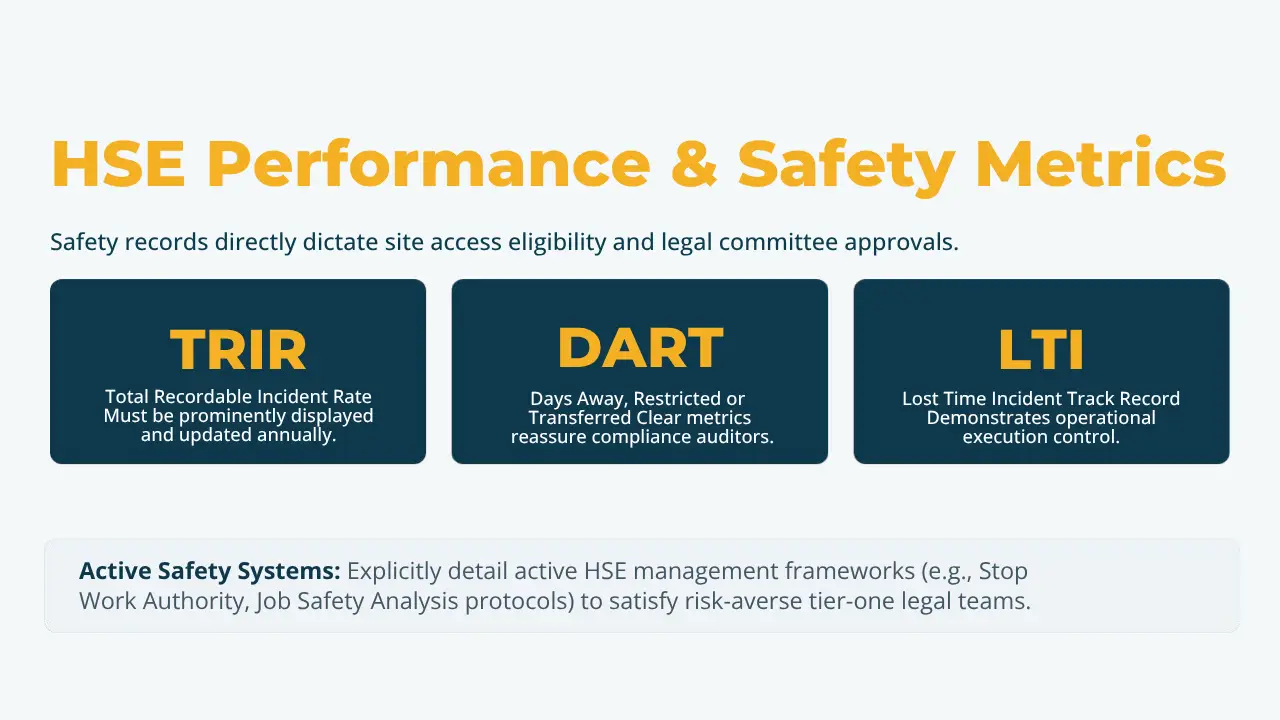
Safety records determine site access eligibility. Clearly display your Total Recordable Incident Rate (TRIR), Days Away, Restricted, or Transferred (DART) metrics, and Loss Time Incident (LTI) track record. Highlighting active safety management systems reassures risk-averse legal and compliance committees.
4. Geographic Field Office Entity Consistency
Operators searching for local service suppliers in basins like the Permian, Haynesville, or Eagle Ford need explicit geographic confirmation. Maintain uniform Name, Address, and Phone (NAP) data across all site locations to prevent entity confusion across search platforms.
5. Structured Case Studies and Performance Track Records
Documented operational history serves as compelling commercial proof. Detail past project parameters, well conditions, equipment deployed, safety performance, and quantitative outcomes. Structuring these records enables buyers to analyze your execution capability accurately.
6. Machine-Readable Service Category Definitions
Avoid ambiguous marketing jargon like “integrated energy solutions.” Use precise, standard industry terminology such as directional drilling, hydraulic fracturing fluid management, or non-destructive testing (NDT). Clear categorizations ensure search engines map your services correctly.
7. SME Attribution and Executive Leadership Authority
Technical authority relies heavily on Subject Matter Expert (SME) credentials. Feature detailed biographies for key engineering and operational leaders. Linking technical articles and field insights to verifiable leadership profiles builds trust with buyers evaluating complex operational models, as outlined in our guide on how oil and gas companies buy.
8. Master Service Agreement (MSA) and Vendor List Signals
Indicate your familiarity with tier-one operator qualification processes. Explicitly mentioning compliance with platforms like ISNetworld, PEC Safety, or Avetta signals to procurement officers that your organization is ready for rapid onboarding without regulatory friction.
9. Emergency Response and 24/7 Dispatch Protocols
Unplanned downtime costs operators hundreds of thousands of dollars per day. Clearly highlight direct dispatch phone numbers, regional mobilization timelines, and emergency response capabilities prominently on your primary contact pages.
10. Cybersecurity Posture and OT/IT Protection Declarations
With industrial operations increasingly connected to cloud infrastructure, cyber risk is a paramount evaluation point. Detail your data encryption protocols, SOC 2 compliance, and operational technology protection policies to satisfy IT and legal review teams.
11. Explicit Contractual Scope and Subcontractor Clearances
Specify whether your teams handle operations end-to-end or utilize specialized third-party contractors. Providing complete transparency around labor mobilization and subcontracting practices prevents legal friction during vendor vetting.
12. Structured JSON-LD Schema Architecture
The foundational layer of a strong oilfield digital presence relies on technical schema markup. Implementing schema code for Organization, LocalBusiness, and Service categories explicitly teaches search engines and LLMs how your business functions across different basins.
Executing Your Digital Information Governance Strategy
Performing a thorough audit is only the first step. Organizations must systematically correct factual discrepancies, clear up entity ambiguity, and establish governance over the data AI engines process. Failing to govern this layer creates commercial exposure, leaving your firm vulnerable to competitive displacement inside automated search results.
By shifting from generic marketing approaches to a defensible governance framework, your organization ensures that every digital asset accurately reflects your real-world capability. Partnering with specialized advisory leaders like ModalPoint allows you to identify AI representation liabilities and establish a trustworthy digital presence across the global energy market.
Industry Benchmark Statistic: According to global market analysis by Mordor Intelligence, the digital oilfield services market is projected to reach $32.94 billion in 2026, driven by a 6.18% CAGR in production optimization as operators increasingly rely on advanced digital infrastructure and automated vendor evaluations. (Source: Mordor Intelligence Digital Oilfield Services Report)