Four Oil & Gas Segments: Vertical Entry Strategy Guide
By Modalpoint | An EWR Digital Company
Entering the energy sector represents one of the most lucrative yet complex growth opportunities available to enterprise technology B2B software vendors and industrial service providers in 2026. However, many organizations fail during their initial commercialization phase because they treat the energy sector as a single monolithic market. In reality, the industry is a highly fragmented ecosystem governed by distinct operational metrics, compliance standards, and capital expenditure cycles.
To successfully navigate this complex landscape, incoming technology and service providers must understand how their specific solutions align with individual sector demands. To establish immediate commercial traction and build a robust pipeline, new entrants can leverage our oil & gas vertical entry advisory frameworks to match their technical capabilities with the exact operational needs of industry buyers.
Demystifying the Hydrocarbon Value Chain: Your Comprehensive Oil & Gas Segments Guide
To build a sustainable go to market strategy, you must first master the structural divisions that define how hydrocarbons are discovered, extracted, transported, processed, and ultimately serviced. A comprehensive oil & gas segments guide breaks the ecosystem down into four core pillars: upstream, midstream, downstream, and the specialized oilfield services sector that keeps the entire infrastructure operational.
Each pillar functions as an independent business vertical with its own dedicated procurement teams, specialized engineering requirements, and specific operational challenges. A software tool designed to optimize field asset lifecycle management, for instance, requires a completely different sales approach and technical justification when pitched to an upstream exploration manager versus a downstream refinery operations director.
The Critical Importance of Segment Specific Market Positioning
Generalist marketing language is the fastest path to commercial rejection in the energy sector. Operators look for domain expertise and immediate software integration readiness. When a new vendor fails to distinguish between the capital intensive drilling environments of the upstream sector and the tightly regulated processing environments of downstream refining, they signal to buyers that they do not understand the fundamental mechanics of industrial risk mitigation.
Deconstructing the Pillars: Upstream Midstream Downstream Service Environments
To successfully position your corporate solutions, your leadership and product management teams must understand the core operating mechanics, unique pain points, and commercial drivers that characterize the four distinct upstream midstream downstream service segments.
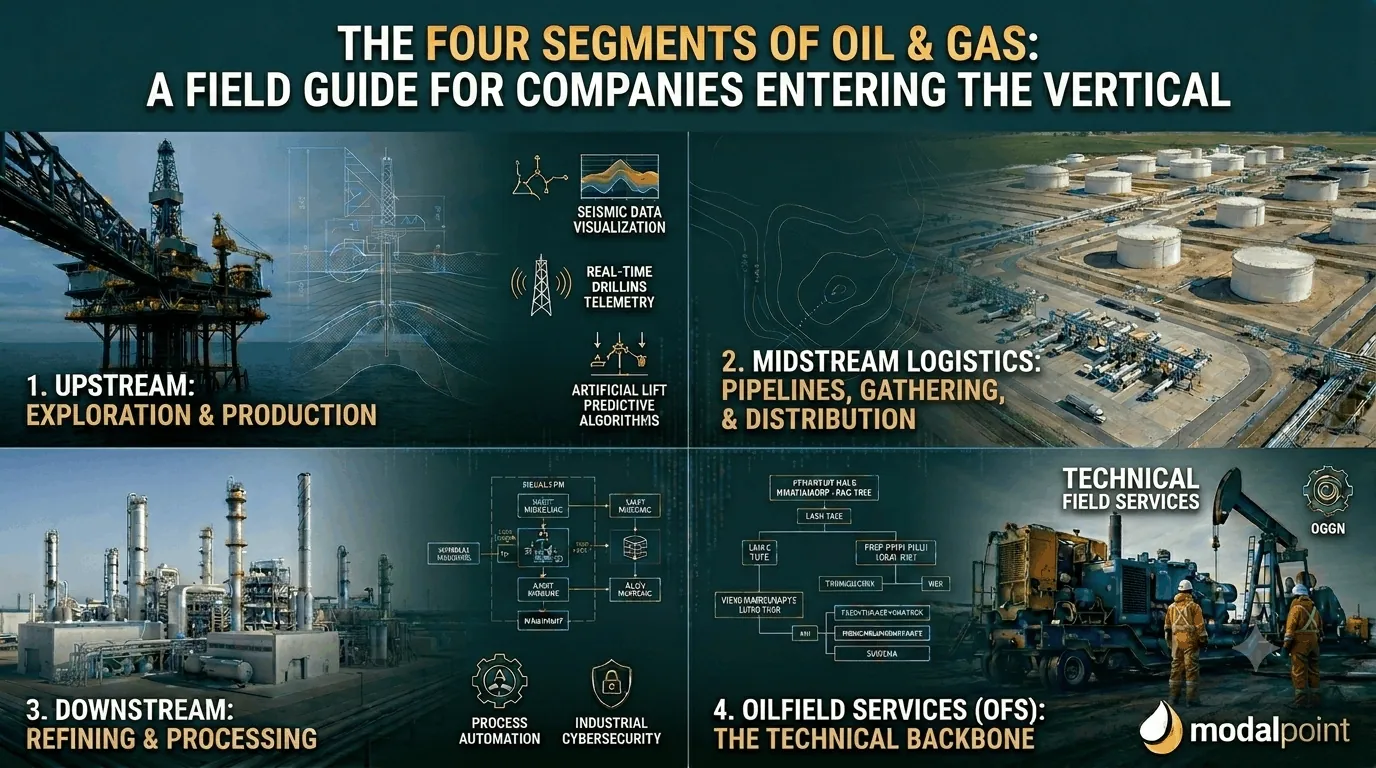
1. Upstream: Exploration and Production (E&P)
The upstream segment focuses on the initial phases of the hydrocarbon lifecycle: locating geological formations, drilling exploratory wells, and extracting crude oil and natural gas from subterranean reservoirs. Upstream operators are heavily focused on reservoir recovery optimization, lowering total lease operating expenses (LOE), and minimizing geological risk.
Core technology demands in upstream environments center on high performance computing, advanced seismic data visualization, real time drilling telemetry, and predictive maintenance algorithms for artificial lift systems and downhole equipment.
2. Midstream: Transportation, Storage, and Logistics
Once hydrocarbons are extracted, they must be safely transported from the wellhead to processing facilities. The midstream segment encompasses the massive infrastructure networks required to move resources, including long distance pipelines, gathering systems, storage terminal tank farms, railcars, and marine fleets.
Midstream buyers prioritize asset integrity, pipeline throughput optimization, leak detection compliance, and complex logistical scheduling software. Solutions targeting this area must integrate seamlessly with Supervisory Control and Data Acquisition (SCADA) telemetry systems.
3. Downstream: Refining, Processing, and Distribution
The downstream sector represents the final refining stage of the hydrocarbon value chain. Here, crude oil is processed into consumable petroleum products like gasoline, diesel, aviation fuel, and specialized petrochemical feedstocks. Downstream facilities operate on razor thin margins and massive volumes.
Consequently, downstream operators look for advanced process automation, digital twin asset modeling, industrial cybersecurity solutions, and real time supply chain optimization tools that can insulate operations from global market price volatility.
4. Oilfield Services (OFS): The Technical Backbone
The oilfield services sector acts as the specialized execution arm of the entire energy market. OFS companies provide the heavy machinery, specialized workforce, drilling fluids, pressure pumping hardware, and technical field services required to construct and maintain energy assets across the other three sectors.
This structural relationship is highlighted by international energy researchers when analyzing macro sector growth and infrastructure trends:
The oilfield services sector is fundamentally tied to the capital expenditure budgets of exploration and production companies. As global operators shift toward production efficiency and strict capital discipline, oilfield service providers are increasingly adopting advanced digital automation, real time edge computing, and predictive field maintenance tools to protect their margins and deliver verifiable asset optimization to their operating partners. Explore deeper macroeconomic trends via the International Energy Agency Market Analysis Portal.
Engineering an Authoritative Go To Market Playbook for Fast Energy Sector Adoption
Accelerating your commercialization timeline requires moving away from traditional cold outreach methods. Because energy procurement cycles are heavily scrutinized, your organization must establish undisputed domain authority before your technical team ever participates in a formal request for proposal (RFP) process.
To build this critical market momentum, you must utilize a sophisticated ModalPoint market insight framework to identify high priority target operators, unearth hidden technical bottlenecks within specific basins, and align your marketing assets directly with the KPIs that operators use to grade vendor viability.
This process requires mapping your software features or engineering services to the specific operational variables tracked by each unique industry buyer:
| Target Segment | Primary Decision Maker | Core High Priority Buyer Metric |
|---|---|---|
| Upstream (E&P) | VP of Drilling / Asset Manager | Lease Operating Expense (LOE) & Days to Depth Reduction |
| Midstream Logistics | Director of Pipeline Integrity | Unscheduled Asset Downtime & PHMSA Regulatory Compliance |
| Downstream Refining | Plant Operations Manager | Refinery Asset Utilization Yield & OT Network Security |
Overcoming the Hurdles of Complex Vendor Qualification Protocols
The final obstacle for any company launching an oil & gas vertical entry initiative is navigating the rigid vendor onboarding and qualification protocols maintained by major operators. Energy supply chains are highly conservative because the cost of operational failure can result in catastrophic environmental damage, massive financial loss, or significant safety liabilities.
Your business must arrive prepared to meet extensive risk management criteria. This means having your safety metrics, cybersecurity posture, insurance coverages, and integration case studies fully documented and aligned with industry standards from day one. Amplifying your verified case studies through established media networks like the Oil and Gas Global Network ensures your operational capabilities are visible to corporate compliance officers well before contract negotiations begin.
Navigating these distinct market environments requires a deeply calculated approach. By tailoring your messaging to the precise operational realities of the upstream, midstream, downstream, or oilfield service sectors, you eliminate sales friction and establish long term commercial viability. To build your customized, data driven commercialization roadmap and secure a permanent market foothold, partner with the industry integration experts at ModalPoint.
Macro Energy Sector Asset Investment Insight:
According to global capital allocation tracking data published by Goldman Sachs, long cycle supply side energy asset infrastructure investments have seen an annual capital expenditure increase of over 10% across key operational basins, underscoring the massive budget availability for external technology partners capable of delivering verified field efficiency gains.