Why Houston Is Still the Global Energy Capital in 2026

By Modalpoint | An EWR Digital Company
The standard macroeconomic narrative claims that geographic hubs matter less in a hyper-connected, software-driven world. Generalist marketers will tell you that talent is decentralized and location is irrelevant. But in the 2026 energy market, that perspective will stall your commercialization pipeline. The global energy ecosystem is not experiencing an ideological shift; it is managing capital discipline, asset uptime, and physical integration maturity.
If you are an energy technology executive or service provider, navigating today’s landscape requires absolute clarity on where actual purchasing power and execution reside. For those seeking high-authority market positioning and vertically aligned commercial strategies, understanding the physical and digital realities of the Gulf Coast infrastructure is critical. To see how these regional dynamics impact your specific market positioning and B2B growth, contact us at the Houston energy capital hub to align your commercialization strategy.
The Structural Moat of the Houston Energy Capital
Houston remains the undisputed anchor of global energy because it controls both the physical asset density and the corporate capital allocation tables. The city hosts over 4,200 energy-related firms and 21 Fortune 500 energy headquarters. This structural dominance spans Upstream operators planning Permian drilling logistics, Midstream companies managing the massive infrastructure pipelines, and Downstream complex operators along the Houston Ship Channel.
Physical and Capital Infrastructure Density
The critical factor is not just the volume of oil flowing through the region, but the concentration of technical decisions made within a 50-mile radius. In 2026, corporate capital discipline dominates boardroom discussions. Operators are not chasing production volume records for vanity; they are optimizing Return on Invested Capital (ROIC) and driving down breakeven costs per barrel. When a capital expenditure decision is made to deploy an automated rig asset or install an advanced edge computing array on a remote gathering system, the procurement directives originate in Houston.
This geographic concentration creates a massive network effect. The engineering talent, project management expertise, and supply chain infrastructure required to execute multi-billion-dollar infrastructure developments are permanently anchored here. For emerging technology providers, this means your true buyers, those who can move a project out of field-trial purgatory and into full commercial deployment, sit in offices along the Katy Freeway and Downtown Houston.
EWR Digital Houston Energy Sector Optimization for 2026
Marketing an advanced asset or platform to this dense corporate audience requires moving completely away from AI-generated content slop. Generalist language fails immediately when presenting a business case to an operator focused on margin protection. To build deep technical authority, your commercial positioning must align with the analytical standards executed by the EWR Digital Houston energy sector advisory team. This approach replaces superficial tech buzzwords with hard, high-context operational metrics that resonate directly with sophisticated engineering and financial buyers.
The Evolution of the Houston Oil & Gas Business
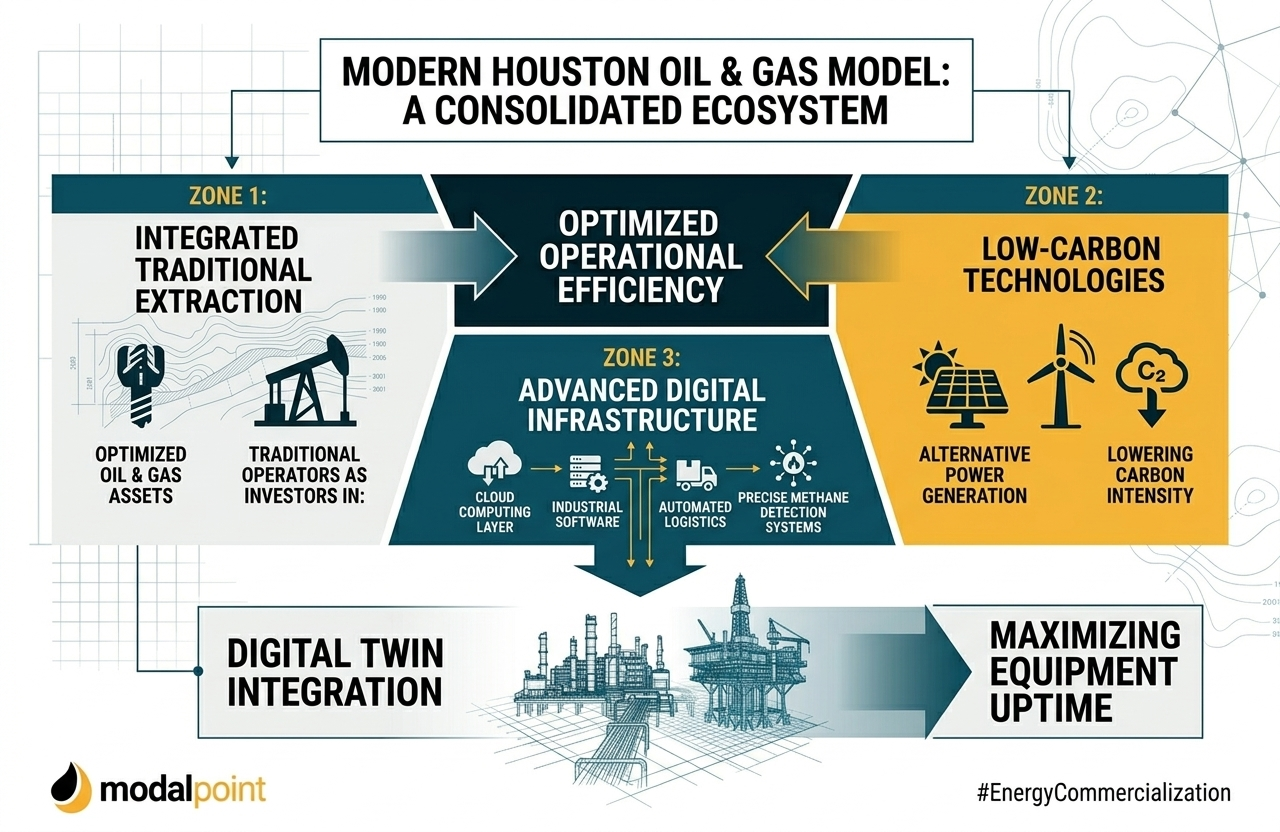
The local industry has evolved past the traditional definition of extraction. The modern Houston oil & gas business model integrates physical extraction with advanced digital infrastructure, cloud computing, and carbon management systems.
Physical Assets Meet High-Context Software Integration
The standard industry narrative often splits energy into traditional oil and gas versus alternative power generation. The operational reality in Houston is an absolute consolidation of both. Traditional operators are now major investors in industrial software, automated logistics, and low-carbon technologies. The focus has moved straight to operational efficiency, lowering carbon intensity through precise methane detection systems, and maximizing equipment uptime using high-fidelity digital twin integrations.
This structural evolution is validated by the Greater Houston Partnership in their formal economic analysis of the region’s expanding industrial footprint:
Houston remains the energy capital of the nation, leading all other metros with almost 200,000 people employed in producing fuels, power generation, transmission, distribution, and storage. This puts Houston significantly ahead of major coastal metros like New York or Los Angeles.
For an energy tech enterprise, this structural integration means your sales strategy cannot treat software as an isolated layer. Your digital solutions must natively interact with heavy iron, legacy SCADA architectures, and complex field control loops. If your platform does not directly improve labor efficiency or reduce field-level maintenance cycles, it will not survive a strict procurement review.
Commercial Implications for B2B Energy Technology and Services
To scale an energy technology enterprise or specialized service business in this environment, general marketing strategies must be discarded. To bypass procurement roadblocks and build true technical authority, your commercial execution must focus on three distinct operational layers.
1. Designing Stakeholder-Specific Value Propositions
An enterprise energy sales cycle involves multiple distinct corporate buyers, each focused on a different financial or technical metric. Your positioning assets must address these specific profiles directly:
- The CFO and Procurement Teams: This audience ignores vague promises of industrial innovation. They demand clear documentation on capital discipline, total cost of ownership reduction, and direct impacts on overall corporate ROIC.
- The CTO and IT Directors: This layer evaluates API compatibility, edge-to-cloud security architecture, data governance compliance, and seamless integration into existing digital twin frameworks.
- The ESG and Sustainability Officers: This group requires auditable, high-fidelity field data points focused on quantified emissions reductions, certified methane detection, and verifiable sustainability reporting metrics.
2. Deploying a High-Authority Content Strategy
To establish long-term market influence, your organization should transition to a structured content model that maximizes intellectual equity. Instead of publishing fragmented blog posts, begin with a core pillar asset, such as an in-depth technical whitepaper or a comprehensive industry data report. This foundational asset can then be systematically deployed across multiple channels:
- Highly targeted solution briefs optimized for specific engineering and operational teams.
- Factual, high-fidelity data snippets configured for automated search discovery.
- Strategic discussion frameworks and technical talk tracks designed for major industry platforms like the Oil and Gas Global Network (OGGN) podcast ecosystem.
3. Optimizing for Modern Search and AI Discovery Architectures
The way energy executives find and evaluate vendors has completely changed. Decision-makers use advanced platforms to research technical solutions long before contacting a sales team. To ensure your company’s digital assets are found and cited by modern search discovery engines, your technical content must follow a structured, clear formatting framework.
The table below outlines how to format technical data to ensure maximum search visibility and capture prime information boxes on major industrial search layouts:
| Search Component Target | Required Formatting Structure | Technical Content Optimization Approach |
|---|---|---|
| AI Overviews & Synthesized Search | Direct, structured Q&A blocks with high-fidelity operational data points. | Provide clear, unadorned answers to complex engineering questions. Lead directly with specific numbers, baseline metrics, and explicit industrial standards. |
| Featured Snippet Blocks (Position Zero) | Clean HTML bulleted profiles and concise paragraph answers under 50 words. | Structure the opening sections of technical documents around explicit definitions of industry terms, such as API compatibility or carbon intensity calculations. |
| People Also Ask (PAA) Frameworks | Clear H3 subheaders framed as explicit operational questions. | Build dedicated sections resolving real-world field problems, focusing heavily on concrete technical challenges like edge computing latency or remote asset data governance. |
By implementing these structured technical profiles, your digital assets become easily accessible to automated data scrapers, anchoring your company as a verified technical authority across the broader energy landscape.
Aligning Technical Authority with Commercial Execution
The energy market rewards deep domain specialization and structural execution. General marketing strategies that rely on shallow industry buzzwords cannot gain traction with sophisticated buyers who manage complex physical infrastructure and strict capital budgets. Winning in this space requires deep commercial focus and clear technical authority.
Establishing this level of structural credibility requires strategic alignment across your entire digital presence. From your core solution architecture to your high-level executive positioning, your market presence must clearly reflect the operational realities of the Gulf Coast industrial landscape. Discover how to transform your technical expertise into a dominant market position by connecting with the advisory experts at ModalPoint.
Critical Industrial Market Data Point:
According to formal employment data from the Greater Houston Partnership, metro Houston’s specialized renewable energy sector alone added 3,967 workers in a single year, reflecting a rapid 20.7 percent year-over-year workforce expansion. This growth rate establishes Houston as the fastest-growing market for diversified energy headcounts across the United States. For more detailed data, review the official Greater Houston Partnership Regional Labor Analysis.