How an LNG Plant Works: From Pipeline Gas to a Loaded Ship
An LNG export plant takes gas that arrives by pipeline, cleans it, and chills it to about minus 162 °C (minus 260 °F). At that temperature it is a liquid at a six-hundredth of its volume as gas, which is what lets it cross an ocean in a ship (US Department of Energy). No country does more of this than the United States. The US Energy Information Administration calls it the world's largest LNG exporter, ahead of Australia and Qatar, and puts its 2025 exports at 15.1 billion cubic feet a day, 26% of all LNG traded. It is a young trade: the first cargo from the Lower 48 left Sabine Pass in February 2016, and Golden Pass, the ninth US export terminal by EIA's count, shipped its first on April 22, 2026.
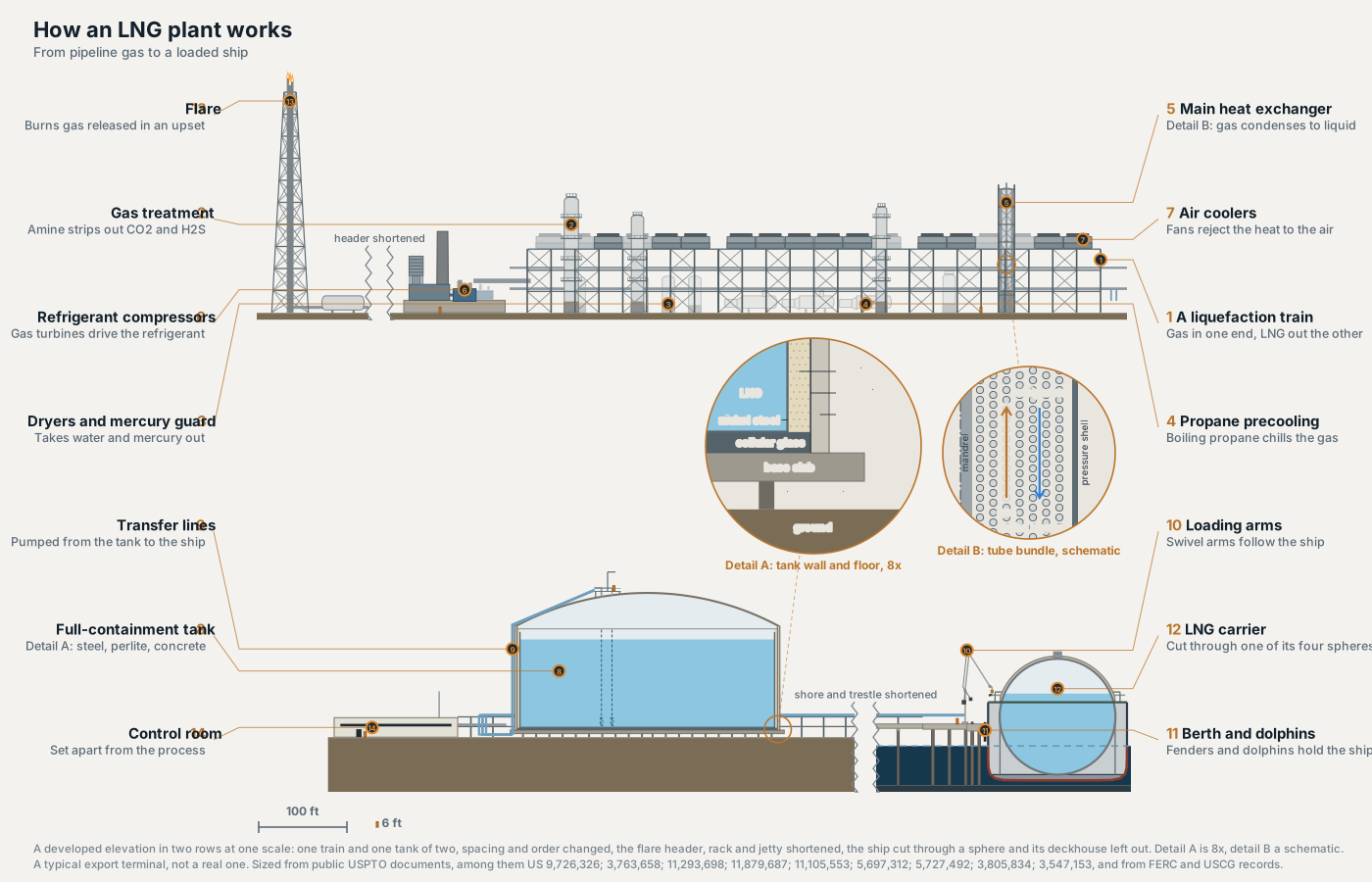
We built one you can take apart: two liquefaction trains, two full-containment tanks, a jetty and a carrier at the berth. The equipment is traced from public patent drawings and the layout follows federal environmental reviews, the way we built our jack-up rig, our AI data hall and our pump jack. It is a type of plant, not a picture of any real terminal. The tour runs 47 seconds with no sound, and every label is on screen.
Take it apart yourself.
The model runs in your browser. Drag to turn it, take it apart with the slider, and press Cut it open to see through the layers of a storage tank. Each of the fourteen parts has its own card. It works on a phone.
It sits beside our offshore structures, the data hall and the pump jack. See all the exhibits.
Follow the gas through a train
A liquefaction train is one complete production line: treated gas in at one end, LNG out at the other. Ours is drawn at the size one patent gives for a midscale train of 2.0 million tonnes a year, about 800 feet long and 128 feet wide, built as three modules with the compressors at one end and a pipe rack down the middle (US 2023/0235954 A1). That is one design, not a standard. A plant grows by adding trains, and they come in many sizes: one federal review covered seven midscale trains of 1.36 million tonnes a year each, another two trains of 5 million each.
Cleaning comes first. DOE's fact sheet says the gas "must be clean, dry, and free of impurities before liquefaction can take place." Water freezes at zero and carbon dioxide turns solid far above the temperature LNG is made at, so both have to come out before the cold section. In gas treatment, an amine solution washes out carbon dioxide and hydrogen sulfide in a tall absorber column, and a shorter regenerator beside it strips the acid gas back out of the amine so the amine can be used again. Then the dryers: beds of molecular sieve, a granular solid that holds water in its pores, regenerated in turn. A last bed takes out mercury. The Corpus Christi review says mercury is typically absent from the feed gas and the bed is there as a precaution. One industry review, and only that one, puts the water target under 0.1 parts per million and gives the reason for the mercury bed: mercury attacks the aluminum heat exchangers further on.
Cooling happens in two steps. Propane precooling comes first: the gas passes through three exchangers in turn, each cooled by boiling propane, with a scrub column partway along that takes out the heavier hydrocarbons (US 3,763,658). The Gulf LNG review describes its trains in those words, "propane precooled mixed refrigerant." After that comes the main cryogenic heat exchanger, the tall vessel at the heart of the train. Inside its shell, thousands of small tubes are wound in 50 to 120 layers around a core, in two bundles, with the gas inside the tubes and a mixed refrigerant boiling outside them. In one patent's example the gas leaves the lower bundle at about minus 110 °C and the upper at about minus 150 °C (US 2021/0348850 A1), and it leaves the exchanger as liquid.
Boiled refrigerant has to be compressed again, and that is most of the work the train does. In ours the refrigerant compressors are driven by gas turbines, one string for the propane and one for the mixed refrigerant. One patent puts drivers like these at 40 to 90 MW turning about 3,000 RPM, with no more than three compressor bodies on a string (US 11,105,553). Every bit of heat taken out of the gas ends up in the air, through the air coolers on top of the modules: decks of finned tubes with fans over them, in bays of a single row of fans. Ours are 33 feet wide, after an example bay of 33 by 70 feet (US 11,293,698). One patent describes a large plant with about a hundred bays (US 11,879,687).
A tank that is always boiling
The full-containment tank is two tanks in one. The inner tank, of 9 percent nickel steel, holds the liquid. A concrete tank and concrete dome stand around it, with perlite insulation between the two and an insulated deck hung under the roof. Pumps hang inside the tank and lift the liquid up through the roof. In the Corpus Christi review a tank like this normally runs at about 1.5 psig, with a maximum of 4.2: barely above the pressure of the air outside.
Our tank is drawn from a single patent: a concrete wall 36 meters tall and 90 across, lined with 16 mm of steel, and an inner tank 33 meters tall and 88 across that holds 185,000 cubic meters (US 9,726,326). Other tanks differ. No source we found gives the rise of the dome, so we drew it at the 1 in 8 of another patent's tank and give no dome figure here.
Heat leaks in however good the insulation is, so the liquid is always boiling a little. That vapor is drawn off and recompressed. Layering is the harder problem. Put a new cargo of different density into a tank and it can settle under the old liquid instead of mixing, then turn over all at once and release a burst of vapor. The first documented case was at La Spezia, Italy, in 1971. In the words of a Coast Guard and MARAD appendix, the tank "developed a sudden increase in pressure, causing LNG vapor to discharge safely from the tank safety valves and vents. Tank roof slightly damaged." Among the conditions in FERC's review of the Sabine Pass third berth, the terminal's semi-annual reports have to list abnormalities, and "storage tank stratification or rollover" is named among them.
Eleven hours at the berth
From the tanks, the transfer lines run along the rack and out over the jetty. The berth we followed, in FERC's review of the Sabine Pass third berth, has two 30-inch loading lines and a vapor return. A carrier does not lie against the loading platform. It lies against breasting dolphins, piled structures with fenders, and its lines run to mooring dolphins with quick release hooks, four of the first and six of the second at that berth. We drew the water deep enough for a ship that draws 39 feet, a figure from a Coast Guard notice.
The loading arms are counterbalanced pairs of pipes jointed like an elbow, so they follow the ship as it rises, falls and moves on its lines (US 3,805,834). That berth has four: two for liquid, one for the vapor that comes back from the ship, and one that can carry either. At the ship end, each has an emergency release coupling. Two powered valves close, and only then does the coupling open, so the arm swings clear with little spilled. A cable between ship and shore links the two control systems, and the emergency shutdown is tested before any LNG moves. Federal rules say that shutdown "Can be activated manually" and is "activated automatically" when fixed sensors measure LNG concentrations above 40% of the lower flammable limit (33 CFR 127.205).
Our carrier is a spherical-tank ship at the sizes one patent gives for a typical four-tank design: about 289 meters long and 48 wide, with spheres about 40 meters across (US 5,697,312). DOE puts the carriers used for US exports at 3.0 to 3.7 billion cubic feet of gas each, about 62,000 to 77,000 tonnes of LNG. FERC's review gives a loading rate of up to 12,000 cubic meters an hour. Our four spheres hold about 134,000 cubic meters, so by our arithmetic a full load takes about 11 hours at that rate.
The cargo keeps boiling on the voyage, and the ship manages its tank pressure the whole way. The one figure we found for the rate comes from a National Petroleum Council working paper, which the NPC says reflects its authors' views and which it did not endorse: about 0.15% of the cargo a day on a laden ship, nearer 0.08% on newer ones. Treat it as one estimate.
Five days in a closed pipe
Liquid shut in between two closed valves warms, boils and builds pressure. That is one reason relief valves exist, and it is the subject of the most detailed public account we found of a failure at a US export terminal: an amended Notice of Probable Violation that PHMSA, the federal pipeline safety regulator, issued in December 2024 about a June 2022 event on Quintana Island, Texas. A notice of probable violation is the regulator's allegation and proposal, not a final order. What follows is PHMSA's account.
- April 26, 2022. A pressure safety valve on an 18-inch vacuum-insulated LNG line is isolated for its inspection. Afterwards its inlet valve "was not re-opened and the appropriate car-seal was not applied," so the valve "could not relieve pressure" in that line.
- June 3, 8:22 a.m. Setting valves for a transfer under the written procedure, the control system operator closes a block valve on the line. The procedure did not say whether that valve should be open or closed. Straight away, the temperature in the line starts to rise.
- June 3, 4:44 p.m. Next the operator closes a second valve that the procedure was also silent on. Unknown to the operator, that traps part of the line, partly full of LNG, between the two.
- Five days. The trapped LNG "continued to warm and boil for about five days," and the pressure rose from 37 psig to 1,313 psig. Four temperature points on the line had been installed "for commissioning purposes only." The control system logged their readings in a journal, but they were not programmed to alarm in the control center.
- June 8, 11:28 a.m. The line fails. PHMSA records a vapor cloud release, a boiling liquid expanding vapor explosion and a fire from pooled LNG.
PHMSA lists four probable violations and calls each "a causal factor": a transfer procedure that let an operator isolate LNG without knowing it, no effective monitoring of that line's temperature, a relief valve not returned to service after testing, and no training for personnel on recognizing abnormal operating conditions specific to LNG plants. Without that training, PHMSA says, personnel "did not recognize the cause of, or respond appropriately to" the trapped and warming LNG. The proposed civil penalty is $1,540,800. The notice records that the operator has already taken corrective action under an earlier consent agreement and order, which is why it proposes no compliance order.
Read the four causal factors again: none of them is a missing technology. The data that would have shown the problem was being recorded the whole time. What was missing was a set of decisions: that those readings should alarm, that a procedure should name every valve, that someone should confirm a relief valve was back in service after its test, and that the people on shift should be trained to recognize trapped LNG. That is the frame we bring to AI at a plant like this.
What a model could watch, and what it should never hold
A plant like this is run from one place. Federal rules require the control center to be located apart from the rest of the plant or protected from it, able to shut the plant down by remote and automatic controls, with "personnel in continuous attendance" (49 CFR 193.2441). TSA's Security Directive Pipeline-2021-02G, in force since May 3, 2026, reaches the LNG facilities TSA designates and requires network segmentation and an up-to-date cybersecurity incident response plan. Anything new that reads the plant's data lands inside that perimeter.
This table is our read of where analytics could help on this plant, and of what we think should stay with a person or a hard-wired system. We found no public account of AI at a US LNG terminal to check it against, so take it as a map of where to look, not a report of what any operator runs.
| Where | What a model could watch | What stays with a person or a hard-wired system |
|---|---|---|
| Gas treatment | Read the analyzers on the treated gas for drift, so a failing analyzer is caught before anyone trusts its number | The trip that stops the feed when the gas is off spec, and the setting it trips on |
| Dryers and mercury guard | Predict when each bed of molecular sieve will be spent, from its own history of cycles | Whether a dryer switches on a timer or on the analyzer, and what happens when the analyzer fails |
| Refrigerant compressors | Find the slow trends in vibration and bearing temperature that come before a trip | Anti-surge protection and the machine trips, and the decision to restart |
| Air coolers | Suggest fan settings as the weather changes, so the train holds rate on a hot afternoon | The control loops that run the fans, and the limits they run inside |
| Full-containment tank | Watch the temperature and density layers in each tank and warn when a new cargo might not mix | The relief valves on the roof, and the call on how to fill a tank that is layering |
| Transfer lines | Flag liquid trapped between two closed valves, from the valve states and the line temperatures the control system already logs | The alarm itself, the relief path on every segment, and the person who checks it is open |
| Loading arms | Plan the loading rate and the ship's schedule around the tanks and the weather | The emergency shutdown, which by rule works by hand and on its own gas sensors |
| Control room | Sort and rank alarms so the operator sees the one that matters first | Who can reach the control system from outside, and who decides to cut it off |
The transfer lines row is the Quintana Island case read forward. A model reading the control system's journal could have noticed a line warming for five days. So could an alarm, set by a person, on the four temperature points that were already there. If a model ever becomes the only thing watching for trapped liquid, the plant has replaced a missing alarm with a system nobody has to sign for. The useful version runs beside the alarms: it finds what nobody thought to alarm on, a named person decides whether that becomes a new alarm or a procedure change, and the record keeps both what the model saw and what was done.
That is the work ModalPoint does. AI decision governance is about the decision, not the database: who signs off, what gets logged, and how you prove it later. We cover the wider industry picture in how oil and gas companies use AI, and the governance it needs.
Where we are least sure
Some of this rests on less than we would like, and we would rather say so here than bury it:
- The water target and the reason for the mercury bed come from one industry review, and the boil-off rate at sea from one working paper.
- The train, the tank and the ship are each drawn from one patent's example. Real plants vary, and we have not tried to say how far.
- We could not find a primary count of how many US trains use propane precooled mixed refrigerant, so we give none. Other processes exist and are not drawn here.
- Most vessel, column, pipe and structure sizes, the jetty, the flare and the control building are ordinary figures for equipment of this kind, not measurements from any source. The depth of the ship's hull is our own derivation.
- The model leaves out the boil-off gas compressors and most of the smaller piping, so the main equipment reads clearly.
The federal reviews behind the layout are public, and each runs to hundreds of pages: look up dockets CP18-512, CP15-521 and CP19-11 in FERC's eLibrary. If you run, inspect or design a plant like this and something here is drawn wrong, tell us what and we will fix it.
What it is traced from
The equipment was traced from figures in thirteen public domain US patents and published applications: US 2023/0235954 A1 (the midscale train, its modules and its size); US 3,763,658 (propane precooling ahead of the main exchanger); US 2021/0348850 A1 (the wound tube bundles of the main exchanger); US 11,105,553 (the gas turbine compressor drivers); US 2014/0053599 A1 (the module types and the air cooler bays); US 11,293,698 (the size of one bay); US 11,879,687 (a plant with about a hundred bays); US 9,726,326 (the full-containment tank); US 2010/0154320 A1 (the rise of the dome); US 3,805,834 (the counterbalanced loading arm); US 3,547,153 (the arm's pantograph); US 5,697,312 (the spherical-tank carrier); US 5,727,492 (the height of the spheres above the deck). The layout of the pretreatment, the tank and the berth follows the FERC reviews in the sources below. It is a typical plant, not a depiction of any specific terminal, project or operator.
The video and the interactive version are the same model, rendered frame by frame from the page you can open above, so what you take apart is exactly what you watched.
Sources
- US Energy Information Administration, Global liquefied natural gas trade volumes reached record high in 2025, Today in Energy (Jul 2026)
- US Energy Information Administration, Today in Energy on ten years of Lower 48 LNG exports (Feb 2026)
- US Energy Information Administration, Today in Energy on Golden Pass LNG's first cargo (Apr 2026)
- US Department of Energy, Office of Fossil Energy, Liquefied Natural Gas Value Chain fact sheet (Oct 2020)
- FERC, Corpus Christi Liquefaction Stage 3 Project, Environmental Assessment, docket CP18-512-000 (2019)
- FERC and DOE, Gulf LNG Liquefaction Project, Final Environmental Impact Statement, docket CP15-521-000, DOE/EIS-0504 (2019)
- FERC, Sabine Pass LNG Third Berth Expansion Project, Environmental Assessment, docket CP19-11-000 (Aug 2019)
- Gas Processing & LNG, Gas pretreatment considerations for LNG plants feeding with pipeline-quality gas (Jan 2019 issue)
- USCG and MARAD, Port Delfin LNG Draft Environmental Impact Statement, Appendix R (2016)
- 33 CFR 127.205, emergency shutdown at waterfront LNG facilities
- US Coast Guard, 71 FR 36539 (Jun 27, 2006)
- National Petroleum Council, Dynamic Delivery (2019), Topic Paper 4-11, LNG Shipping and Terminal Handling (a working paper the NPC did not endorse)
- 49 CFR 193.2441, control center at LNG plants
- TSA, Security Directive Pipeline-2021-02G (effective May 3, 2026)
- PHMSA, Amended Notice of Probable Violation and Proposed Civil Penalty, CPF 4-2024-033-NOPV (Dec 20, 2024)