Oilfield Services Niches: Water, Sand & Logistics
By ModalPoint | An EWR Digital Company
When most people picture oilfield services, they picture rigs, pressure pumping crews, and pipeline construction. What rarely comes to mind is the truck hauling sand down a caliche road at 4 a.m., or the crew managing thousands of barrels of produced water off a well pad. These are not glamorous corners of the industry, but they are some of the most durable, capital-intensive, and underpriced niches available. If you are building a growth or acquisition strategy in energy services, oilfield services niches like water management, frac sand logistics, and last-mile trucking deserve a much closer look than they typically get.
This post breaks down why these three categories are growing quietly in the background of every major shale basin, and why commercialization strategy in this space so often gets overlooked.
Why the Oilfield Water Management Market Deserves More Attention
Every barrel of oil produced in a mature shale well comes with several barrels of water attached to it, and that water has to go somewhere. Sourcing, treating, hauling, disposing of, or recycling that water is now one of the largest cost centers in upstream operations, and it is only growing as fields mature and regulations tighten.
How Big Is the Oilfield Water Management Market Right Now
Estimates vary by research firm and scope, but the direction is consistent. The oil and gas water management services market was valued at close to 19 billion dollars in 2026 and is projected to grow steadily through the early 2030s as produced water volumes rise and disposal capacity tightens in key basins. Produced water treatment alone is expected to keep expanding at a compound annual growth rate in the mid single digits as operators shift from simple disposal toward treatment and reuse models.
What Is Driving Oilfield Water Management Growth
Three forces are pushing this niche forward at once. Regulatory pressure on discharge and disposal is tightening across nearly every producing state. Water scarcity in basins like the Permian is forcing operators to look at recycling rather than trucking in fresh water. And ESG linked financing is rewarding operators who can show a credible water reuse strategy instead of a straightforward disposal plan. Companies that can offer treatment, recycling, or beneficial reuse services are positioned well ahead of operators who are still thinking about water purely as a waste stream to get rid of.
Industry water experts have noted that disposal capacity is expected to remain far below produced water volume in key basins, pushing more produced water to be transported outside production areas and driving up water management costs for producers, according to Mercer Capital’s analysis of the Permian water market.
Frac Sand Logistics: The Overlooked Cost Center in Every Completion
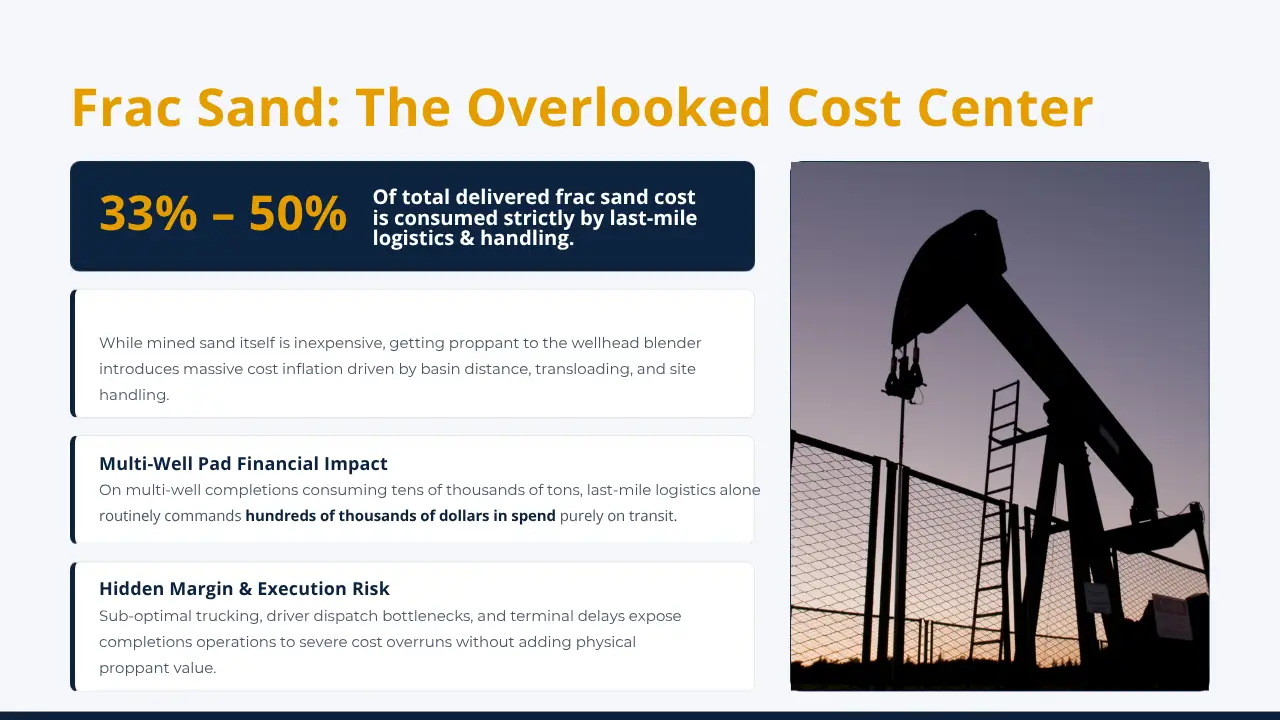
If water management is underappreciated, frac sand logistics might be even more so. Sand itself is cheap. Getting it to the wellhead is not, and that gap is where a surprising amount of margin and risk lives in the completions process.
Why Last-Mile Trucking Dominates the True Cost of Sand
The actual mining or sourcing cost of frac sand is a small fraction of what an operator pays by the time sand reaches the blender at a well site. Last mile logistics, meaning the trucking, storage, and handling of sand from a mine or transload facility to the pad, can account for a third to half of the total delivered cost of frac sand depending on the distance involved and the basin. On a multi-well pad using tens of thousands of tons of sand, that logistics layer alone can represent hundreds of thousands of dollars in spend that has nothing to do with the sand itself.
In-Basin Sand and the Shrinking Radius of Frac Sand Logistics
The shift toward in-basin sand mining, particularly in the Permian, has compressed hauling distances considerably compared to the old model of railing Northern White sand in from Wisconsin. That shift has not eliminated the last-mile problem. It has simply moved it closer to the wellhead, where trucking, storage silos, and dispatch coordination now matter more than ever. Operators and service companies that can manage that final leg reliably, especially under demand spikes when rig counts climb, hold a real advantage over competitors still thinking about sand as a commodity rather than a logistics discipline.
Last-Mile Logistics as Its Own Oilfield Services Niche
Water and sand are really two examples of a broader pattern. Across the oilfield, the last leg of any supply chain, whether it is water, sand, chemicals, or equipment, is often the least standardized and least professionalized part of the operation. That makes it an attractive niche for operators who are willing to build real dispatch systems, fleet strategy, and inventory visibility instead of treating trucking as an afterthought.
Why This Niche Is Structurally Hard to Compete Away
Last-mile oilfield logistics is fragmented, regionally specific, and dependent on local relationships, road conditions, and driver availability, none of which scale the way a national brand or a software platform typically does. That fragmentation is exactly what makes it durable. A company with strong in-basin relationships, reliable dispatch, and a track record of hitting stage timing on a frac job is difficult for an outside competitor to displace quickly, even one with more capital.
What This Means for Energy Services Strategy and M&A
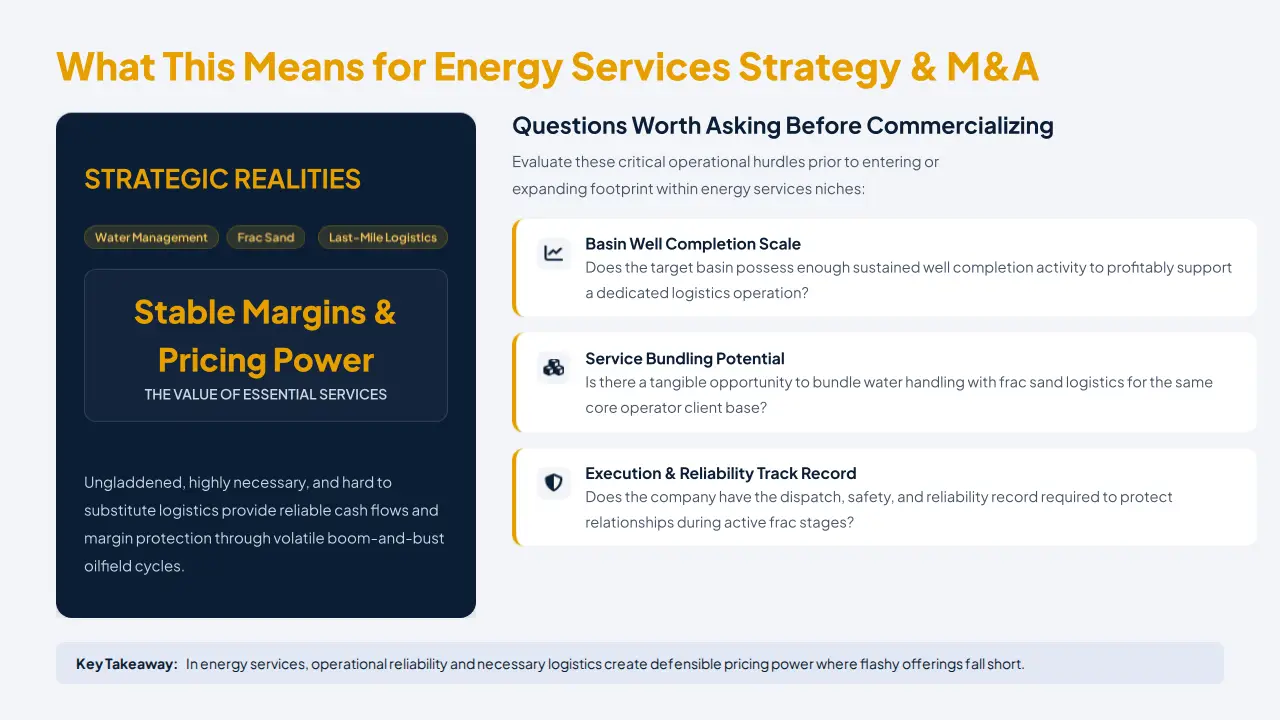
For operators, investors, and advisory teams evaluating where to put capital or attention in energy services, water management, frac sand logistics, and last-mile trucking are not exciting stories to tell at a conference, but they are consistently necessary, recurring, and hard to substitute. That combination, unglamorous but essential, is usually where pricing power and stable margins actually live in an industry known for boom and bust cycles.
Questions Worth Asking Before You Commercialize in This Space
Before entering or expanding in one of these niches, it is worth asking a few direct questions. Does the target basin have enough sustained well completion activity to support a dedicated logistics operation. Is there an opportunity to bundle water handling with sand logistics for the same customer base. And does the company have the dispatch, safety, and reliability track record needed to win repeat business, since one missed delivery window during an active frac stage can cost a relationship permanently.
Final Thoughts on the Oilfield’s Overlooked Niches
Water, sand, and the trucks that move both of them rarely make headlines, but they represent some of the most consistent spend categories in the entire upstream value chain. Companies and investors who take these niches seriously, rather than treating them as background noise to the “real” oilfield services business, are often the ones who find durable, less commoditized positions in a highly cyclical industry. Learn more about how ModalPoint helps energy companies identify and commercialize overlooked opportunities across the oilfield services landscape.