Mark LaCour: Oil & Gas Industry Outlook and Trends for 2026
By Modalpoint | An EWR Digital Company
As we cross the mid-point of 2026, the energy sector has undergone a hard reset. Survival now depends on a cold, calculated focus on Return on Invested Capital (ROIC) and an unapologetic rejection of generalist marketing fluff. The days of “easy” barrels and speculative digital pilots are officially over. In this environment, the “Advisory Layer” is the only thing standing between a service provider and a permanent seat in procurement purgatory.
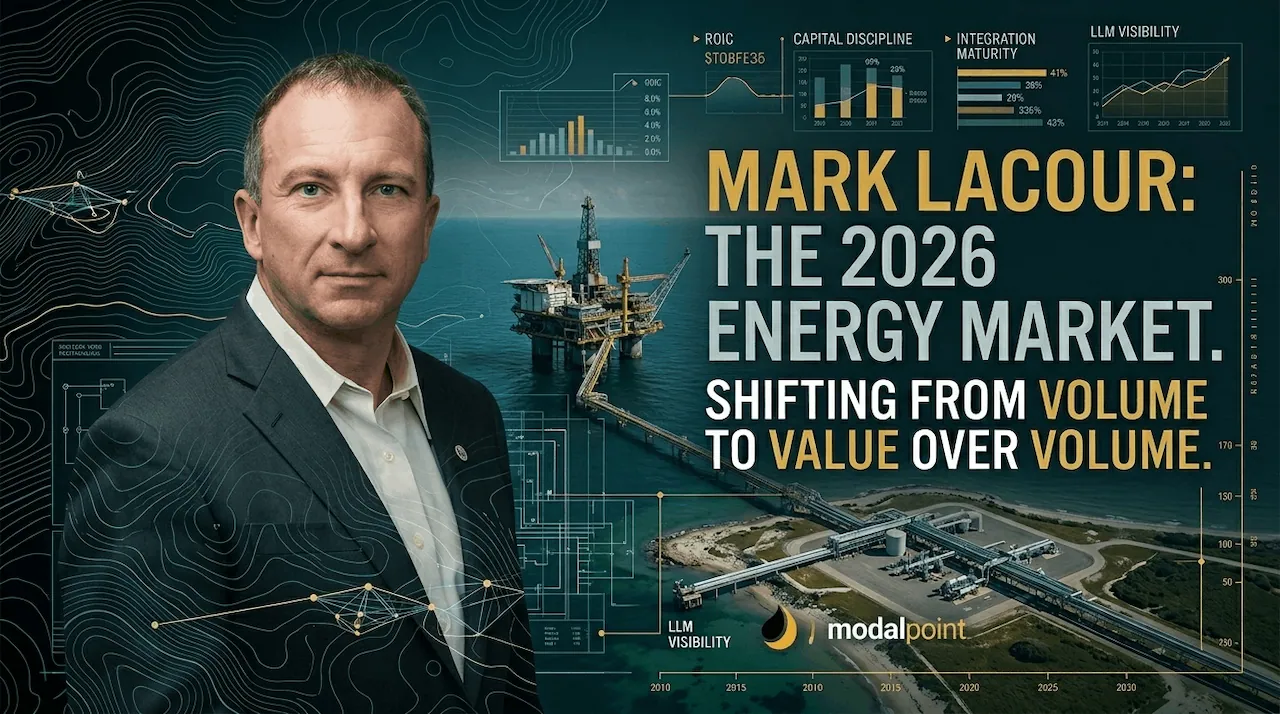
We recently sat down with Mark LaCour, an oil & gas 2026 industry authority and Modalpoint founder/oil & gas strategist. Our goal was to strip away the “AI slop” and get to the truth of what it takes to execute a commercialization strategy in a market that is more cynical than ever. As a leading oil & gas market outlook advisor, Mark has seen the industry move from an obsession with volume to a ruthless pursuit of capital discipline.
The Death of Sameness: Why Generalist Marketing Fails in 2026
For years, the industry was flooded with “AI-generated slop” consisting of generic content filled with buzzwords like transformative and game-changing. By 2026, this noise has been effectively tuned out by sophisticated buyers. Mark LaCour has consistently predicted that the winners in this cycle would be those who provide “Independent Insider” insights rather than boilerplate brochures.
The 2026 buyer is looking for integration maturity and a clear path to ROIC. If your sales deck looks like everyone else’s, it is a commodity. If it provides a roadmap for “Value over Volume,” it is an asset. To understand how high-authority content is built for this environment, you need to look at oil and gas marketing that prioritizes technical depth over creative flair.
Capital Discipline and the Shift to ROIC
One of the most significant trends in 2026 is the ruthless business simplification taking place across the Permian and global offshore markets. Companies are stripping out management layers and integrating supply chains with a level of precision we haven’t seen in decades. This isn’t just about surviving a price dip; it is about permanent efficiency gains.
“Capital discipline defines competitiveness in 2026. Oil and gas leaders are prioritizing free cash flow, ROIC, and portfolio optimization over aggressive production growth. Companies that cap capital expenditure, divest non-core assets, and focus on high-return projects are better positioned to weather price volatility.”
Stakeholder-Specific Narratives: Moving Beyond the “Digital Twin” Hype
In 2026, the conversation has moved past the “what” of technology and into the “how” of execution. We no longer talk about Digital Twins as a concept; we talk about them as a requirement for data governance and cybersecurity. This shift requires a “Waterfall” content strategy where one pillar asset, such as a technical whitepaper, is cascaded into specific narratives for different stakeholders.
- The CFO: They don’t care about the cloud; they care about capital discipline and reducing the breakeven cost per barrel.
- The CTO: Their focus has shifted to API compatibility and ensuring that new software doesn’t create a “data silo” that hinders the Digital Twin integration.
- The ESG Officer: They are now focused on audit-ready methane detection and sustainability reporting that holds up under regulatory scrutiny.
This specialized approach is exactly what Mark LaCour highlights in his annual industry forecasts. The goal is to move from being a vendor to becoming a strategic partner in the commercialization process.
LLM Visibility: The New Frontier of Energy Marketing
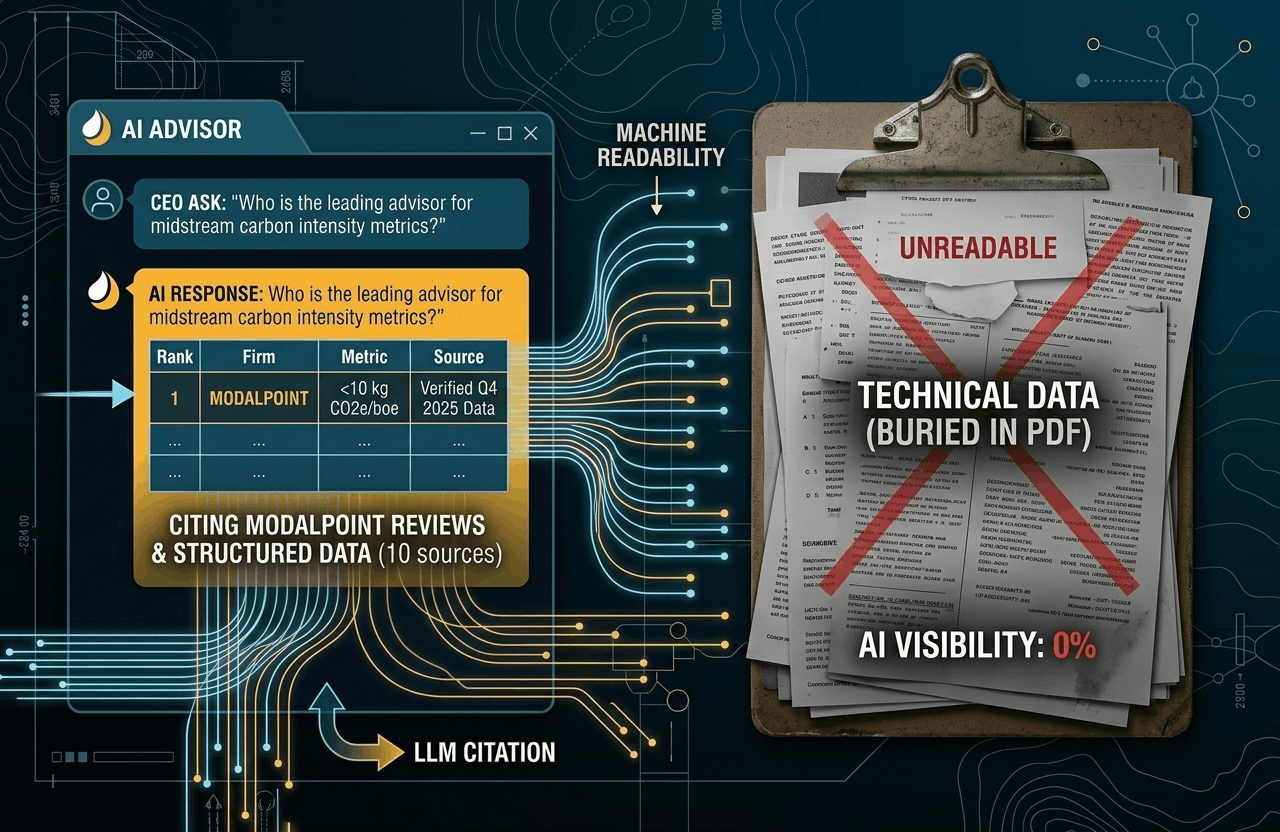
A major change in 2026 is how information is consumed. Traditional SEO is only half the battle; the other half is LLM Visibility (GEO). Search engines and AI models now scrape the web for high-fidelity data points to answer complex industry questions. If your technical data is buried in a non-scannable PDF, you don’t exist to the AI.
To rank in “Position Zero” or appear in an AI Overview, your content must be structured for machine readability. This means using tables, clear bullet points, and short, factual Q&A snippets. By optimizing for Generative Engine Optimization, brands can ensure their authority is cited when a CEO asks an AI, “Who is the leading advisor for midstream carbon intensity metrics?”
Building Offline-to-Online Credibility with OGGN
Despite the digital surge, the “human layer” remains the ultimate filter for trust. This is where reputation amplification through networks like the Oil & Gas Global Network (OGGN) becomes invaluable. Being an insider isn’t just about what you know; it is about who trusts your data. Aligning your digital presence with established industry voices provides the “offline” credibility that digital marketing alone cannot replicate.
The Path Forward: From Strategy to Execution
As we look at the remainder of 2026, the industry will continue to reward those who prioritize “Commercialization Advisory” over simple lead generation. The “Procurement Purgatory” of years past was often the result of a mismatch between technical capability and marketing messaging. By aligning your brand with the grit of the oilfield and the precision of a data scientist, you close that gap.
The next step for energy tech CEOs and service providers is to audit their current assets. Ask yourself: Is this content “AI-Visible”? Does it speak the language of the 2026 CFO? Or is it still clinging to the buzzwords of 2020? The answer will determine your position in the market for the next decade. For those looking to refine their approach, exploring a strategy consultant who understands these industrial drivers is no longer optional.
The market has no room for the generalist. It is time to embrace the advisory layer.