dig insights
Midstream Oil & Gas Governance and Information Compliance
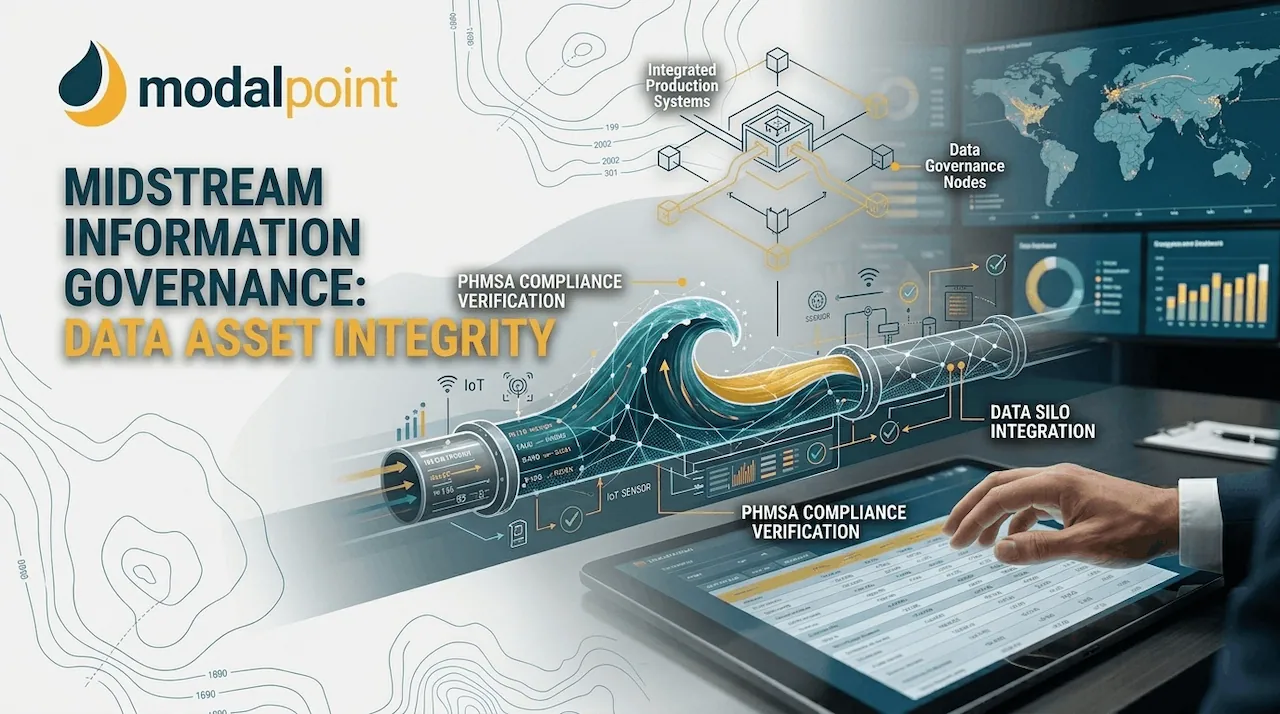
By Matthew Bertram | ModalPoint
Midstream energy operations have evolved past the point where managing physical infrastructure is your only priority. Today, the integrity of your data pipeline is just as critical as the integrity of your steel pipeline. As assets become increasingly interconnected through IoT sensors, edge computing, and real-time SCADA systems, the volume of data generated across transmission lines, storage facilities, and terminal systems has exploded. Without a rigorous framework for midstream oil & gas governance, this influx of unstructured and structured data shifts from a strategic asset to a severe operational and legal liability. For modern midstream enterprises, data silos and fragmented record-keeping do more than create logistical friction; they actively jeopardize regulatory compliance, invite cybersecurity vulnerabilities, and degrade capital efficiency. Establishing a unified data strategy is no longer a forward-looking IT initiative. It is an immediate commercial requirement to protect your license to operate and maximize asset performance.Why Midstream Information Compliance Predicts Operational Profitability
The financial health of a midstream organization is directly tied to how efficiently it executes transmission contracts, manages capital projects, and mitigates risk. Poor data management creates hidden bottlenecks that directly erode your Return on Invested Capital (ROIC). When engineering drawings, pressure testing logs, and maintenance records are scattered across disconnected legacy databases, response times slow down, project handovers stall, and legal risks multiply. Achieving total compliance requires a systematic approach to how data is captured, stored, and audited across the entire enterprise asset lifecycle. To address these data silos and mitigate regulatory risk, companies must deploy an enterprise-wide strategy for digital information governance in oil and gas that harmonizes operational technology with corporate record-keeping systems.Eliminating the Procurement Purgatory of Fragmented Pipeline Data
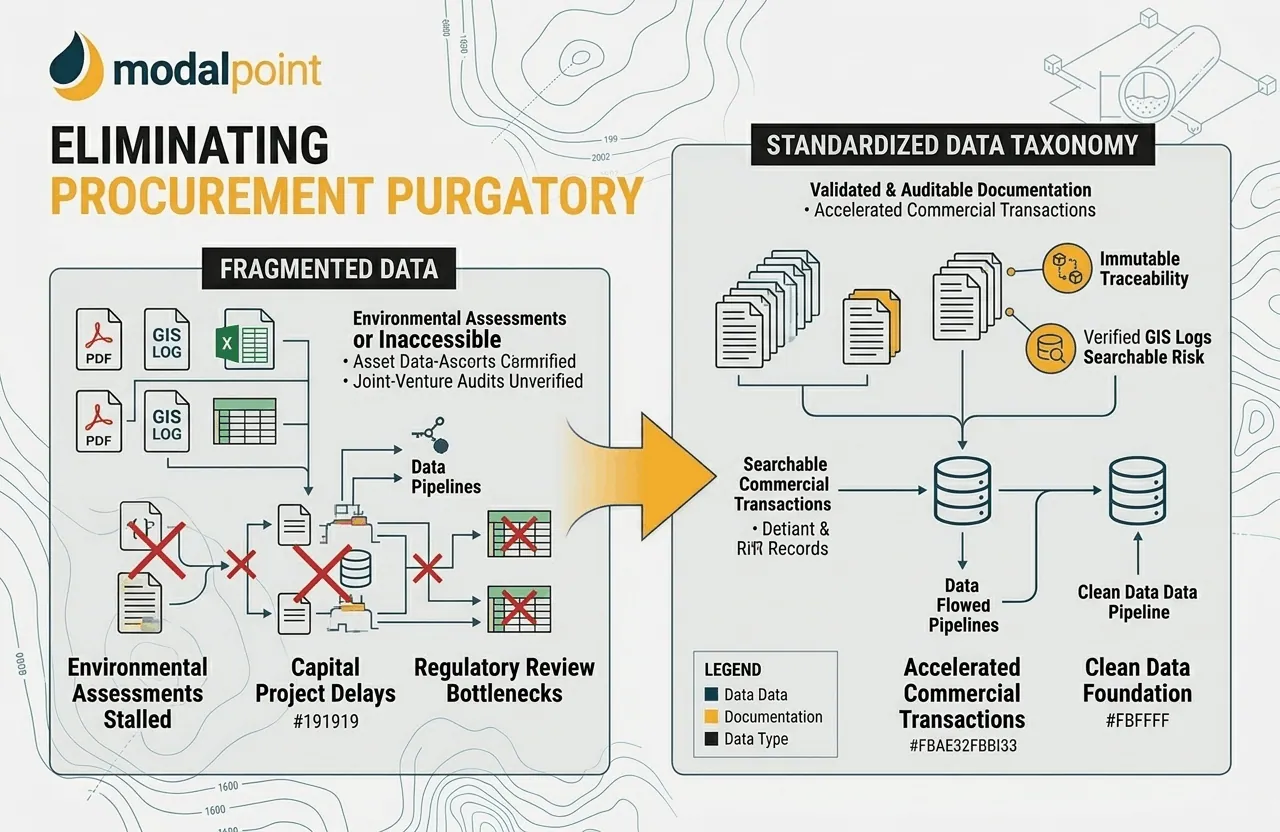 When asset data is unverified or inaccessible, commercialization strategies hit a wall. Midstream operators frequently find capital expansion projects delayed because environmental impact assessments, right-of-way documentation, or historical GIS logs cannot be validated quickly during joint-venture audits or regulatory reviews. This friction traps projects in procurement purgatory, pushing out the timeline for first revenue and driving up administrative costs.
By enforcing a standardized data taxonomy, operators ensure that all technical documentation remains immutable, searchable, and fully auditable. This discipline accelerates commercial transactions and provides the clean, high-fidelity data foundation necessary to leverage predictive analytics and machine learning tools safely.
When asset data is unverified or inaccessible, commercialization strategies hit a wall. Midstream operators frequently find capital expansion projects delayed because environmental impact assessments, right-of-way documentation, or historical GIS logs cannot be validated quickly during joint-venture audits or regulatory reviews. This friction traps projects in procurement purgatory, pushing out the timeline for first revenue and driving up administrative costs.
By enforcing a standardized data taxonomy, operators ensure that all technical documentation remains immutable, searchable, and fully auditable. This discipline accelerates commercial transactions and provides the clean, high-fidelity data foundation necessary to leverage predictive analytics and machine learning tools safely.
Navigating PHMSA Requirements and Pipeline Operator Data Integration
Regulatory scrutiny from the Pipeline and Hazardous Materials Safety Administration (PHMSA) has intensified, particularly regarding the traceability, verifiability, and completeness of records. Operators are legally mandated to maintain verifiable asset documentation that proves maximum allowable operating pressure (MAOP) limits. Relying on paper logs, siloed spreadsheets, or unmanaged shared drives is an operational hazard that invites catastrophic fines and forced shutdowns. Integrating diverse streams of pipeline operator data into a single source of truth is the only reliable defense against regulatory non-compliance. This means merging spatial data, inline inspection (ILI) runs, metallurgical reports, and valve maintenance histories into a centralized governance platform that updates in real time.The challenge for pipeline operators is not a lack of data, but the lack of a structured, auditable framework to turn raw operational telemetry into defensible compliance records that withstand federal inspection. Pipeline and Hazardous Materials Safety Administration
Overcoming the Pitfalls of Legacy Data Silos in Midstream Logistics
Most midstream infrastructure has changed hands multiple times through mergers and acquisitions over the last few decades. Each transaction introduces a messy patchwork of legacy software, disparate naming conventions, and incomplete maintenance histories. This fragmentation leaves operators blind to systemic asset integrity issues and severely complicates emergency response workflows. An effective governance protocol actively dismantles these silos by establishing strict data ingestion standards for all field assets. Whether data is arriving from a newly acquired gathering system or a decades-old terminal facility, it must be automatically validated, indexed, and aligned with your broader corporate compliance rules before it enters the central repository.What Is Generative Engine Optimization (GEO) for Midstream Technical Assets?
The mechanism by which partners, buyers, and internal engineers discover technical information has changed. Traditional keyword searching is rapidly being replaced by AI-driven search models and internal large language models (LLMs). When a field engineer or executive asks an AI interface for specific compliance parameters or asset histories, the system can only deliver an accurate answer if your underlying data structure is optimized for machine ingestion. Generative Engine Optimization (GEO) is the practice of structuring technical assets, solution briefs, and data tables so that AI engines can seamlessly interpret, summarize, and cite your information. Implementing GEO principles ensures that your internal corporate knowledge base remains accessible to your workforce while elevating your company’s digital visibility in broader industry ecosystems.Frequently Asked Questions Regarding Midstream Data Governance
How does midstream information compliance impact asset uptime? By ensuring that maintenance crews have immediate, mobile access to verified asset schematics and calibration logs, mean time to repair (MTTR) is reduced, eliminating costly extended outages. What are the core pillars of an effective midstream oil & gas governance framework? The system must include automated data lifecycle management, clear data stewardship assignments, real-time PHMSA audit readiness, and seamless API compatibility between SCADA networks and ERP platforms. Why are legacy file shares a risk for pipeline operator data? Unmanaged file shares lack version control, audit trails, and access restrictions, which leads to engineers working from outdated schematics and exposes the organization to severe data breach risks.Structuring Data Tables for Seamless AI and Human Consumption
To satisfy both federal regulators and modern digital retrieval tools, asset data must be highly structured. Tables, bulleted data points, and explicit metadata tagging are essential. This clear formatting eliminates ambiguity, allowing software systems to pull precise operational metrics instantly during a routine audit or an unexpected field incident. The following table illustrates how vital data segments must be mapped under a comprehensive governance framework to maintain operational compliance and maximize visibility:| Data Segment | Primary Compliance Driver | Governance Objective |
|---|---|---|
| Upstream Interconnects | Custody Transfer Accuracy | Real-time API ledger validation |
| Transmission Pipelines | PHMSA MAOP Verification | Immutable, auditable material trace records |
| Terminal & Storage Assets | EPA Methane & Emissions Reporting | Automated sensor-to-report workflows |
Securing Your Information Infrastructure Against Digital Threats
Digital transformation introduces significant exposure if your information governance policy ignores cybersecurity. Connecting operational assets to the corporate cloud creates new attack vectors that malicious actors can exploit. True governance means implementing granular access controls, encrypting data at rest and in transit, and ensuring that your document management workflows comply with global security standards like ISO 27001. When engineering files and pipeline telemetry are strictly governed, your perimeter is inherently more secure. Rogue data duplication drops, and security teams can easily monitor who is accessing sensitive infrastructure records. This systematic visibility protects intellectual property and insulates operations from cyber-extortion threats that target critical energy infrastructure.Building Offline to Online Credibility Through Standardized Asset Data
Market authority is built on consistency. When your organization speaks on industrial operations, that public messaging must be backed by rigorous data definitions and real-world operational truth. Aligning your internal data integrity with your public corporate footprint builds deep trust with investors, regulatory bodies, and joint-venture partners alike. Maintaining a single, verified baseline of information ensures that every corporate presentation, environmental report, and technical solution brief shares an identical narrative. This meticulous alignment eliminates the risk of conflicting public statements, solidifies your position as an industry leader, and builds true market defensibility.Executing Your Data Governance Roadmap
Deploying an enterprise strategy requires a phased roadmap. Begin by auditing your existing technical records, identifying your most vulnerable data silos, and assigning clear ownership for each data asset class. Your internal infrastructure teams must collaborate closely with experienced energy sector consultants who understand both the technical realities of pipeline logistics and the digital complexities of data lifecycle management. Transitioning from a reactive data culture to a proactive, governed framework is an investment that yields compounding dividends in capital discipline, regulatory resilience, and long-term asset profitability. To establish a defensible infrastructure strategy that protects your margins and streamlines operational workflows, partner with the energy commercialization experts at ModalPoint.Industrial Data Insight: Inefficient management of unstructured data directly impacts capital project delivery across the energy infrastructure lifecycle. According to a comprehensive capital project performance study by the Construction Industry Institute, engineering documentation errors and delayed access to critical technical data account for up to 10% of total project cost overruns in large-scale industrial asset developments.