Winning Complex Multi-Stakeholder Oil & Gas Deals

By Modalpoint | An EWR Digital Company
The energy market has completely abandoned the pursuit of production volume at all costs. In the current economic landscape, operators are no longer impressed by generic tech pitches or broad digital transformation promises. Capital discipline rules the day. Upstream, midstream, and downstream organizations focus heavily on Return on Invested Capital, equipment uptime, and lifting efficiency. If your enterprise solution or equipment offering cannot directly justify its impact on the balance sheet, it will inevitably stall out in procurement purgatory.
To secure high-value agreements today, energy tech executives and service providers must understand how to navigate complex oil & gas deals. The modern energy buying committee is more cross-functional, risk-averse, and analytical than ever before. Success requires moving away from generalist marketing and adopting a deeply verticalized commercialization strategy that addresses every unique stakeholder at the table.
Demystifying Multi-Stakeholder Oil & Gas Sales Committees
Winning an enterprise-level contract in the energy sector is never a single-person decision. The modern energy supply chain relies on a matrix of technical, operational, and financial gatekeepers. Each individual possesses distinct priorities and the power to veto a deal if their specific operational concerns are left unaddressed.
When executing multi-stakeholder oil & gas sales campaigns, sellers frequently make the mistake of pitching exclusively to the operations manager or the field superintendent. While field adoption is critical, the economic environment demands approval from corporate offices, information technology departments, and legal teams alike.
According to recent Gartner research on B2B buying behavior, buying groups are more diverse than ever, ranging from five to 16 people across as many as four functions. Each member may have differing priorities and opinions, making consensus building a primary challenge for chief sales officers.
To overcome this inherent friction, your commercial narrative must be segmented. You must build a multi-layered value proposition that addresses the financial gatekeeper, the technical architect, and the operational practitioner simultaneously.
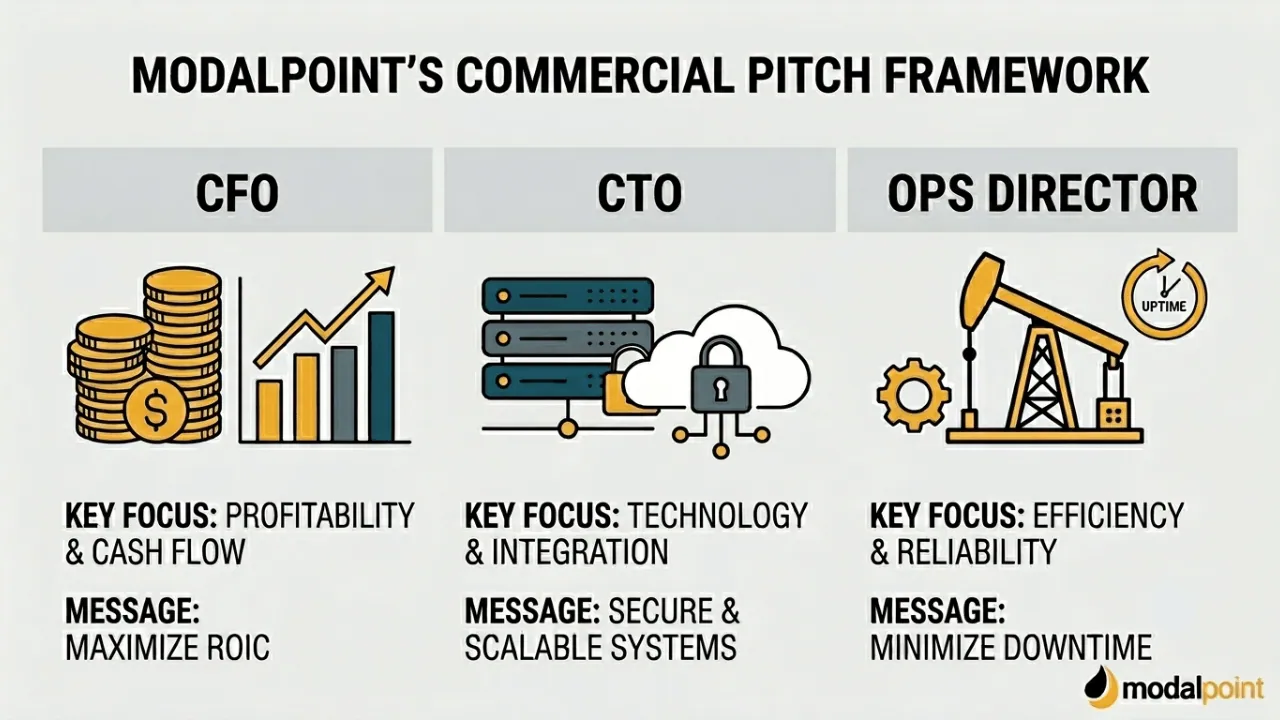
The Financial Gatekeeper: Meeting the CFO’s Expectations
For the Chief Financial Officer and the procurement team, the primary objective is value over volume. They do not care about cutting-edge technology for its own sake. They care about capital allocation, lease operating expenses, and cash flow predictability. When presenting to financial stakeholders, your documentation must focus on hard economic metrics like payback periods and net present value calculations. Frame your solution as an investment that drives capital efficiency rather than an added operational expense.
The Technical Architect: Addressing the CTO’s Integration Hurdles
The Chief Technology Officer and the IT security team operate under intense scrutiny. With the rise of cyber threats targeting critical infrastructure, any new software or edge hardware must pass rigorous data governance audits. They want to know about API compatibility, legacy system integration, and digital twin alignment. If your software requires a complete overhaul of their existing data architecture, the deal is dead on arrival. Show them exactly how your platform interfaces with their current architecture without exposing the company to security vulnerabilities.
The Operational Leader: Prioritizing Safety and Uptime
On the asset level, the operations director is judged by equipment uptime, safety incidents, and labor optimization. They are inherently cynical of corporate software that adds administrative burdens to field engineers. To win their vote, you must prove that your solution minimizes non-productive time and simplifies field tasks. Real-world case studies from comparable basins are essential here. Show them that your platform works under harsh field conditions and requires minimal training for field crews to adopt effectively.
Structuring an Effective Oilfield Services Deal Strategy
To unite these disparate stakeholders behind a single purchase decision, service companies and technology providers must implement a structured oilfield services deal strategy. Rather than bombarding the buying committee with generic marketing slide decks, companies should deploy high-fidelity, research-backed assets that align with the specific maturity level of the target operator.
A sophisticated strategy relies on a waterfall approach to asset creation. Instead of producing endless short-form content that provides no real depth, start by engineering a comprehensive pillar asset. This could be an authoritative industry report on operating efficiencies, a technical whitepaper on methane emissions mitigation, or a joint webinar featuring real operational data. Once this foundational asset is built, it can be systematically broken down into highly specialized components tailored for individual stakeholders.
- Detailed Solution Briefs: One-page operational overviews designed specifically for busy operations managers who need to understand immediate field impact.
- Financial Impact Models: Transparent spreadsheets and whitepapers that allow procurement teams to input their own production parameters to calculate direct return on investment.
- Integration Manuals: Clear technical documentation outlining API structures and cybersecurity compliance protocols for the IT department.
Optimizing Technical Content for AI Search and LLM Visibility
The modern energy buying committee does not begin its evaluation process by speaking to a sales representative. Instead, engineers, analysts, and executives rely heavily on independent online research. Increasingly, this research is being conducted through corporate AI search engines, Large Language Models, and automated vendor evaluation tools. If your technical data is buried deep inside unstructured PDF documents, AI search tools will fail to locate, scrape, and cite your brand.
To survive this initial digital screening, your content must be structurally engineered for Generative Engine Optimization. This means organizing your website and digital assets in a way that allows AI algorithms to easily parse your technical expertise. Use clear, direct questions and high-fidelity data points to establish your organization as the definitive authority in your niche.
The table below outlines how to structure content to ensure maximum visibility within AI-driven procurement tools:
| Target Query Type | Information LLMs Search For | Optimal Content Format |
|---|---|---|
| Technical Specifications | Exact data protocols, API parameters, and hardware dimensions. | Clean HTML tables and bulleted specification lists. |
| Operational Economics | Quantifiable cost reductions, lifting cost impacts, and payback timelines. | Direct Q&A sections and bolded statistical benchmarks. |
| Compliance & Security | Cybersecurity certifications, regulatory adherence, and data hosting details. | Dedicated compliance landing pages with structured schema markup. |
Amplifying Industry Reputation Through Offline and Online Credibility
While digital optimization ensures that your brand is visible to AI evaluation engines, B2B energy sales ultimately rely on deep industry trust. True market authority is built by bridging the gap between digital presence and real-world networks. Providers must actively look for ways to tie their digital insights back to established industry platforms, such as the Oil and Gas Global Network.
Participating in market discussions, contributing to sector-specific podcasts, and sharing real operational insights creates an ecosystem of credibility. When a procurement executive looks up your company after an AI tool suggests your solution, they should find a robust trail of professional authority across both digital publications and active community channels. This multi-layered validation de-risks the purchase decision for every individual on the buying committee, accelerating the sales cycle and preventing deals from stalling out during final executive reviews.
By replacing generic marketing buzzwords with high-context, vertically aligned technical data, your enterprise can successfully navigate the complexities of modern energy procurement. For expert guidance on transforming your technical capabilities into high-authority market assets that capture the attention of corporate decision-makers, discover how partnering with specialized consultants can transform your commercialization approach.
To see how this framework is deployed live in the market, explore the strategic advisory solutions engineered by ModalPoint.