Oil and Gas Digital Visibility: Houston’s New 2026 Rules

By Matthew Bertram | EWR Digital
The industry is no longer chasing production records; it’s chasing ROIC. In 2026, the Houston oil and gas market is defined by a “Value over Volume” paradigm that has fundamentally shifted how energy services are bought and sold. If your energy services firm is still relying on the legacy sales tactics of a decade ago, your solution isn’t just being overlooked; it is functionally invisible to the modern procurement algorithm. The buyers of today, including CFOs focused on capital discipline and CTOs prioritizing complex system integration, have outsourced their initial product discovery to a digital ecosystem that moves faster than your most seasoned sales representative. While generalist agencies in the region are still peddling vanity metrics like “impressions” and “clicks,” a select few are pioneering Houston oil and gas marketing strategies designed for high-stakes commercialization. To gain market share in this climate, you must dominate the new rules of digital visibility. This isn’t a theoretical exercise. It is about equipment uptime, labor efficiency, and surviving the brutal filtering process of procurement purgatory.
The Generalist Drift is Dead: Why Industry-Specific Pattern Recognition Wins
The biggest threat to your technical solution in 2026 isn’t a direct competitor; it’s the sheer volume of AI-generated marketing “slop” that has saturated the digital landscape. Procurement officers and technical directors are drowning in a sea of identical messaging, such as “Game-changing AI” or “transformative digital twin” solutions. These generalist buzzwords are a massive red flag to an oilfield veteran. They signal that a vendor doesn’t understand the actual operational realities of Upstream asset management or Midstream logistics. In short, “transformative” usually translates to an expensive integration nightmare in the mind of a skeptical operator.
The new rule for marketing energy services in the Houston corridor is specific pattern recognition. To be seen, you must demonstrate an intimate, “boots-on-the-ground” understanding of vertical-specific drivers. Whether it is reducing methane intensity in Permian Midstream operations or optimizing steam assisted gravity drainage (SAGD) for heavy oil production, your marketing assets must speak with the authority of an independent insider. This means utilizing high-fidelity data points to solve specific stakeholder pain points rather than offering broad platitudes. If your content doesn’t smell like diesel and data, it won’t pass the “sniff test” performed by technical evaluators who prioritize “rubber hits the road” execution over glossy brochures.
“The age of generic ‘digital transformation’ is over. Energy leaders are demanding solutions that target specific ROIC bottlenecks and deliver visible, defensible value within one to two quarters.”
Establishing this level of authority requires moving beyond basic SEO tactics. High-volume, low-intent keywords are a waste of capital. You need content optimized for high-value transactional intent, specifically keywords that describe the specialized solutions your firm provides. This is where the intersection of engineering and marketing becomes critical. For more on how technical precision drives revenue in the energy sector, review our strategic approach to energy market positioning. The stakeholders you are targeting are searching for specific answers to complex questions regarding breakeven costs and integration maturity models. If your digital footprint doesn’t provide those answers in a structured, easily digestible format, you are effectively ceding your market position to more agile competitors.
Stakeholder-Specific Narratives: Bypassing the Procurement Filter
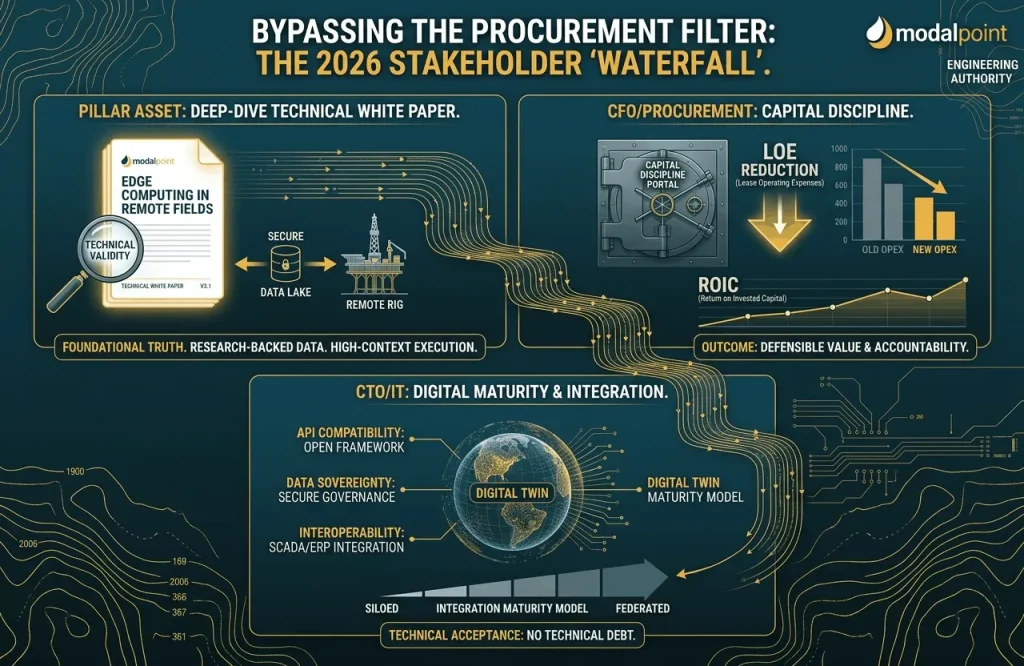
In 2026, the “unified sales pitch” is an antique. The decision-making unit for an industrial contract has expanded, and each participant has a different set of anxieties and KPIs. Your digital visibility strategy must acknowledge this fragmented reality. A CTO evaluating your software for API compatibility and data sovereignty does not care about the same features as a CFO who is auditing lease operating expenses (LOE). Successful oil and gas digital visibility requires a “waterfall” content strategy. This involves taking a deep-dive technical asset, such as a whitepaper on edge computing in remote fields, and cascading it into hyper-specific narratives for every seat at the table.
The CFO and Procurement: Capital Discipline as a Service
The financial arm of an energy company is looking for “Value over Volume.” In a world of fluctuating commodity prices and high interest rates, they need to see a clear path to ROIC. Your content for this persona should focus on capital discipline, reduction in OPEX, and the mitigation of financial risk. They want to know if your solution will improve the bottom line in the current fiscal year. If you cannot provide a “Value over Volume” analysis, you will never make it past the initial budgetary review. Visibility for this group is achieved through case studies that emphasize “Defensible Value” and “Accountability.”
The CTO and IT Director: Managing the Digital Twin Maturity Model
The IT department is the gatekeeper of the modern oilfield. They are wary of “Siloed Solutions” that don’t talk to their existing ERP or SCADA systems. When writing for this persona, the focus must be on cybersecurity, API compatibility, and data governance. They are looking for “Digital Twin” integration maturity. Your technical briefs must demonstrate how your solution fits into their existing data lake without creating more technical debt. If your marketing doesn’t address “Data Sovereignty” or “Interoperability,” the CTO will veto your solution before it even reaches the pilot stage.
The ESG Officer: Methane Intensity and Regulatory Compliance
With increasing pressure from investors and regulators, the ESG officer has become a major stakeholder in the commercialization process. They are looking for solutions that provide accurate methane detection and verifiable sustainability reporting. Content tailored for this audience must be rooted in transparency and measurable outcomes. They need to see how your equipment or software helps them meet carbon intensity targets without sacrificing production efficiency. Providing “High-Fidelity Data” on environmental impact is no longer optional. It is a requirement for visibility in the 2026 market.
GEO: The Rise of Generative Engine Optimization in Energy
Perhaps the most significant shift in EWR Digital Houston strategies is the transition from traditional search engines to Generative Engines. Modern buyers are no longer just scrolling through ten blue links. They are asking AI assistants to find the top three providers of subsea leak detection systems with proven integration in the Gulf of Mexico. If your content isn’t structured to be read and cited by these Large Language Models (LLMs), you have an “AI Visibility” gap that will eventually lead to revenue loss.
Generative Engine Optimization (GEO) requires a different approach to content structure. AI engines prioritize “Structured Data” and “High-Fidelity Insights.” They look for clear, authoritative answers to complex questions. This is why we advocate for the use of detailed tables, specific technical bullet points, and FAQ sections that directly address “People Also Ask” queries on Google. By providing these LLMs with the precise data they crave, you increase the likelihood that your brand is the one recommended during the AI-driven research phase of the procurement process.
- Detailed Solution Briefs: Move away from “Features” and toward “Outcomes.” A solution brief should be a one-page distillation of how a specific technology solves a specific operational bottleneck.
- Factual Q&As: Structure content as direct answers to industry-specific technical questions to win “Position Zero” and Featured Snippet boxes.
- Podcast Integration: Use talking points from the Oil and Gas Global Network (OGGN) to bridge the gap between offline authority and online data signals.
The 2026 Operational Directive: Engineering Content for Impact
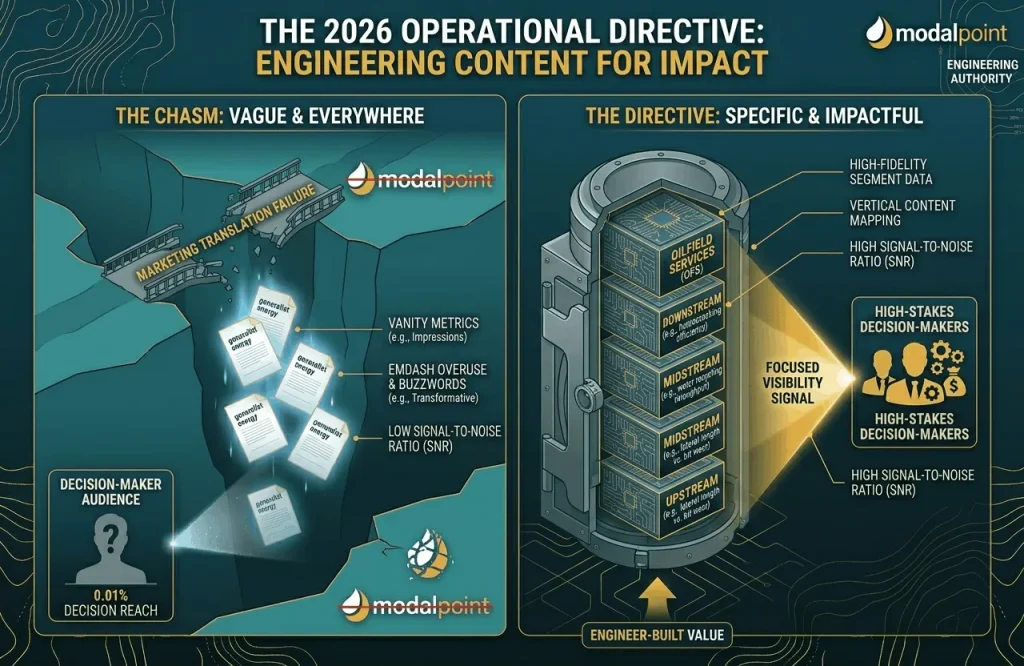
The gap between engineering and marketing in the energy sector is often a chasm. The engineers build the value, but the marketing teams fail to translate it. To fix this, you must treat your content creation like an engineering project. This “operational directive” ensures that every piece of content is vertically aligned with the segment it serves, whether that is Upstream, Midstream, Downstream, or Oilfield Services. You cannot use the same narrative for a refinery manager that you use for a completions engineer.
Furthermore, your visibility strategy must account for the “Digital Visibility Trap,” which is the idea that being “everywhere” is as good as being in the “right place.” In 2026, authority is built through niche domination. It is better to be the absolute authority on “Permian Basin water midstream logistics” than to be a generalist energy consultant with no specific domain expertise.
This niche authority is what allows you to bypass the noise and speak directly to the high-stakes decision makers who are actually signing the checks.
Vertical Alignment and Reputation Amplification
Finally, building visibility in Houston requires “Reputation Amplification.” This involves tying your digital brand back to the physical world of the oilfield. This can be achieved through strategic partnerships, guest appearances on industry podcasts, and maintaining a presence at technical conferences like OTC or SPE events. The goal is to create a feedback loop where your offline credibility creates online data signals that improve your search and AI visibility. When a buyer hears your name on a podcast and then sees your authoritative technical brief at the top of an AI search, the trust is already established. That is how you bypass procurement purgatory.
The Houston oil and gas market in 2026 is a digital-first environment where authority and technical precision are the only currencies that matter. If your visibility strategy is still based on 2020 tactics, you are losing ground every day. The industry is not waiting for you to catch up; the buyers have already moved on to the next generation of data-driven, ROIC-obsessed advisors.
Next Step: Does your current sales deck pass the AI Visibility test?
The reality is that most sales decks and technical whitepapers are invisible to the algorithms that drive 2026 procurement. Should we analyze your current “Pillar Assets” and transform them into a series of AI-visible solution briefs specifically for your most important stakeholders?
RELEVANT STATISTIC:
As of late 2025, over 70% of B2B buyers in the industrial sector reported that they prefer a “representative-free” sales experience, relying instead on digital research, AI-summaries, and peer-reviewed technical documentation to make final procurement decisions.
Source: Gartner
The governance stakes have risen since this was written. TRAIGA, the EU AI Act, and NIST AI RMF now make AI-influenced decisions something an operator has to be able to defend on the record, which is exactly what ModalPoint’s DIG framework is built for.