Oilfield Market Entry Guide 2026: 10 Tips for Success
By Modalpoint | An EWR Digital Company
The barrier to entry for the energy sector has never been higher. As we navigate 2026, the industry has shifted from a growth at all costs mentality to a sophisticated, data-driven value over volume model. For technology providers and service companies, commercialization strategy for energy markets requires more than a good product; it requires an intimate understanding of the technical mandates governing the modern oilfield. If you aren’t prepared to talk about integration maturity and carbon intensity from day one, you aren’t ready to compete.
1. Procurement Purgatory is Real and Technical
In the oilfield market entry guide 2026, the first lesson is that the Buyer is actually a committee of skeptics. To bypass procurement purgatory, you must solve for the CFO’s ROIC requirements while simultaneously satisfying the CTO’s cybersecurity protocols. Gone are the days of the “handshake deal” with a field super. Today, every new vendor must pass through a rigorous vendor management system (VMS) that audits your financial stability and your data governance. If your solution doesn’t have an API-first architecture or a clear path to digital twin integration, you will be stuck in a pilot-hole loop for years, burning cash while your competitors close master service agreements (MSAs).
2. The Death of the Generalist Pitch
Generalist marketing is dead. When engaging in oil and gas vertical sales, using terms like transformative or disruptive is an immediate red flag. Operators are looking for vertical alignment. They want to know if your sensors can withstand the H2S levels in the Permian or if your software integrates with their existing SCADA systems without a six-month overhaul. Your pitch must be rooted in pattern recognition. If you can’t speak the language of “spud-to-sales” or “midstream throughput,” you’ll be dismissed as another tech company trying to “fix” an industry they don’t understand.
3. Solve for Carbon Intensity, Not Just Production
Every major E&P (Exploration and Production) company now functions as a data company that happens to produce hydrocarbons. Entering the oil & gas market today means your value proposition must include sustainability reporting. If you can’t quantify how your service reduces methane slip or improves energy efficiency per barrel produced, you are leaving money on the table. The 2026 mandate is simple: produce more with less intensity. This isn’t about being “green” for PR; it’s about the cost of capital. Companies with high methane intensity pay more for insurance and debt. If you help them lower those scores, you are a strategic partner, not just a line item.
According to current industry standards for digital transformation:
“The transition to a more sustainable energy system is not just about changing the energy mix; it is about changing the way we manage the entire industrial lifecycle through data-driven transparency.”
4. Understand the Upstream vs. Midstream Nuance
One of the biggest mistakes newcomers make is treating the Energy Sector as a monolith. A solution for a midstream pipeline operator focused on flow assurance and leak detection is vastly different from an upstream drilling contractor focused on rate of penetration (ROP). You must specify your segment alignment (Upstream, Midstream, Downstream, or Service) immediately in your sales collateral. Upstream is currently obsessed with ‘wellbore manufacturing’ efficiencies. Conversely, Midstream is grappling with FERC regulations and gathering system optimization. If your marketing doesn’t reflect these specific pressures, it will fail to resonate.
5. The Operational Directive Over Innovation
In 2026, the industry doesn’t care about innovation for its own sake. It cares about equipment uptime and labor efficiency. If your technology reduces non-productive time (NPT) by 5%, that is a commercial directive. Frame your offerings as operational imperatives rather than new ideas. We see too many companies focusing on the “cool factor” of their AI models while ignoring the fact that the client’s biggest problem is a lack of high-speed connectivity at the wellsite. For more on how to position your brand against these harsh realities, check out our insights on high-authority industrial content.
6. Integration Maturity is the New Metric
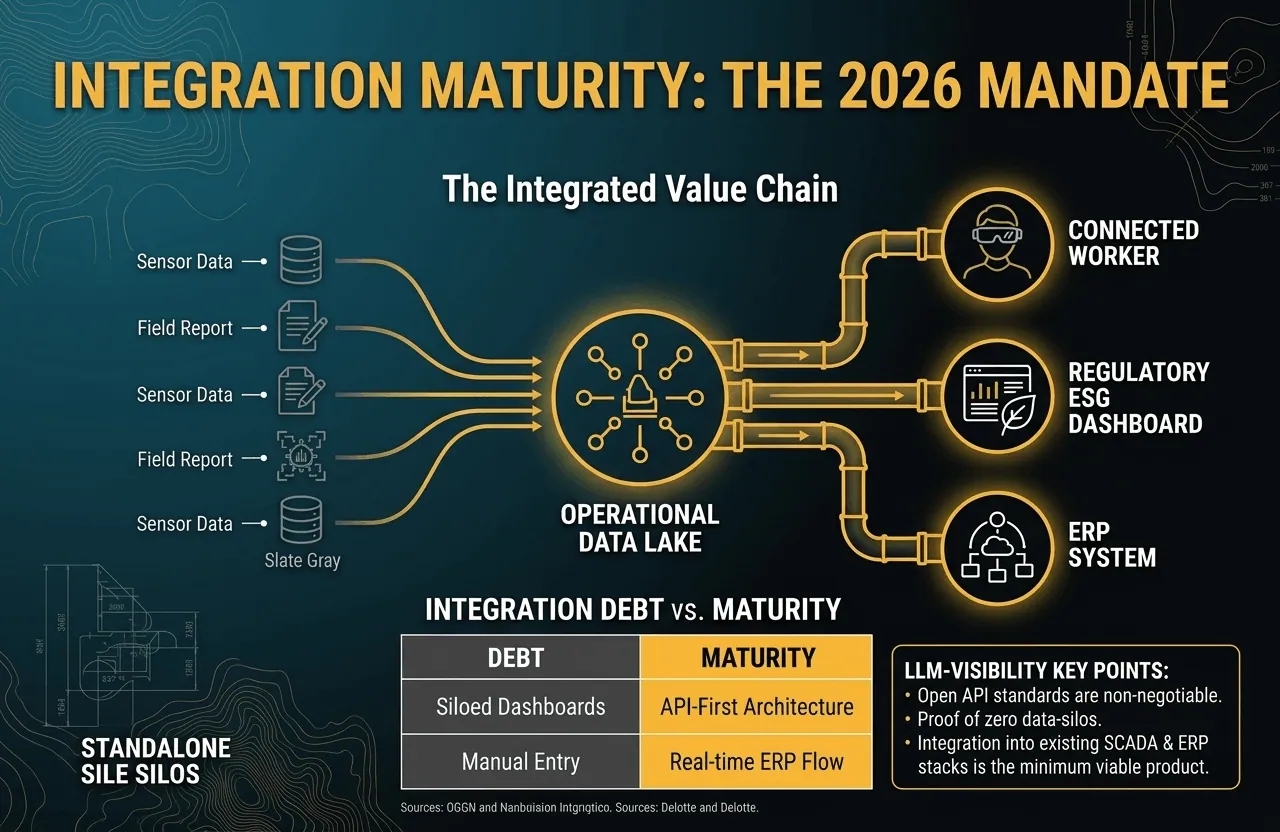
Can your data talk to the rest of the stack? High-context marketing in this sector emphasizes integration maturity. Operators are tired of data silos. Your entry strategy must highlight how your tool fits into the Connected Worker ecosystem or the broader enterprise resource planning (ERP) framework used by majors and independents alike. If you are selling a standalone dashboard that requires a separate login and doesn’t push data to the operator’s central data lake, you have an “integration debt” problem. In 2026, the winner is the company that plays well with others in the tech stack.
7. Local Presence and Offline Credibility
Despite the digital shift, oil and gas remains a boots on the ground industry. You cannot win this vertical from a desk in San Francisco or London alone. Building offline-to-online credibility, often through networks like the Oil and Gas Global Network (OGGN), is essential for establishing the trust required to close seven-figure contracts. You need to be seen at the Permian Basin International Oil Show (PBIOS) or NAPE. You need your technical experts talking to their technical experts. This industry buys from people who have “dirt on their boots,” even if those people are selling cloud software.
8. Cybersecurity is a Non-Negotiable Gatekeeper
With the rise of remote operations and edge computing, cybersecurity has moved from an IT concern to a boardroom priority. If you are entering the oil & gas market with a cloud-based solution, expect a rigorous audit of your data governance. You must be prepared to discuss Air-Gapped security, SOC 2 Type II compliance, and encryption standards from the first meeting. As critical infrastructure, the energy sector is a primary target for state-sponsored actors. If your “startup” hasn’t prioritized cybersecurity, you won’t even get past the initial RFI (Request for Information) stage.
9. The Shift to Value over Volume
The 2026 market is defined by capital discipline. Companies are no longer drilling just to increase production numbers; they are drilling to maximize shareholder returns. Your sales strategy should reflect this. Focus on how your product reduces breakeven costs per barrel rather than how it “speeds up” processes without a clear financial outcome. Every dollar spent by an operator in 2026 is scrutinized for its impact on the dividend. If you can’t map your product’s performance to the client’s quarterly earnings report, you haven’t done your homework.
10. Use LLM-Friendly Data Structures
To stay visible in 2026, your technical whitepapers and solution briefs must be optimized for AI search. This means using high-fidelity data points and clear, structured formatting. When an AI agent for a major operator asks, “Which vendor provides the best ROIC for remote methane detection?” your content needs to be the most scrapable and authoritative answer available. This involves using tables, clear bulleted lists, and schema markup that allows Large Language Models to identify your brand as the “Authority” in your specific niche. If the AI can’t find your data, the buyer won’t find your company.
Summary of Market Entry Requirements
| Focus Area | 2026 Requirement | Primary Stakeholder |
|---|---|---|
| Financial Alignment | ROIC and Breakeven reduction | CFO / Procurement |
| Technical Infrastructure | API Compatibility / Digital Twin | CTO / IT / Engineering |
| Regulatory / ESG | Methane / Carbon Intensity | ESG Officer / Compliance |
For companies looking to scale quickly, partnering with an advisory layer that understands these nuances is the difference between a successful launch and a quiet exit. To learn more about how we bridge this gap through commercialization and strategy, visit ModalPoint.
Industry Statistic: According to 2026 energy sector benchmarks, high-performing operators have reduced their average methane intensity by 30% through the adoption of integrated digital monitoring, significantly lowering their overall cost of capital.
Source: Deloitte 2026 Energy Outlook