Sales Marketing Alignment Oil & Gas: Fix Bad Lead Quality
By Matthew Bertram | EWR Digital
If you have sat in a pipeline review where sales blames marketing for weak leads and marketing blames sales for ignoring them, you already know how expensive this argument is. It is not a personality problem. It is a structural one, and in energy and oilfield services, where deal cycles are long and buyers are technical, the cost of that friction shows up directly in stalled pipeline and missed quota. Sales marketing alignment in oil and gas is not a soft skills initiative. It is a governance problem with a measurable fix.
This post breaks down why the finger pointing happens, what it is actually costing energy companies, and the specific system changes that close the gap for good.
Why Sales and Marketing Keep Blaming Each Other in Energy Sector Sales Cycles
The complaint sounds the same in almost every organization. Sales says the leads marketing hands off are not real buyers, just names that downloaded a whitepaper. Marketing says sales never follows up fast enough, and by the time someone calls, the lead has gone cold or moved to a competitor. Both sides are usually right, and that is exactly the problem.
The Root Cause: No Shared Definition of a Qualified Lead
In most oilfield services and energy companies, marketing and sales never sat down and agreed on what a qualified lead actually looks like. Marketing counts a form fill or a webinar registration as a win. Sales wants a named decision maker at a company with an active project, budget, and timeline. Without a documented, shared definition, every handoff becomes a debate instead of a process.
The Second Cause: No Accountability on Either Side of the Handoff
Even when a lead is genuinely good, there is often no service level agreement governing what happens next. Marketing has no visibility into whether sales followed up in five minutes or five days. Sales has no visibility into what content or campaign actually attracted the lead in the first place. Each team operates in its own system, measuring its own metrics, with no shared scoreboard.
What Poor Oilfield Services Lead Quality Actually Costs You
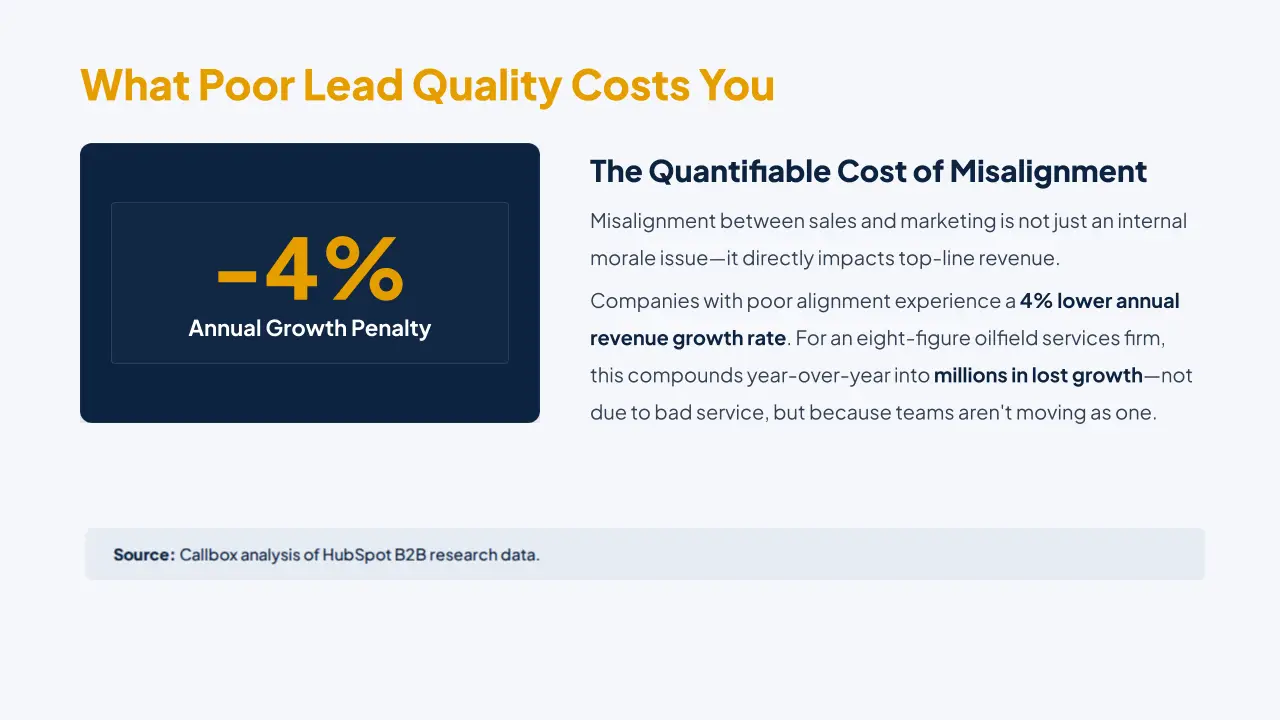
This is not just an internal morale issue. Misalignment between sales and marketing has a direct, quantifiable impact on revenue, and the data on this is not close.
“Companies with poor b2b marketing and sales alignment see a 4% lower revenue growth rate each year compared to their aligned peers,” according to Callbox’s analysis of HubSpot research.
For a mid-sized energy services firm running eight figures in annual revenue, that gap compounds year over year into millions of dollars in lost growth, not because the product or service is wrong, but because sales and marketing are not moving as one team.
Where the Money Actually Leaks
The leak rarely shows up as a single dramatic failure. It shows up as a pattern: leads that sit untouched for days, campaigns built around personas that do not match what sales is actually closing, and account executives building their own outreach lists because they do not trust what marketing sends them. Multiply that across every rep and every campaign, and you have a sales enablement problem hiding inside what looks like a lead generation problem.
Building Real Energy Sector Sales Enablement: The Fix That Works
Fixing this does not require a reorganization or a new headcount. It requires a small number of shared systems that force sales and marketing to operate against the same definitions, the same data, and the same accountability.
Step One: Document a Shared Lead Definition
Sales and marketing need to agree, in writing, on what separates a marketing qualified lead from a sales qualified lead. For energy and oilfield services companies, this usually means specifying the buyer’s role, the type of project, budget signals, and timeline, not just engagement activity like a content download. Once this is documented, both teams can be measured against the same standard instead of arguing about it every quarter.
Step Two: Set a Follow-Up Service Level Agreement
Speed to lead is one of the most fixable problems in any go to market motion. A written SLA that specifies how quickly sales must respond to a qualified lead, and how marketing will route and prioritize that lead, removes the ambiguity that causes leads to go cold. This single change often has a bigger revenue impact than any new campaign or ad spend increase.
Step Three: Build a Feedback Loop, Not a Complaint Loop
When sales rejects a lead, that rejection needs a reason code, not just silence. Was the budget too small, the timing wrong, or the contact the wrong persona? When marketing has that data, campaigns and targeting improve instead of repeating the same mistakes. This turns “these leads are bad” from a complaint into a data point marketing can actually act on.
Step Four: Put Both Teams on One Shared Dashboard
Sales and marketing should be looking at the same numbers in the same system, tracking lead volume, response time, conversion rate, and revenue attribution together. When both teams are judged on the same pipeline outcomes instead of separate departmental metrics, the incentive to point fingers disappears because there is nowhere left to point.
Why This Matters More in Oil and Gas Than in Most Industries
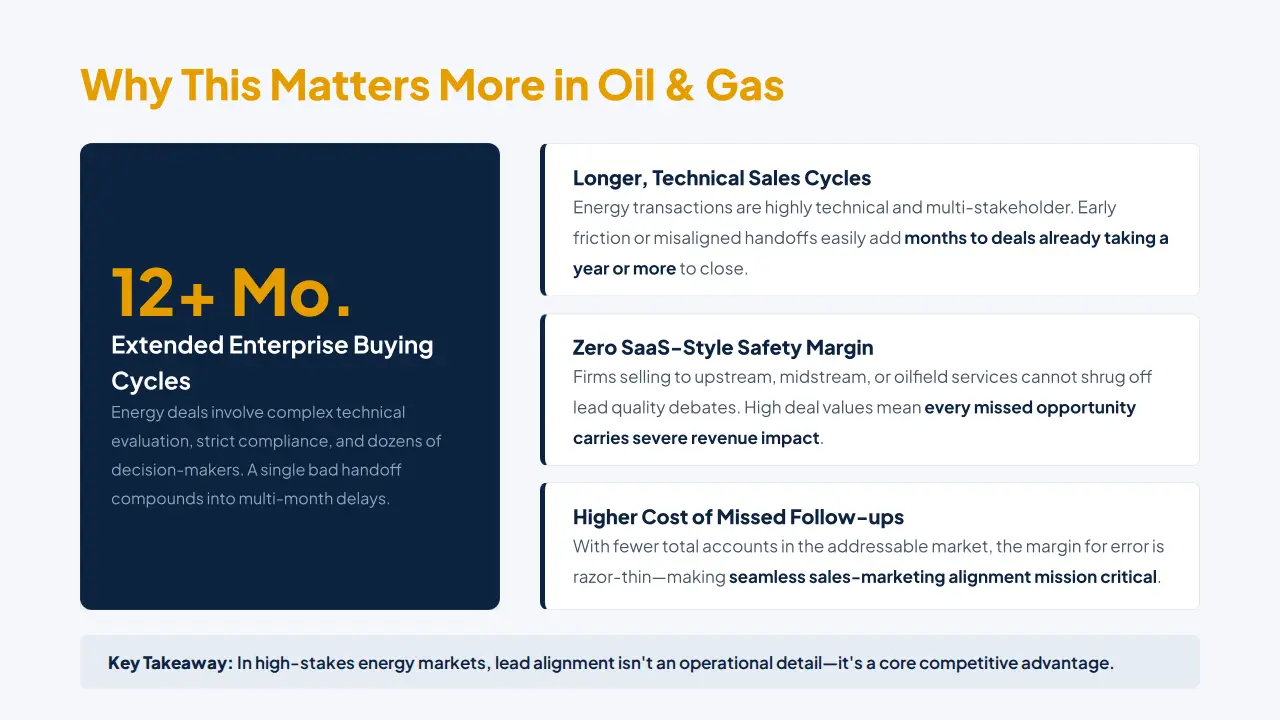
Energy sector buying cycles are longer, more technical, and involve more stakeholders than a typical B2B sale. A single misaligned handoff early in the process can add months to a deal that already takes a year or more to close. Companies selling into upstream, midstream, or oilfield services markets cannot afford the same lead quality debates that a fast moving SaaS company might shrug off. The margin for error is smaller, and the cost of a missed follow-up is higher.
Final Thoughts on Fixing the Sales and Marketing Divide
The tension between sales and marketing is rarely about effort. It is about the absence of shared definitions, shared accountability, and shared data. Energy and oilfield services companies that fix this at the system level, rather than trying to fix it in a single tense meeting, see the finger pointing stop because the structure no longer allows it to continue. If your teams are stuck in the same argument every quarter, the fix is not a pep talk. It is a governed process both sides can see and trust. Learn more about how ModalPoint helps energy companies build the systems that keep sales and marketing rowing in the same direction.