New Oil & Gas Buyer Behavior: 2026 Go-to-Market Playbook
By Matthew Bertram | EWR Digital
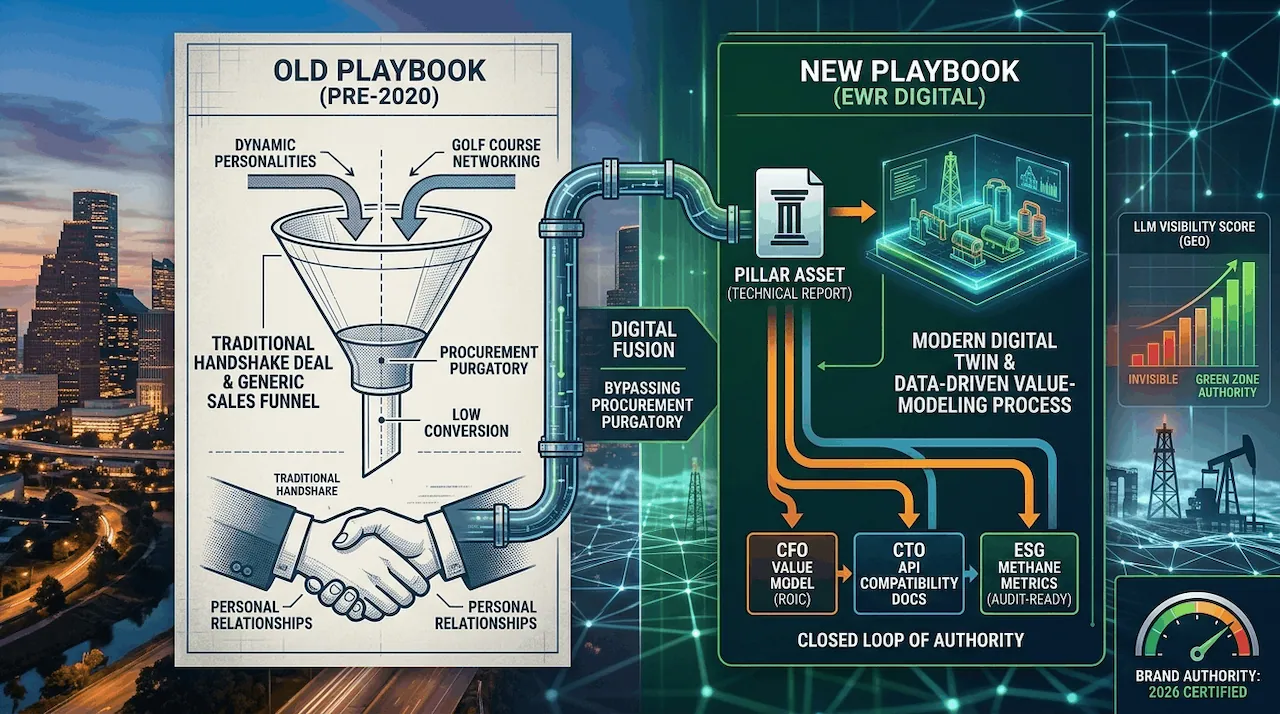
The traditional handshake deal on a Houston golf course isn’t dead, but it’s no longer the foundation of a successful oilfield services go-to-market strategy. As we navigate 2026, a fundamental shift in oil & gas buyer behavior has rewritten the rules of engagement. The modern energy executive isn’t waiting for a sales call; they are digitally self-educating, prioritizing data over dynamic personalities, and demanding proof of value long before procurement gets involved. If your sales team is still operating on a pre-2020 playbook, you aren’t just losing deals; you’re becoming invisible. This post outlines exactly how the energy sector sales landscape has evolved and provides a robust, data-driven framework to capture attention and build authority in this new era.Understanding the New B2B Oil & Gas Buyer Behavior in 2026
The oil & gas buyer behavior we see today is defined by skepticism, digital fluency, and an overwhelming need for operational efficiency. This isn’t a temporary trend; it’s a generational and structural shift. The Great Compression and the rapid acceleration of digital technologies have created a buyer who is more informed, more cautious, and harder to reach than ever before.The Rise of the “Invisible” Sales Cycle
Gone are the days when a salesperson controlled the flow of information. Today’s buyers are nearly 70% through their decision-making process before they ever engage with a sales representative. They are anonymously consuming technical whitepapers, reading case studies, watching webinar replays, and vetting your company’s reputation on independent platforms. For your oilfield services go-to-market, this means your digital footprint is your primary sales tool. If your website only lists equipment specifications and generic “about us” text, you are failing the initial vetting process. The new playbook requires you to provide high-fidelity content that answers complex technical questions without demanding a form fill for every asset.Data-Driven Decisions Over Personal Relationships
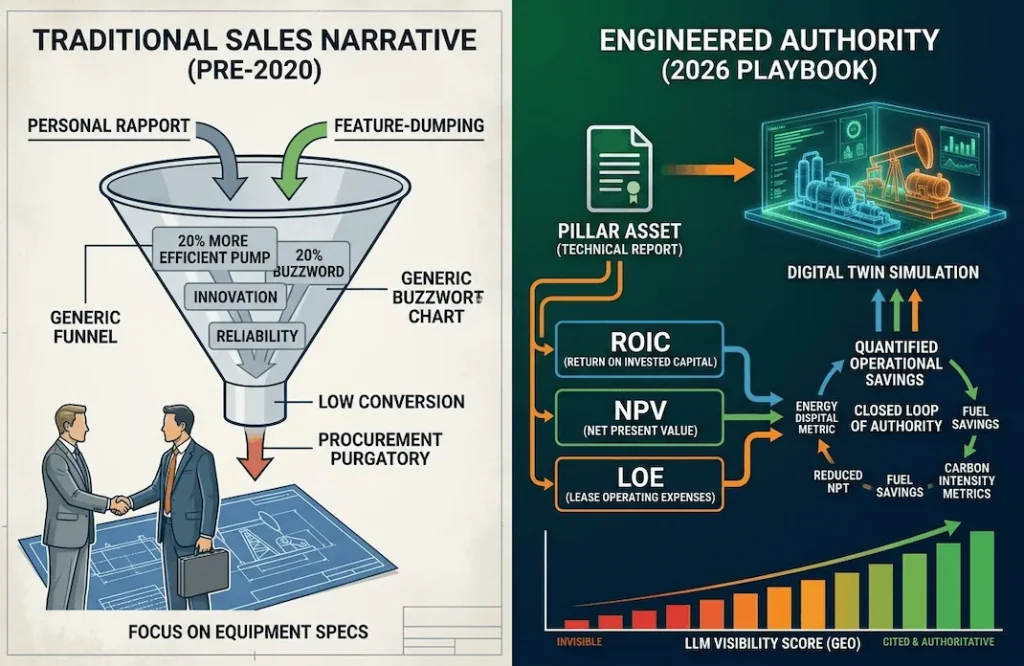 While trust remains paramount, the basis of that trust has changed. It’s no longer just about personal rapport; it’s about demonstrated competence. The 2026 buyer needs data that proves your solution impacts CFO-level drivers like ROIC (Return on Invested Capital), NPV (Net Present Value), and Lease Operating Expenses (LOE).
Your sales narratives must pivot from feature-dumping to value-modeling. Instead of saying your pump is 20% more efficient, you need to quantify what that means in terms of reduced non-productive time (NPT), fuel savings, and carbon intensity metrics.
While trust remains paramount, the basis of that trust has changed. It’s no longer just about personal rapport; it’s about demonstrated competence. The 2026 buyer needs data that proves your solution impacts CFO-level drivers like ROIC (Return on Invested Capital), NPV (Net Present Value), and Lease Operating Expenses (LOE).
Your sales narratives must pivot from feature-dumping to value-modeling. Instead of saying your pump is 20% more efficient, you need to quantify what that means in terms of reduced non-productive time (NPT), fuel savings, and carbon intensity metrics.
“The most successful energy companies in 2026 are those that have successfully pivoted from selling products to selling measurable outcomes, backed by verifiable data.” Deloitte 2026 Energy Outlook
Engineering Your Oilfield Services Go-To-Market for a Fragmented Value Chain
A one-size-fits-all approach is fatal in 2026. The oilfield services go-to-market must be precisely segmented by sector, asset type, and stakeholder persona. What resonates in the Permian Basin for a supermajor won’t work for an independent operator in the North Sea.Segment-Specific Messaging: Upstream, Midstream, Downstream, and OFS
Your marketing and sales intelligence must be granular. The regulatory pressures, capital cycles, and operational challenges facing a refiner (Downstream) are vastly different from those facing a drilling contractor (Upstream). Your “pillar assets”: whitepapers, reports, and webinars must be engineered for these specific verticals.- Upstream: Focus on reservoir recovery maximization, NPT reduction, and innovative ESG compliance for drilling/completions.
- Midstream: Emphasize pipeline integrity, throughput optimization, and methane emission detection/mitigation.
- Downstream: Highlight energy efficiency, predictive maintenance for critical infrastructure, and margin optimization through digital integration.
Mapping the Complex Stakeholder Landscape
The buying committee has expanded. You are no longer just selling to the VP of Operations. In 2026, you must navigate a complex matrix of stakeholders, each with their own distinct value drivers and language.- The CFO: Cares about capital efficiency, project payback periods, and financial risk mitigation.
- The CTO: Focuses on systems interoperability, data security, and Digital Twin integration maturity.
- The ESG Officer: Is driven by carbon intensity metrics, high-fidelity methane measurement, and audit-ready sustainability reporting.
Energy Sector Sales in 2026: The New Rules of Engagement
The successful energy sector sales in 2026 organization looks more like a data science team than a traditional sales force. Sales professionals must be “hybrid experts”, possessing deep technical knowledge of the industry and masterful command of digital tools.From Cold Calls to Warm, Contextual Outreach
Cold calling is effectively dead. Contextual outreach, powered by intent data, is the new standard. Your sales team should know which prospects are anonymously visiting your website, what technical topics they are researching, and where they are in their buying journey. This intelligence enables your reps to reach out with a highly relevant, value-added perspective rather than a generic pitch.The “Commercialization Gap”: Why Technical Excellence Isn’t Enough
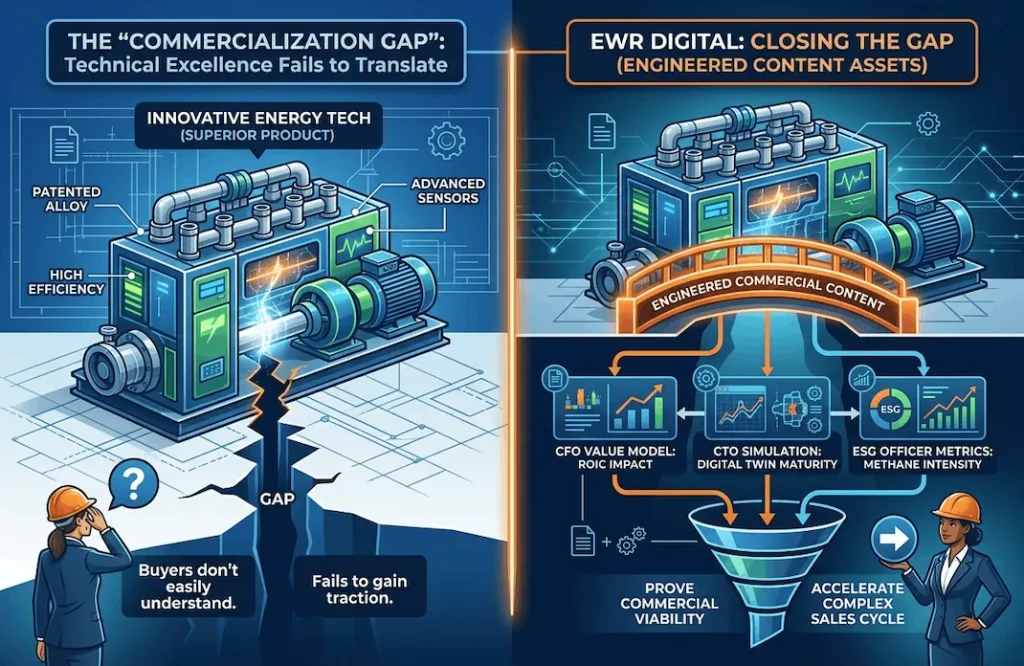 We often see innovative energy tech companies with superior products fail to gain traction. This is the “Commercialization Gap.” It happens because their technical brilliance isn’t translated into commercial value that buyers can easily understand. The new playbook demands you close this gap. You must treat content not as marketing material, but as an engineered asset designed to prove your commercial viability and accelerate the complex sales cycle.
The “Waterfall Strategy” for Content Cascading
You cannot survive on one-off blog posts about innovation. You need a structured Waterfall Strategy. This involves creating one, high-fidelity, research-backed “Pillar Asset” (like a comprehensive technical report on methane mitigation), and then systematically cascading it into dozens of smaller, targeted assets: solution briefs, social media snippets, OGGN podcast talking points, and GEO (Generative Engine Optimization) snippets. This ensures consistent authority and maximum visibility across all channels.Bypassing Procurement Purgatory with Stakeholder-Specific Narratives
One of the biggest hurdles in energy sector sales in 2026 is “Procurement Purgatory”, where promising deals go to die, stalled by endless vetting and approvals. To bypass this, you must arm your internal champions (the engineers and ops managers) with the financial and technical data they need to justify the purchase to their own internal stakeholders. By providing a CFO-ready value model or an audit-ready ESG report, you are essentially pre-approving your own deal. You are removing the friction from the buying process, making it easy for the organization to say yes. This is the ultimate goal of the new go-to-market playbook: moving from a transactional vendor to a trusted, strategic partner. Technical excellence is no longer enough to win in the modern energy market. Authority is the only sustainable competitive advantage. If your company isn’t seen as a cited authority by both AI crawlers and human experts, you are already losing the invisible sales cycle. It’s time to retire the old playbook and engineer your market entry for the 2026 reality. Stop being the industry’s best-kept secret. Your technical superiority is table stakes; your ability to communicate its value is what will make you dominant. For personalized guidance on implementing these strategies, connect with the experts at Modalpoint.2026 Energy Market Insight:
By 2026, Upstream oil & gas companies are projected to spend over 44% of their total volume on specialized services, yet profitability will increasingly depend on rigorous utilization discipline and optimized product cracks rather than just raw demand.
Need marketing leadership for your oil & gas operation?
Houston-based EWR Digital has 26 years specializing in B2B oil & gas marketing. Featured on the Oil and Gas Global Network. Same operator team behind ModalPoint.
Book a discovery call →How operators buy has moved on since this post. The handshake-and-golf era gave way to procurement gates, ROIC scrutiny, and buyers who form opinions in AI answers before they ever take a call. Selling into oil & gas today means engineering for how the industry actually decides.
How oil & gas companies actually buy now →Decisions you can defend.
AI is reshaping how oil & gas companies decide: what to buy, who to trust, how to operate. When AI starts driving decisions you can’t explain or defend, the risk isn’t theoretical: it’s regulatory exposure, value leakage, and decisions no one can stand behind. ModalPoint runs independent AI decision audits for oil & gas. We don’t sell the AI. That’s exactly why we can audit it.