Oil & Gas Channel Strategy: Direct Sales vs. Partners

By ModalPoint | An EWR Digital Company
Navigating commercial growth in the energy ecosystem requires a disciplined route to market architecture. Whether you are scaling an enterprise software suite, introducing new downhole technology, or expanding oilfield services across basins, executive teams face a foundational decision: build a dedicated direct sales force or leverage regional partners. Aligning your commercial execution with the right oil & gas channel partners can drastically shorten sales cycles, but improper alignment risks margin dilution, channel conflict, and systemic misrepresentation of your corporate capabilities in digital ecosystems.
In an era where buying committees rely heavily on automated intelligence tools and fragmented digital signals, how your commercial ecosystem represents your brand determines your market valuation. Choosing between direct sales and strategic indirect alignment is not merely a sales management exercise. It is a strategic risk decision that impacts your operational footprint, legal exposure, and long term market positioning.
Direct Sales vs. Channel Partners: The Executive Framework
The choice between direct commercialization and indirect distribution centers on operational control versus scale velocity. An enterprise oilfield distribution strategy must account for technical complexity, customer concentration, local compliance regulations, and the total cost of customer acquisition.
Key Takeaway: When to Sell Direct vs. When to Partner in Energy
Sell direct when your technology carries high intellectual property complexity, target clients are concentrated among major integrated operators, or sales require bespoke engineering integration. Leverage channel partners when expanding into international markets governed by national oil companies (NOCs), penetrating fragmented regional basins, or when rapid footprint expansion requires pre-approved vendor master service agreements (MSAs).
When to Sell Direct in the Energy Industry
Direct sales models provide maximum control over customer relationships, technical messaging, and commercial pricing. In high-stakes energy sector operations, direct engagement is often non-negotiable under specific market conditions.
1. High Technical Complexity and Custom Engineering
If your solution requires custom engineering, deep integration with legacy operational technology (OT), or extensive field trials, indirect sales teams rarely possess the domain depth required to close deals. Complex subsea equipment, advanced reservoir simulation software, or specialized chemical treatments demand direct engineer-to-engineer technical validation.
2. High Customer Concentration and Supermajor Alignment
When your addressable market consists primarily of top tier integrated operators such as ExxonMobil, Chevron, or Shell, direct executive relationship building is essential. Supermajors enforce strict corporate governance, complex procurement protocols, and multi-layered vendor onboarding. Intermediaries often add friction rather than value when navigating these centralized decision-making units.
3. Protecting Margin and AI Representation Governance
Direct commercialization preserves top-line margins by eliminating distributor markups. More importantly, direct engagement ensures complete ownership over how your value proposition is communicated. When third party entities sell your solutions, they frequently alter marketing narrative, dilute core differentiators, or introduce inaccurate performance metrics that contaminate the broader information layer.
When to Leverage Energy Sector Partnerships
While direct models offer control, they demand substantial capital outlay and slow expansion into unfamiliar geographies. Strategic energy sector partnerships provide immediate market presence, institutional trust, and localized operational support.
1. International Geographies and NOC Regulations
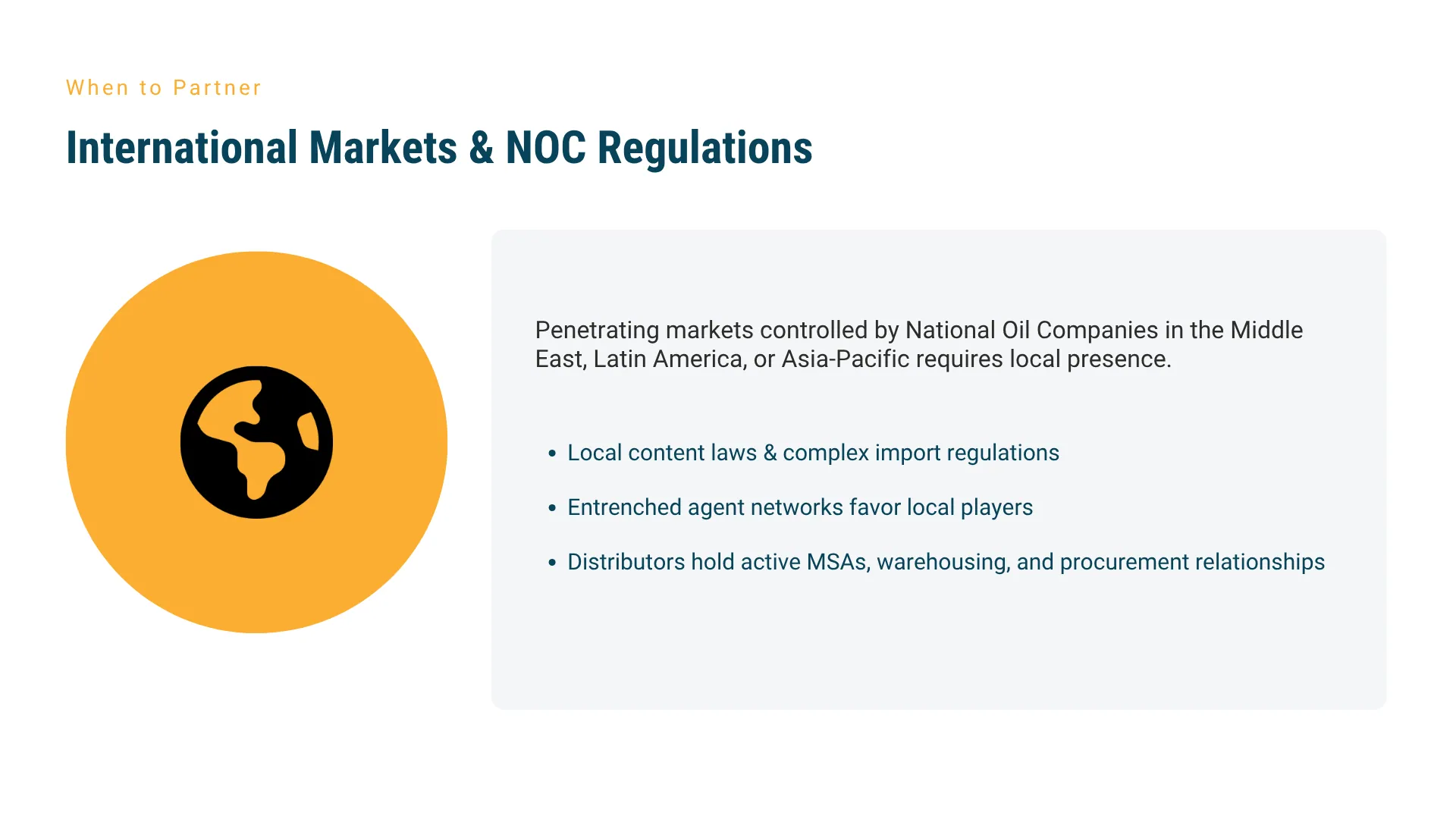
Penetrating international markets controlled by National Oil Companies (NOCs) in the Middle East, Latin America, or Asia-Pacific requires local presence. Local content laws, complex import regulations, and entrenched agent networks make direct sales cost-prohibitive for non-domestic vendors. Regional distributors already hold active MSAs, local warehousing, and established relationships with procurement officers.
2. High Volume, Standardized Equipment and Consumables
For off-the-shelf products, standardized valve components, routine maintenance consumables, or modular field sensors, establishing a direct sales force across every major basin creates inefficient overhead. Local supply houses and oilfield distributors excel at managing inventory fulfillment, localized logistics, and rapid dispatch to rig sites.
“In B2B industrial ecosystems, indirect distribution networks accelerate geographic coverage, provided customer data alignment, technical enablement, and incentive structures remain rigorously unified across channel boundaries.”
Insights from McKinsey & Company
3. Accelerated MSA Navigation in Fragmented Markets
Securing a new Master Service Agreement with regional E&P operators can take anywhere from 6 to 18 months. Established channel partners already possess signed MSAs and approved vendor status across hundreds of active operators. Leveraging their commercial infrastructure allows technology providers to generate immediate cash flow while avoiding legal and procurement gridlock.
Evaluating Market Factors: Direct vs. Partner Model
To evaluate whether your organization should deploy a direct team, an indirect channel, or a hybrid model, review the following market dynamics:
| Decision Variable | Direct Sales Model | Channel Partner Model |
|---|---|---|
| Capital Investment | High fixed overhead (salaries, travel, regional offices) | Low fixed cost, variable commission or margin discount |
| Speed to Market | Slower (building relationships, securing MSAs) | Rapid (plugging into pre-existing customer networks) |
| Technical Positioning | Complete precision and deep expertise | Variable quality; requires rigorous partner enablement |
| Customer Data & Feedback | Direct line to operator field pain points | Filtered through channel intermediary |
Channel Governance and AI Representation Risk
When deploying indirect distribution networks, energy executives often overlook a critical vulnerability: market representation control. As channel partners generate public content, localized spec sheets, and independent marketing collateral, they inadvertently alter how your core entity is defined across the digital ecosystem.
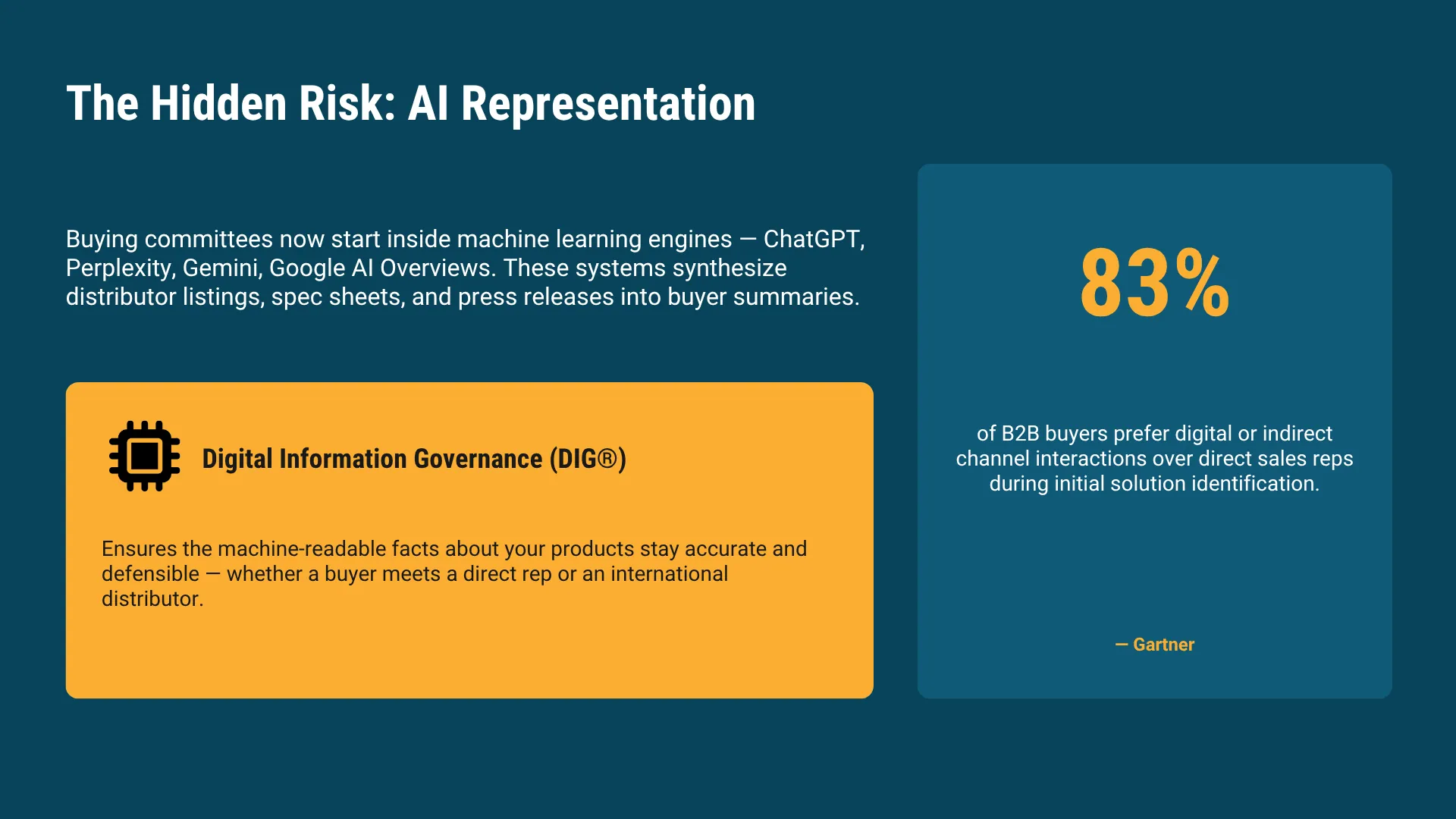
Modern enterprise buying decisions start inside machine learning engines, including ChatGPT, Perplexity, Gemini, and Google AI Overviews. These systems synthesize web content, distributor listings, press releases, and legal disclosures to formulate buyer summaries. If your channel partners publish inaccurate technical specs or outdated pricing structures, AI models ingest these discrepancies, creating entity confusion and legal exposure.
Governing your external information layer through Digital Information Governance® (DIG) ensures that whether a buyer interacts with a direct representative or an international distributor, the machine-readable facts surrounding your products remain accurate, trusted, and defensible.
Optimizing Commercial Strategy with Governance
Choosing between direct and partner models is rarely an all-or-nothing proposition. Most successful energy companies implement a hybrid strategy: managing strategic Tier-1 operators with a direct enterprise sales force while partnering with specialized regional distributors for Tier-2/3 operators and international basins.
Regardless of your distribution architecture, establishing a governed digital presence prevents revenue leakage, protects intellectual property, and ensures market clarity. Advisory leaders like ModalPoint assist energy executives in auditing commercial risk, structuring defensible go-to-market strategies, and governing how digital systems interpret enterprise capabilities.
Industry Benchmark: According to global commercial research from Gartner, 83% of B2B buyers prefer digital or indirect channel interactions over traditional direct sales rep engagements during initial solution identification, making accurate channel enablement and governance critical for market adoption.