Oil & Gas Market Entry Q&A: Mark LaCour on AI & Growth
By Mark LaCour (Advisor) | ModalPoint
Entering the energy sector requires a fundamental shift in how commercial leaders evaluate risk, sales velocity, and digital positioning. For decades, companies entering the market assumed that superior technology or competitive pricing would automatically guarantee enterprise adoption. Today, the reality is far more complex. Upstream operators, midstream transport providers, and downstream refiners operate within rigid risk-averse environments where traditional sales collateral is no longer the primary decision driver. Furthermore, artificial intelligence engines now summarize corporate capabilities, evaluate market readiness, and shape procurement decisions long before a sales executive ever speaks with a Vice President of Operations.
To navigate this landscape, commercial executives frequently turn to proven industry expertise. As a senior ModalPoint advisor, Mark LaCour regularly fields high-stakes inquiry from technology founders, industrial suppliers, and service providers trying to penetrate the energy sector. This Mark LaCour oil & gas Q&A addresses the core entering oil & gas market questions that executive teams ask when attempting to break through operational barriers, avoid missteps, and govern their digital visibility in front of modern buyers.
Understanding the Energy Buyer: How Upstream and Downstream Decisions Are Made
Question 1: What is the single biggest misconception companies have when entering the oil and gas market?
The single largest misconception is assuming that the energy market behaves like standard enterprise B2B tech or industrial manufacturing. Outside vendors often believe that presenting superior ROI metrics will instantly unlock procurement budget. In reality, oil and gas companies do not buy on innovation alone; they buy on risk mitigation, operational continuity, and field safety. If a new software tool or field service threatens to interrupt ongoing production even for an hour, the commercial value proposition collapses instantly.
When leadership teams ask entering oil & gas market questions, they often fail to realize that buyers operate inside distinct silos. Upstream exploration and production teams prioritize asset integrity and reservoir efficiency. Midstream operators focus on pipeline throughput and regulatory compliance. Downstream refiners prioritize margin optimization and safety protocols. A generic marketing message that attempts to address all three sectors simultaneously signals an immediate lack of industry maturity.
Question 2: How has the sales cycle evolved for industrial suppliers and tech providers?
The purchasing funnel is no longer linear. Procurement teams and engineering managers do not wait for vendor trade show presentations or cold outreach emails to begin their technical evaluations. Instead, buyers rely on internal consensus networks, trusted industry peers, and automated intelligence tools to perform preliminary technical discovery. A company’s digital footprint must communicate proven operational experience and rigorous technical alignment before an introductory conversation can occur.
To successfully establish a market foothold, companies must align their commercial messaging with how operators actually evaluate vendors. Reviewing the oil and gas market entry strategy methodology shows that credibility is established through clear category language, verified case studies, and governed data layers rather than generic marketing fluff.
Governing Digital Information in the Age of AI Search and Discovery
Question 3: How does artificial intelligence impact vendor selection in the oil and gas industry?
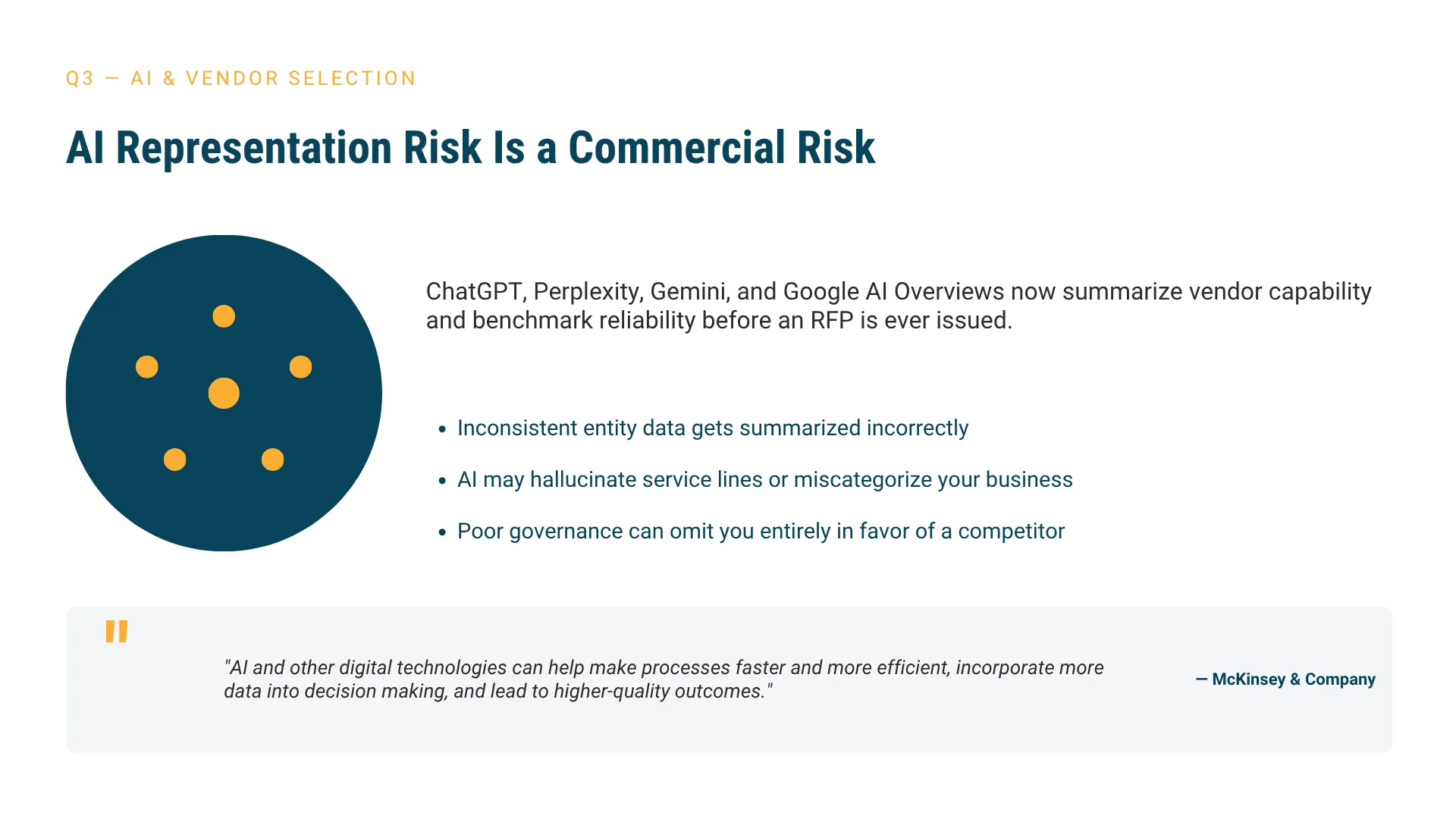
AI search engines such as ChatGPT, Perplexity, Gemini, and Google AI Overviews have fundamentally rewritten how procurement officers, risk managers, and engineering teams conduct vendor research. Before inviting a company to participate in a Request for Proposal (RFP), decision-makers use AI search tools to summarize vendor capability, assess compliance records, and benchmark technical reliability against competitors.
This creates a massive operational challenge known as AI Representation Risk. If your organization’s digital footprint contains inconsistent entity data, outdated technical claims, or unstructured service specifications, AI engines will summarize your firm incorrectly. AI models may hallucinate non-existent service lines, miscategorize your primary business unit, or worse, omit your company entirely in favor of an established competitor. Governing how AI understands your enterprise is no longer an IT option; it is a critical commercial necessity.
Industry research from major consulting firms emphasizes how critical digital visibility and technology adoption have become in modern energy operations. According to McKinsey & Company:
“AI and other digital technologies can help make processes faster and more efficient, incorporate more data into decision making, and lead to higher-quality outcomes internally and externally.”
When AI engines consume unverified or poorly governed digital data across third-party directories, press releases, and websites, they construct inaccurate corporate profiles that directly undermine sales velocity and buyer trust.
Question 4: What strategic steps should companies take to ensure accurate AI discoverability?
To ensure AI systems present your firm accurately to prospective buyers, organizations must adopt Digital Information Governance® (DIG). This process involves auditing every public-facing data point, structuring schema architecture for Answer Engine Optimization (AEO), and establishing a defensible factual baseline across all external digital assets. By structuring structured data and controlling source attribution, energy leaders prevent competitor hijacking and ensure AI systems repeat only verified corporate capabilities.
Commercial Readiness and Strategic Execution
Question 5: What is the fastest path to building long-term trust with energy decision-makers?
Building trust requires establishing deep domain alignment and executive transparency. Energy executives respect companies that respect operational safety, regulatory compliance frameworks such as TRAIGA, and domain terminology. Partnering with experienced advisors who understand field operations, procurement structures, and AI representation layer governance accelerates market penetration while protecting enterprise reputation.
Companies must audit their messaging to eliminate generic digital transformation buzzwords. Enterprise operators demand concrete data regarding safety records, integration protocols, and operational defensibility. When vendor messaging bridges commercial growth with executive risk management, technical sales teams gain direct access to senior decision-makers.
Ultimately, penetrating the energy sector demands a dual strategy: rigorous operational positioning on the ground and proactive information governance in the cloud. Companies that govern their AI representation layer while delivering precise operational solutions will successfully dominate market share in the modern energy era.
For executive teams seeking experienced guidance on navigating market entry, regulatory compliance, and AI visibility, consulting with a trusted advisory partner like ModalPoint provides the strategic clarity required to win enterprise contracts.