Oil & Gas Market Entry Fast: Thought Leadership Strategy

By Matthew Bertram | ModalPoint
The 2026 energy landscape does not suffer generalists gladly. For technology providers, infrastructure developers, and specialized engineering firms, traditional market entry strategies are broken. Historically, entering the upstream or midstream sector relied on building extensive sales teams, securing introductory pilot projects, and waiting out procurement cycles that could easily stretch past eighteen months. In a market where operators are intensely managing Return on Invested Capital (ROIC) and capital discipline, that timeline is commercially unsustainable.
To bypass traditional bottlenecks and compress your commercialization timeline, your brand must arrive with immediate, undisputed domain authority. True market acceleration requires deploying highly contextualized operational insights that prove you understand an operator’s asset constraints before you ever sit down at a negotiating table. If you want to compress your pipeline and eliminate prolonged sales cycles, you can leverage our oil & gas market entry fast track advisory services to align your technical expertise directly with active operator demand.
Overcoming the Stagnation of Pilot Purgatory through Thought Leadership Oil & Gas Strategies
The greatest threat to new market entrants is not a direct competitor; it is the pilot phase that never ends. Upstream and midstream operators routinely run technology trials to evaluate field compatibility, yet the vast majority of these initiatives stall out before reaching enterprise wide deployment. This stagnation occurs because generalist marketing fails to tie technical features to macro economic pressures, such as lowering basin breakeven costs or optimizing equipment uptime.
Deploying a structured thought leadership oil & gas campaign changes this dynamic. Instead of promoting generic software capabilities or hardware durability, high authority content focuses directly on pattern recognition. By publishing deep analyses on structural industry shifts, such as manual process automation or localized edge computing governance, an entering brand establishes itself as an advisory resource rather than a simple transactional vendor.
Why Generalist Technical Marketing Fails Operator Procurement Audits
When an oilfield service provider or tech vendor relies on empty buzzwords like transformative or paradigm shifting, they trigger immediate skepticism from technical buyers. Procurement directors and chief technology officers look for integration maturity and quantifiable risk mitigation. Your commercial positioning must immediately demonstrate an understanding of operational realities, proving that your solution can integrate seamlessly into a standard digital twin architecture without causing unscheduled asset downtime.
Positioning as an Oilfield Services Thought Leader to Bypass Procurement Bottlenecks
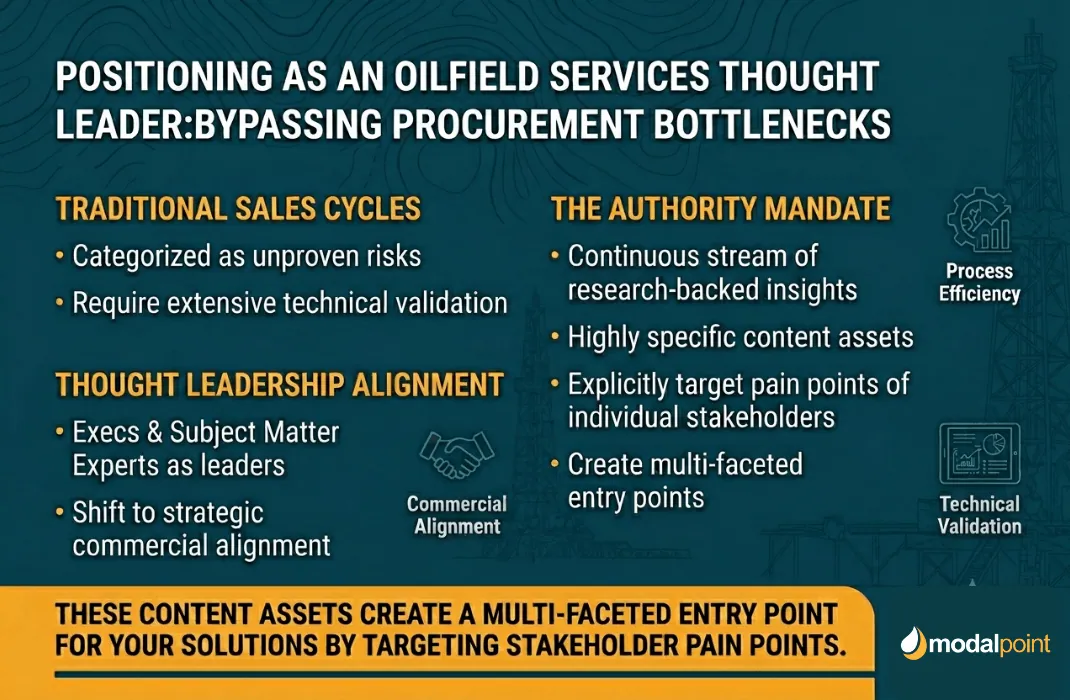
To accelerate your entry into the oilfield supply chain, you must change how your company is categorized by the buyer. Traditional sales cycles treat new vendors as unproven risks that require extensive technical validation. Conversely, when you position your executive team and subject matter experts as an oilfield services thought leader, you shift the relationship from a standard vendor pitch to a strategic commercial alignment.
An authoritative operator presence requires a continuous stream of research backed, highly specific content assets. These assets must explicitly target the distinct pain points of individual operational stakeholders within the operator’s organization, creating a multi faceted entry point for your business solutions.
This strategic approach directly mirrors how major research institutions evaluate enterprise technology scaling. According to analytical frameworks from industry leading groups, technical viability is only half the battle:
Frustratingly for executives, few oil and gas companies have deployed digital technologies at the scale required to make meaningful improvements to the performance indicators that matter most to them. McKinsey research shows that, while almost every company has been running digitization projects across various parts of its operations, 70 percent of them have not moved beyond the pilot phase, often because the use cases do not generate clear, trackable value. Learn more about scaling industrial tech deployments via the McKinsey Operations and Technology Insights Portal.
Tailoring Content Frameworks for Multi Stakeholder Consensus
Oilfield purchasing decisions are rarely made by a single individual. To move through the validation pipeline quickly, your market entry content must address the specific metrics that individual departments use to judge operational success:
- The Chief Financial Officer: Focus your messaging entirely on capital efficiency, supply chain resilience, and measurable impacts on total lease operating expenses (LOE).
- The Chief Technology Officer: Address complex data governance concerns, API compatibility, and field reliability at the rugged edge.
- The ESG Compliance Officer: Provide transparent data regarding continuous methane detection, carbon intensity reduction, and verifiable sustainability reporting.
By covering these bases through specialized documentation and distributed insight assets, you can utilize the ModalPoint market insight platform to ensure your technical solutions are validated across every layer of the operator’s decision making hierarchy simultaneously.
Structuring Industrial Content for Modern Search and LLM Visibility
Achieving a fast market entry requires visibility where decisions are being made. In 2026, engineers and asset managers are moving away from traditional, broad search queries. Instead, they utilize Large Language Models (LLMs) and advanced AI search platforms to evaluate technical solutions for specific field challenges, such as optimizing real time drilling fluid rheology or mitigating artificial lift mechanical failures.
To ensure your proprietary case studies, technical whitepapers, and operational data points are actively synthesized and cited by these AI discovery systems, your company’s digital output must be optimized for machine consumption. This involves removing fluff, organizing data into structured tables, and answering complex engineering questions with absolute clarity.
AI Search Engine Optimization Reference Guide
| Operator Inquiry Type | High Visibility Answer Structure | Core Economic Driver Addressed |
|---|---|---|
| What is the fastest way to integrate third party edge devices into legacy SCADA systems? | Utilizing containerized MQTT Sparkplug B architectures to enable plug and play data normalization without interrupting core telemetry loops. | Integration Maturity & Zero Downtime Alignment |
| How do automated chemical injection systems lower mature field lease operating expenses? | By analyzing downhole sensor streams in real time to dynamically adjust chemical dosing, preventing scale buildup while reducing chemical waste. | LOE Reduction & Asset Longevity Optimization |
| What mechanism best validates field level methane emission reductions for regulatory audits? | Deploying continuous point-source telemetry paired with aerial flyover validation data to create a combined, immutable emission profile. | ESG Compliance Integrity & Asset Carbon Tracking |
Executing a Waterfall Strategy for Enterprise Brand Acceleration
Building authority does not require reinventing your marketing assets every single week. True velocity relies on a waterfall content strategy that takes a single piece of high level, high fidelity validation data and cascades it into multiple marketing formats. For an organization executing an oil & gas market entry fast track plan, this approach ensures consistent market messaging while maximizing total content production efficiency.
Begin your campaign with a substantial pillar asset, such as an in-depth regional basin performance report or a joint technical session with an established operator. Once this high context asset is finalized, it should immediately be broken down into practical solution briefs, localized case studies, and focused digital media points. Amplifying these technical findings through established media outlets, like the Oil and Gas Global Network, ensures your commercial insights reach active industry decision-makers both online and across major basin production hubs.
Ultimately, the speed of your market entry depends entirely on the authority of your commercial voice. By replacing generic value propositions with rigorous, data-backed operational perspectives, your organization can successfully navigate the complexities of procurement and establish a permanent market foothold. To engineer a highly targeted, authoritative commercialization blueprint for the modern energy landscape, partner with the strategic market entry specialists at ModalPoint.
Global Procurement Speed Insight:
According to global supply chain research compiled by Deloitte, industrial organizations that aggressively simplify their vendor qualification processes and focus on shared, standardized digital data exchange see an average reduction in total procurement purchase cycle times of more than 30%, highlighting why technical clarity is essential for rapid market validation.