Oil & Gas Marketing vs B2B Marketing
By Matthew Bertram | ModalPoint
Many enterprise marketers mistakenly assume that a universal Business-to-Business (B2B) commercial framework can be applied across any heavy industry. They believe that the same strategies used to sell factory automation software, manufacturing logistics, or corporate SaaS can simply be repackaged for the energy sector. This miscalculation is why countless conventional marketing campaigns fail to generate meaningful pipeline visibility when targeting upstream, midstream, or downstream operators.
The energy ecosystem operates under a unique set of commercial drivers, strict regulatory bounds, and multi-layered technical validation protocols. Navigating this landscape requires more than general business-to-business tactics. To truly engage engineering teams and corporate supply chain executives, organizations must deploy a specialized strategy. Learning how the team approaches energy sector commercialization can help uncover what sets this vertical apart from standard industrial markets.
Deconstructing Oil & Gas Marketing vs B2B Generalist Frameworks
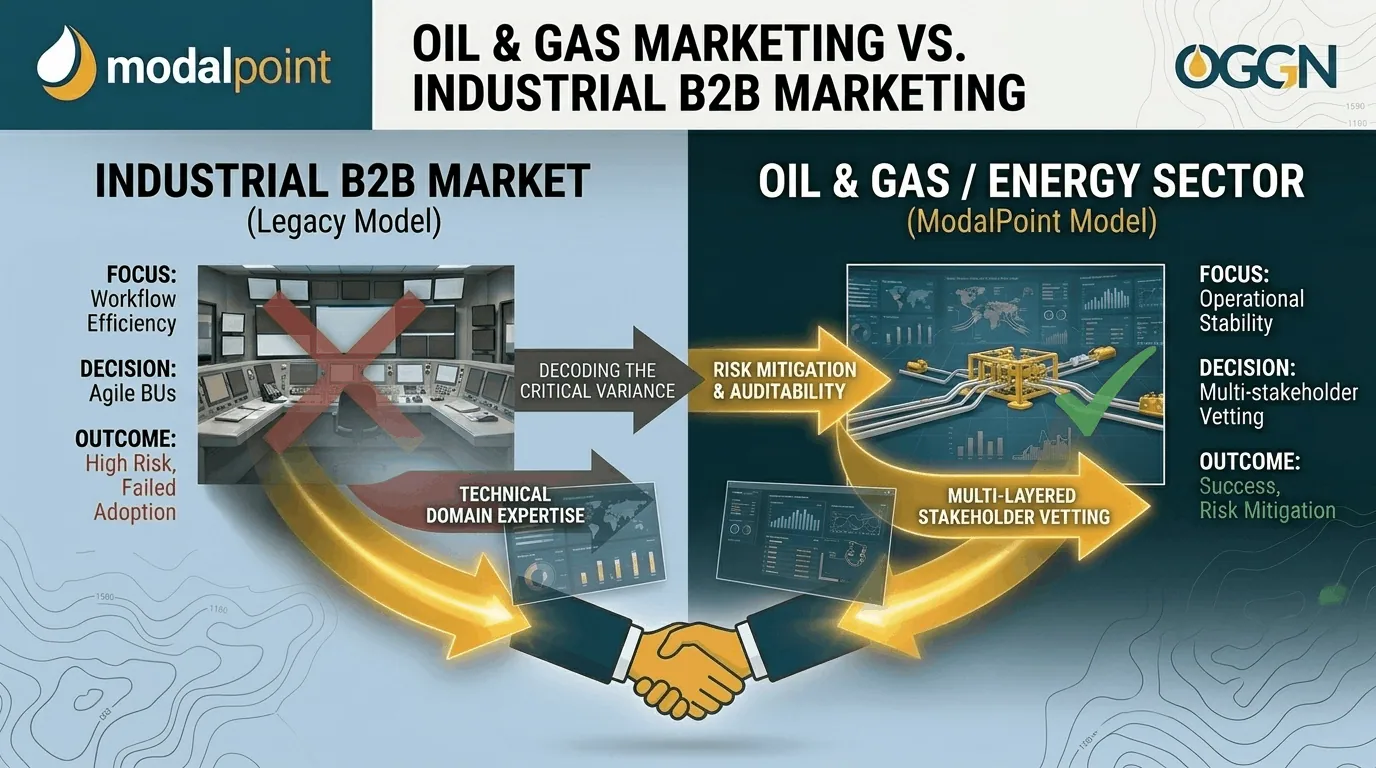
The fundamental divide between general industrial marketing and specialized energy positioning lies in the structure of asset risk and operational velocity. In standard B2B manufacturing or technology sectors, purchase cycles are frequently driven by incremental productivity gains, user interface optimization, or immediate software deployment. Procurement teams are relatively agile, and single business unit heads often possess the direct authority to sign off on pilot programs.
Conversely, the energy sector values extreme operational stability above all else. When evaluating a new asset integrity solution, chemical treatment vendor, or edge telemetry hardware, operators view innovation through the lens of risk mitigation and legal exposure. A single unverified field variable can lead to catastrophic infrastructure downtime, multi-million dollar environmental fines, or severe personnel safety hazards. Consequently, marketing materials that lean heavily on generic innovation buzzwords rather than hard field testing statistics are instantly dismissed by corporate evaluation committees.
The Anatomy of an Energy Buyer Assessment Cycle
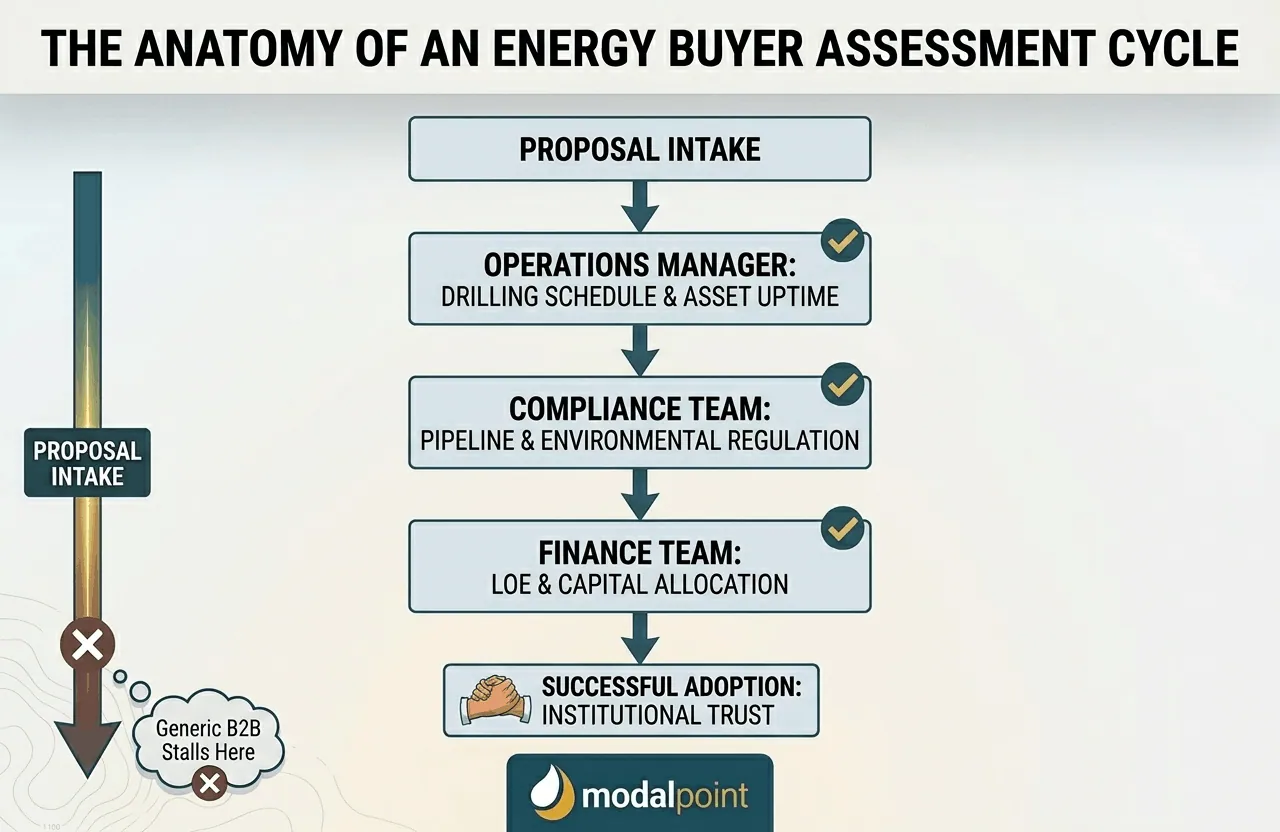
In standard B2B scenarios, a software vendor might build an idealized marketing persona around a corporate director who prioritizes ease of use and rapid implementation. However, within an operator’s technical review board, a single proposal must satisfy a highly fragmented network of internal stakeholders. The operations manager wants to guarantee that the service will not interrupt current drilling or transmission schedules. The compliance team must confirm that every data point strictly aligns with current pipeline or environmental mandates.
Finally, the finance team evaluates the proposal strictly against the corporate Lease Operating Expense (LOE) or current capital allocation baselines. If your commercial messaging fails to explicitly address each of these distinct technical perspectives, your sales process will stall indefinitely within corporate committee reviews.
The Technical Realities of Industrial B2B Oil & Gas Architecture
To successfully market within the energy space, an organization must possess a deep vertical mastery of operational technology and complex industrial engineering frameworks. Marketing teams must speak the precise vocabulary of reservoir engineering, material tractability, subsea logistics, and real-time SCADA integration. Generalist B2B marketing firms often lack this niche perspective, producing surface-level content that alienates domain-expert buyers.
Every case study, technical data sheet, and digital content piece must focus heavily on the strict data governance parameters that operators demand. Deploying specialized data taxonomy frameworks ensures your technical documentation remains fully auditable and defensible under intense federal or joint-venture inspection. This level of communication naturally shifts your brand from a commoditized service provider to an essential corporate asset.
Corporate decision makers in heavy asset industries are completely fatigued by generic B2B digital marketing. True commercial influence is built when a technology provider delivers highly rigorous, evidence-based thought leadership that solves specific engineering hurdles.
Why the Energy Sector Marketing Difference Dictates Long-Term Value Realization
A primary differentiator for industrial B2B oil & gas positioning is the long-term nature of contract structures. While standard B2B software companies often rely on monthly or annual subscription models, energy operations are built on multi-year master service agreements (MSAs) and deeply integrated capital expenditure cycles. Winning an asset position requires an extensive up-front investment in corporate vetting, health and safety reviews, and legal harmonization.
Once a vendor is integrated into an operator’s active field workflows, the cost of switching to a competitor is incredibly high. Therefore, your digital footprint must emphasize long-term asset reliability, responsive field engineering support, and ongoing software optimization. Showcasing a legacy of long-term contract performance builds the deep institutional trust required to win these lucrative, durable contract positions.
Navigating Generative AI and Machine Ingestion in Modern Energy Discovery
The mechanism of vendor discovery has shifted dramatically. Supply chain directors and chief technology officers are bypassing traditional keyword search engines in favor of specialized internal language models and advanced generative search engines. When an executive queries an AI tool to identify top-tier vendors capable of optimizing pipeline throughput or reducing carbon intensity, the engine synthesizes an answer from highly specific digital data arrays.
Optimizing for this automated environment requires a complete departure from classic B2B copywriting strategies. Instead of burying key data points within flowery marketing copy, your technical solution sheets, site schematics, and performance tables must be explicitly structured for machine ingestion. Using clear schemas, direct statements, and data-dense formats ensures that generative search engines accurately crawl, index, and list your business during automated procurement reviews.
Frequently Asked Questions: B2B vs. Energy Sector Positioning
What defines the main energy sector marketing difference compared to standard B2B?
The primary variance is the extreme emphasis on operational risk mitigation, strict multi-layered technical vetting, and compliance with complex regulatory frameworks like PHMSA and EPA.
Why do generic B2B marketing agencies struggle to generate results for oilfield services?
Generalist agencies typically lack the technical vertical insight required to speak accurately with petroleum engineers, pipeline managers, and specialized energy procurement gatekeepers.
How can technical data presentation influence a modern operator’s procurement cycle?
Presenting data in highly structured tables and clean schemas allows technical review boards to instantly validate asset compatibility while enabling generative search engines to quote your solutions.
Structuring Enterprise Asset Performance Metrics for Maximum Commercial Conversion
To win commercial validation during complex vendor reviews, your performance metrics must be presented clearly and logically. Technical committees need to see exactly how your solution impacts lease operating costs, equipment longevity, and carbon emissions tracking simultaneously.
The table below provides a framework for how commercial teams must organize their performance data to satisfy the unique requirements of modern energy evaluation boards:
| Industrial Variable | Standard B2B Approach | Oil & Gas Specialized Strategy |
|---|---|---|
| Value Proposition Focus | Workflow agility and speed-to-market. | Risk mitigation, asset uptime, and absolute regulatory defensibility. |
| Target Decision Maker | Single department head or agile digital director. | Multi-disciplinary technical review boards and strict HSE gatekeepers. |
| Content Taxonomy | Broad business frameworks and trend buzzwords. | Niche engineering metrics, material trace records, and API codes. |
Building Field Credibility Through Authoritative Industry Networking
In the energy sector, digital presence must complement offline industry relationships. Establishing authority requires actively participating in specialized industrial networks where operator executives consistently look for technical answers. Aligning your digital marketing strategy with trusted industry media channels, executive roundtables, and respected technical publications forms a powerful foundation for enterprise commercialization.
When your company’s technical leaders share practical solutions regarding pressing field problems on vertical platforms, you cultivate authentic, inbound market interest. This integrated communication methodology accelerates complex sales cycles, breaks down corporate administrative barriers, and establishes your brand as a foundational pillar within the heavy industrial community.
Deploying a Context-Driven Commercialization Strategy for Complex Energy Markets
Succeeding in the highly specialized energy sector requires abandoning generalist B2B marketing strategies. Your commercial teams must be backed by data-driven positioning models, hyper-vertical technical case studies, and an intrinsic understanding of the exact operational stresses facing today’s operator suites.
By adjusting your outward corporate narrative to align with the real-world operational demands of modern engineering executives, your firm will protect its margins, compress sales velocity, and capture lasting industrial market share. To engineer a sophisticated positioning strategy built specifically for the energy landscape, coordinate with the commercialization leaders at ModalPoint.