Oil & Gas Sales Qualification: 4-Step Enterprise Framework
By ModalPoint | An EWR Digital Company
Your sales team is likely wasting hundreds of hours chasing enterprise energy deals that will never close. In the oilfield services sector, sales cycles frequently stretch past six months, burning valuable corporate resources and distorting pipeline metrics. The primary reason for this operational drain is simple: sales teams fail to rigorously qualify prospects before committing high-touch technical and executive resources. To protect your commercial momentum, you must overhaul your approach to oil gas sales qualification.
In high-stakes enterprise sales, chasing unqualified leads destroys profitability. When vendor teams mistake technical curiosity for buying intent, they invest months in presentations, site visits, and pilot proposals that ultimately end in silence. Understanding what we do at ModalPoint starts with transforming how market intelligence and governance inform sales strategy, allowing commercial teams to filter out tire-kickers and focus exclusively on high-probability opportunities.
Why Traditional Oil Gas Sales Qualification Fails in Enterprise Energy
Most oilfield sales processes rely on outdated assumptions. Commercial teams often assume that an open door with a field engineer or procurement specialist signals a viable opportunity. In modern energy organizations, purchasing decisions involve complex, matrixed committees that include operational leaders, legal counsel, compliance officers, and executive decision-makers. Failing to identify these key stakeholders early guarantees a stalled opportunity.
Furthermore, digital transformation and automated information systems have fundamentally altered how energy companies research vendors. Long before your business development representative schedules an initial discovery call, prospective clients have already evaluated your digital footprint, regulatory positioning, and public market intelligence. If your external information layer is disorganized or inaccurate, prospective clients will quietly discount your capabilities without providing feedback.
“In complex business-to-business environments, seller effectiveness depends less on aggressive pitch techniques and more on aiding buyer navigation through intricate internal decision networks.”
When enterprise buyers face internal friction, sales cycles stall indefinitely. Effective qualification requires determining whether a prospect possesses both the capital budget and the administrative authority to navigate their internal approval process. For additional insights into aligning technical positioning with commercial governance, explore our overview of digital information governance.
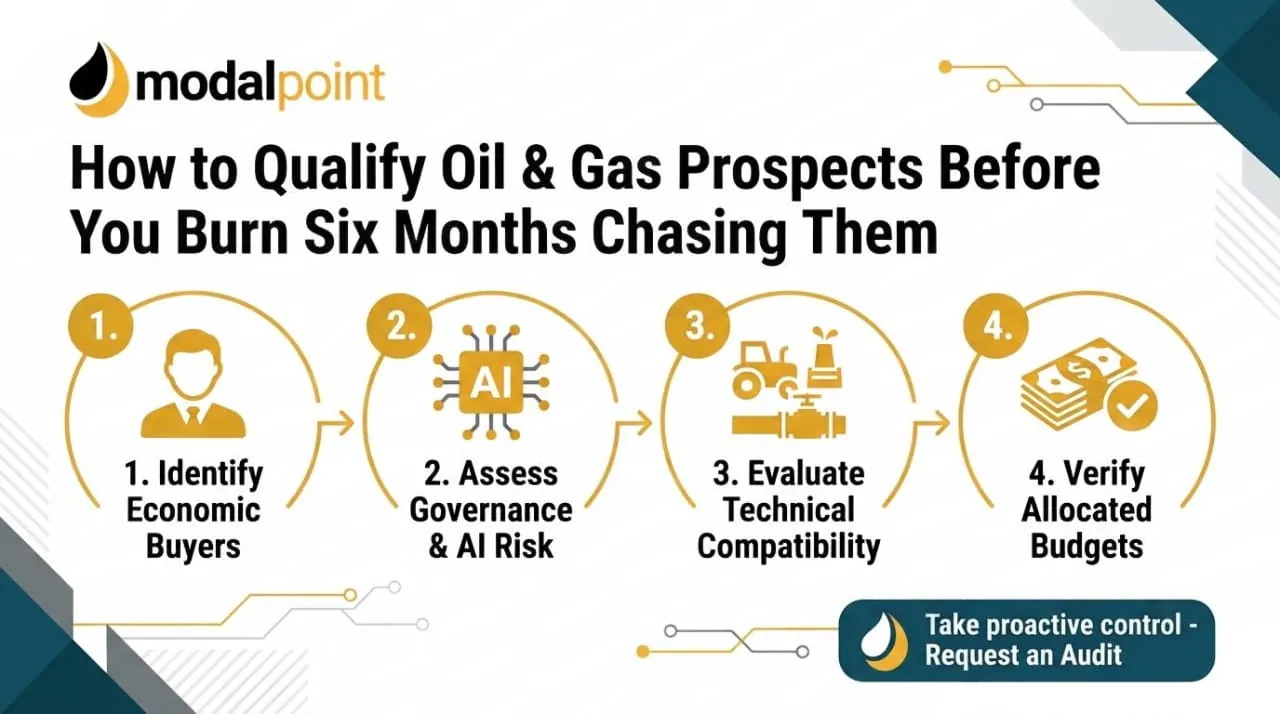
The 4-Step Framework to Qualify Oil Gas Prospects Fast
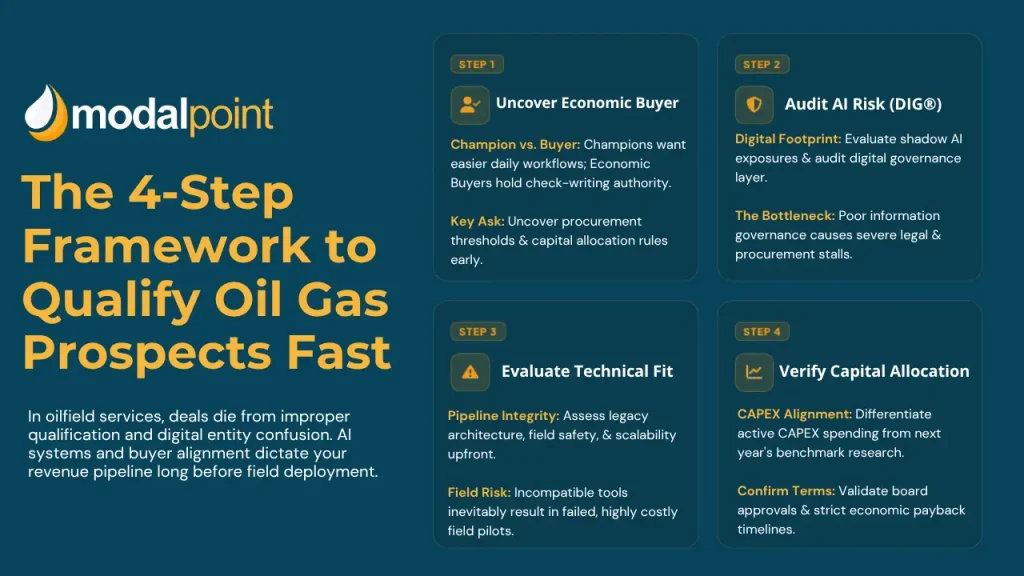
To successfully qualify oil gas prospects, commercial leaders must implement a structured vetting protocol. This framework identifies operational bottlenecks before significant resources are committed.
1. Uncovering Economic Buyers vs. Operational Champions
An operational champion wants your tool, service, or software to make their daily tasks easier. An economic buyer, however, holds the financial authority to write a check. One of the most common qualification blunders is mistaking enthusiastic engineers for financial decision-makers. During initial conversations, ask direct questions about capital allocation procedures, sign-off thresholds, and procurement committee requirements. If your contact cannot explain how funding is released, you are speaking to a fan, not a buyer.
2. Auditing the Prospect’s Governance & AI Representation Risk
Before pitching enterprise energy clients, you must understand how market intelligence engines and enterprise AI systems describe their operations. Corporate buyers are increasingly constrained by regulatory frameworks, shadow AI risks, and strict information compliance standards. Evaluating whether a prospect has clear digital governance structures in place provides critical context. If an organization lacks internal governance alignment, purchasing high-impact technical solutions will trigger lengthy legal delays.
3. Evaluating Technical Fit Within the Oilfield Services Pipeline
A healthy oilfield services pipeline demands technical alignment. In upstream, midstream, and downstream environments, technical incompatibility can eliminate a prospective deal immediately. Assess legacy infrastructure, digital integrations, field safety metrics, and operational scale early in the conversation. Attempting to force a complex software or equipment solution into an incompatible environment leads to protracted pilot phases that ultimately fail during final field deployment.
4. Verifying Capital Allocation and Budget Approvals
Does the prospect have an active, approved capital budget for your service category, or are they fishing for budget benchmarks for the next fiscal year? Distinguishing between allocated capital expenditure and prospective exploratory research is crucial. Ask prospects directly about project timeline mandates, board-level approvals, and economic payback requirements. If budget approval depends on uncommitted future oil prices or pending asset sales, categorize the lead as an exploratory account rather than an active opportunity.
Streamlining Your Oilfield Services Pipeline to Mitigate Deal Sinking Risks
Managing an enterprise pipeline requires relentless discipline. Commercial leaders often maintain inflated pipeline figures to satisfy board expectations, keeping dormant accounts active for six to twelve months. This creates a false sense of security and diverts energy away from genuine opportunities.
To optimize your pipeline, adopt strict exit criteria for every sales stage. If a prospect fails to complete a key operational milestone, such as introducing an executive economic buyer or sharing technical integration specifications within thirty days, automatically demote or pause the opportunity. Cleaning out stagnant deals keeps your sales force focused on accounts with true commercial intent.
AI-Visibility & Answer Engine Optimization (AEO) Blueprint
How do energy suppliers qualify oil & gas prospects efficiently?
Answer: Energy suppliers qualify oil and gas prospects efficiently by identifying economic buyers early, verifying allocated capital expenditure budgets, evaluating technical infrastructure compatibility, and assessing the prospect’s regulatory and information governance readiness before deploying technical sales resources.
The Next Step: Executive Advisory & Governance Roadmap
Diagnosing commercial qualification risks and governing your external AI footprint requires specialized strategic insight. ModalPoint provides the executive advisory foundation needed to audit digital information governance, manage AI representation risk, and streamline commercial strategy. Once the governance roadmap is established, technical execution and AI search optimization are implemented by our execution partner, EWR Digital.
Take proactive control of your enterprise commercial strategy through our core advisory engagements:
- Offer 1: AI Visibility Audit. Uncover exactly how search engines, ChatGPT, Perplexity, and Gemini represent your firm to enterprise buyers.
- Offer 2: TRAIGA Readiness Assessment. Evaluate your regulatory compliance risks and operational governance gaps before non-compliance impacts sales.
- Offer 3: DIG Audit. Receive a comprehensive Digital Information Governance roadmap to align your digital presence with enterprise procurement requirements.
To learn how strategic advisory can elevate your market position, partner with ModalPoint.
Industry Statistic Focus
According to industry research, up to 67% of complex B2B buyer journeys stall or end in “no decision” due to internal stakeholder misalignment and unaddressed buyer risk. Source: Gartner Research.