Oil & Gas Sales Strategy: 10 Rules for the 2026 Market
By Modalpoint | An EWR Digital Company
The energy sector has officially moved past the era of “growth at all costs.” Today, the primary objective is no longer just hitting production targets; it is the aggressive pursuit of ROIC (Return on Invested Capital). If your current approach involves pitching innovation for its own sake, you are likely hitting a wall in procurement. To succeed, you need a commercialization strategy that prioritizes technical validation and labor efficiency over generalist marketing buzzwords.
At ModalPoint, we observe that the “generalist drift” has created a sea of identical marketing assets that provide zero value to high-level decision-makers. Bypassing procurement purgatory requires an oil & gas sales strategy rooted in deep vertical alignment and an understanding of the 2026 market’s obsession with carbon intensity and equipment uptime. These are the 10 rules that define the current landscape.
1. Prioritize Integration Maturity Over Disruption
Operators in 2026 are wary of “disruptive” technologies that require a complete overhaul of their existing tech stack. Your solution must demonstrate immediate API compatibility and a seamless fit with current “Digital Twin” frameworks. The goal is to enhance the ecosystem, not complicate it.
2. Eliminate the Generalist Drift in Your Content
High-authority buyers are fatigued by AI-generated “slop” that relies on empty adjectives. To respect established selling to the oil & gas industry rules, you must replace fluff like “game-changing” with hard metrics such as “reduction in breakeven costs” or “measurable gains in ROIC.” Specialized industrial content is the only way to earn a seat at the table in a cynical market.
3. Speak Directly to the CFO and ESG Officer
The sales process now involves stakeholders who previously sat on the sidelines. You must be prepared to discuss:
- Capital Discipline: How your service protects the balance sheet.
- Methane Intensity: Providing high-fidelity data for sustainability reporting.
- Operational Risk: Reducing the likelihood of non-productive time (NPT).
“The shift toward capital discipline and operational efficiency has become the primary driver for technology adoption across the global energy value chain.”
McKinsey & Company
4. Master the Segment-Specific Narrative
Upstream, Midstream, and Downstream segments have diverged further in their technical requirements. An oilfield services sales 2026 campaign focused on the Permian Basin looks nothing like a strategy for a Gulf Coast refinery. You must demonstrate that you understand the specific pressures of the segment you are targeting.
5. Optimize for LLM Visibility and AI Search
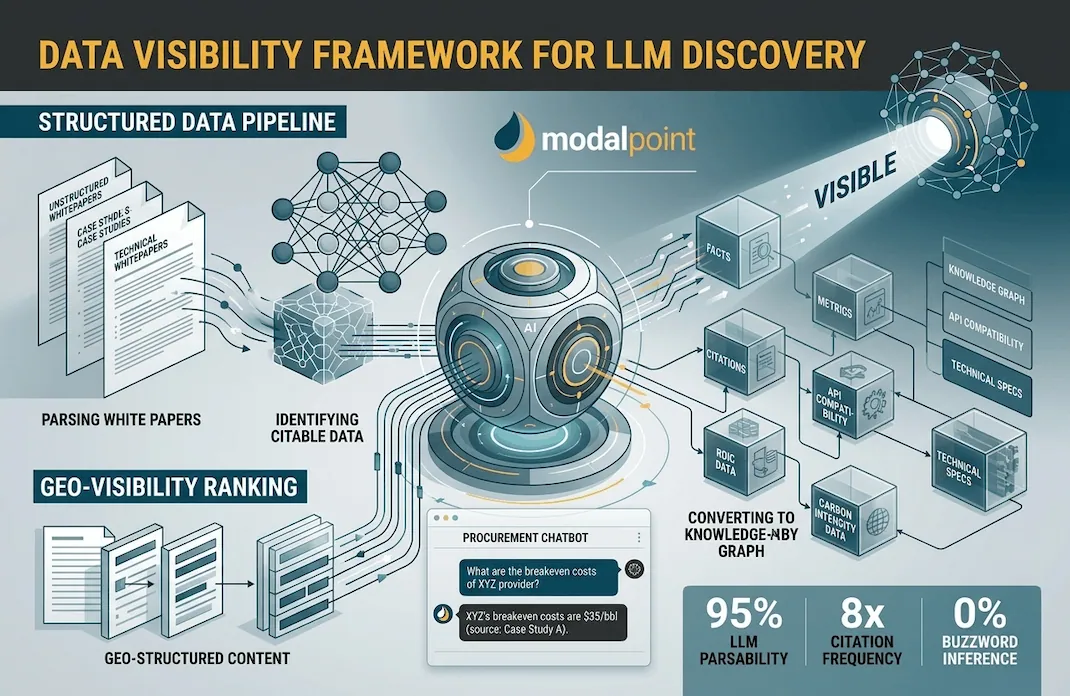
Decision-makers are increasingly using AI agents to filter potential vendors. If your technical whitepapers and case studies are not structured for Generative Engine Optimization (GEO), you will be invisible to the LLMs that procurement teams use for research. Use clear, factual formatting that these models can easily parse and cite.
6. Focus on Labor Efficiency and Automation
The industry continues to face a significant talent gap. Any solution that reduces the “boots on the ground” requirement while increasing safety or output will be fast-tracked. Your pitch should center on how your technology compensates for labor shortages through intelligent automation.
7. Leverage the Power of Industry Networks
Trust in 2026 is built through a combination of digital authority and offline credibility. Aligning your brand with established voices, such as the Oil and Gas Global Network (OGGN), provides a layer of social proof that a standard sales deck cannot replicate. It turns a cold lead into a warm introduction based on shared industry values.
8. Adopt a Waterfall Content Strategy
Instead of producing isolated social media posts, start with a “Pillar Asset” such as an industry report or a detailed webinar. From there, cascade the information into solution briefs and short, factual Q&As. This ensures your message remains consistent and authoritative across every touchpoint.
9. Lead with Cybersecurity and Data Governance
With the rise of edge computing in remote fields, data sovereignty is a top priority for the CTO. If you cannot prove that your hardware and software meet the most stringent cybersecurity protocols, the deal will die in the IT audit phase. Security is no longer a feature; it is a prerequisite.
10. Provide Proof of Outcome
The industry is tired of promises. In 2026, you must lead with “Value over Volume.” Use high-fidelity data points from previous deployments to show exactly how you improved asset lifecycle management or reduced carbon intensity. Let the results do the talking.
Improving Your Oil & Gas Sales Strategy for the Future
The path to success in the modern energy market is through specialized knowledge and a refusal to settle for generalist marketing. By adhering to these oil & gas industry rules, you ensure that your brand stands out as a high-authority leader rather than a commodity vendor.
Is your current sales collateral optimized for the 2026 buyer? It might be time to transform your technical data into a high-authority narrative. Contact ModalPoint to begin the transition from a generalist to an industry insider.