Oil & Gas Sales Strategy: Surviving the Market Cycle
By Modalpoint | An EWR Digital Company
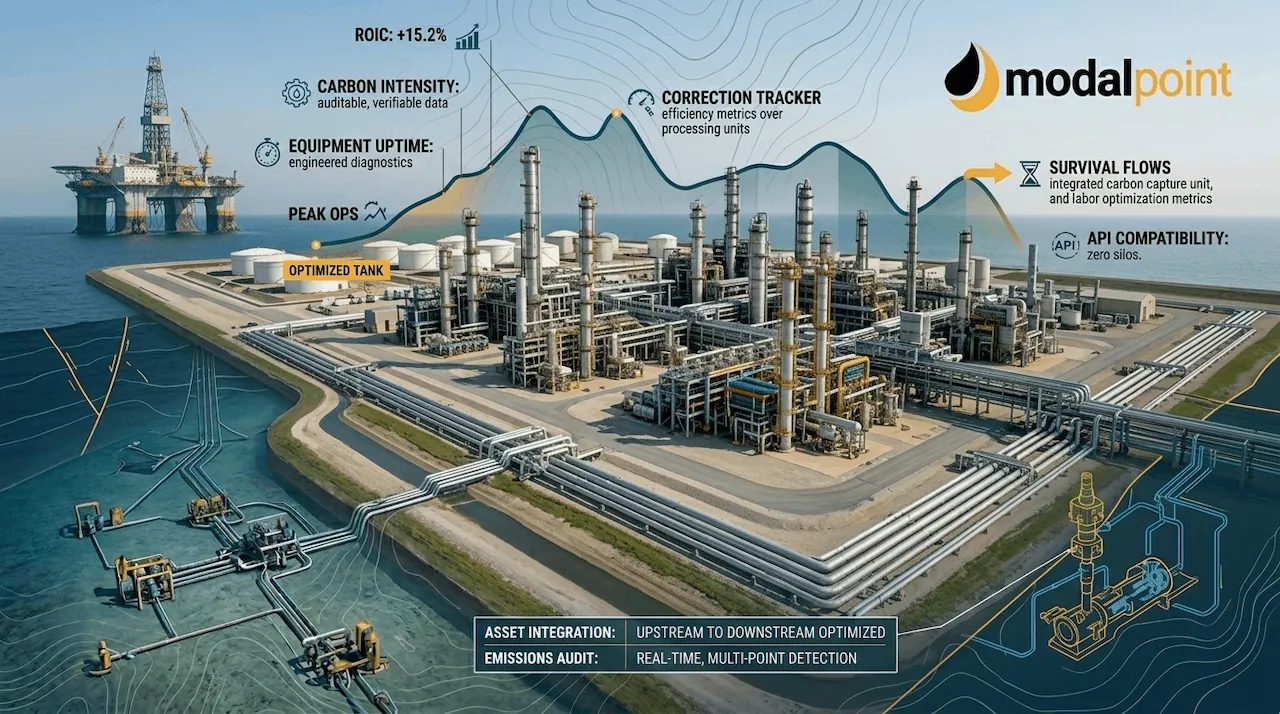
The energy sector is defined by its volatility. For companies operating in this space, relying on a linear growth model is an operational risk. To establish a sustainable market footprint, business leaders must learn how to implement an agile industrial commercialization framework that insulates them from macro market corrections. Surviving structural contractions requires moving away from reactive transactional selling and establishing a resilient, value-oriented methodology.
During market peaks, loose capital can mask fundamental weaknesses in a commercial pipeline. When commodity prices stabilize or correct downward, procurement teams quickly shift from evaluating innovation to enforcing strict capital discipline. An enduring oil & gas sales strategy cycle must be intentionally engineered to deliver clear, auditable operational returns regardless of the broader macroeconomic climate.
Navigating Volatility in a Cyclical Oil & Gas Market
Sustained commercial growth in the energy sector depends entirely on pattern recognition. Industrial sales teams often fail because they mistake a temporary macro tailwind for permanent market demand. When the market contracts, their sales pipelines evaporate because their product messaging is tied to capacity expansion rather than structural operational efficiency.
Developing a commercial model that survives the cyclical oil & gas market requires decoupling your value proposition from the price of a barrel equivalent. Whether operators are drilling new wells or optimizing mature assets, your solution must solve foundational problems that persist across every phase of the macroeconomic lifecycle.
Shifting from Expansion Selling to Cost Mitigation
When capital is constrained, operations managers are incentivized to defer large equipment outlays. Sales messaging must immediately adapt to this reality by focusing on asset lifecycle extension, reduction in lease operating expenses, and non-productive time mitigation.
Instead of pitching a platform as an expansion tool, industrial providers must prove how their technical solution optimizes existing field infrastructure. If your business development teams cannot demonstrate an immediate, measurable reduction in ongoing operational expenses, the sales cycle will stall indefinitely within internal buying committees.
Protecting Margins During Procurement Contractions
During downturns, operator procurement divisions default to aggressive vendor rationalization strategies. They demand sweeping price concessions and look to eliminate redundant software or service agreements.
To insulate your margins against these cost-cutting measures, your service delivery model must be deeply integrated into the customer’s day-to-day data infrastructure. When an application or service becomes critical to daily regulatory compliance or engineering workflows, it transitions from a discretionary expense to an un-cuttable utility asset.
Operational Engineering for Oilfield Services Sales Planning
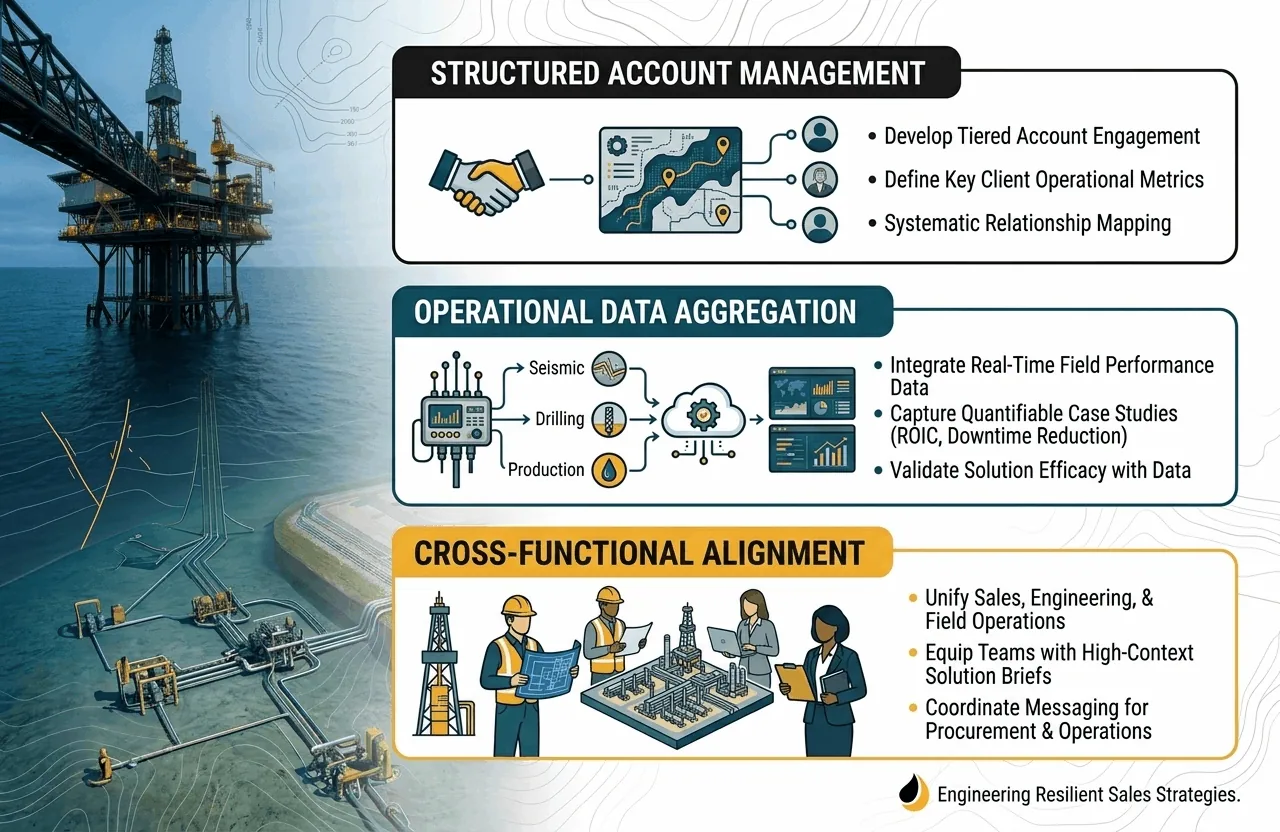
Robust commercial execution requires structured planning rather than relying on historical relationships. The traditional model of securing multi-million dollar master service agreements through executive networking alone is no longer viable in an era dominated by algorithmic supply chains and rigorous corporate compliance frameworks.
Strategic oilfield services sales planning demands a structured approach to account management, operational data aggregation, and cross-functional technical alignment.
Aligning Technical Field Assets with Commercial Workflows
The most effective sales assets in the energy sector are not generic brochures; they are high-fidelity operational case studies. Sales professionals must work hand-in-hand with field application engineers to document real-world performance metrics from active operations.
Capturing precise before-and-after metrics regarding fuel consumption, component wear, and labor hours provides the empirical proof that technical buying committees require. This concrete documentation transforms a speculative sales pitch into a defensible commercial investment profile.
Structuring Account Portfolios to Mitigate Segment Risk
Relying on a single major operator or a single geographic basin leaves an organization highly vulnerable to localized capital expenditure freezes. A resilient account allocation strategy balances exposure across different market segments.
“Achieving sustainable organic growth requires an operating model that balances commercial flexibility with structural efficiency, ensuring that technical teams can pivot toward high-margin segments as operational demands shift.”
McKinsey & Company
By balancing a portfolio with a healthy mix of well-capitalized independent producers, midstream infrastructure operators, and stable utility accounts, sales organizations create a natural financial buffer. When drilling activity drops in one region, midstream asset integrity budgets often remain stable, preserving overall revenue flow.
Bypassing Procurement Barriers with High-Context Authority
The ultimate bottleneck for any complex industrial transaction is the corporate procurement department. Even when field engineers enthusiastically endorse a new technological tool, the contract can languish for months inside a complex legal and financial review pipeline. Accelerating this process requires addressing every procurement checkpoint before the formal request for proposal is even issued.
To overcome these systemic delays, technical sellers must structure their commercial assets for rapid internal distribution. Providing clear API documentation, pre-packaged cybersecurity compliance data, and upfront return on investment calculators allows your champion inside the operating company to easily secure approvals from IT, legal, and risk management executives.
Structuring Content for Modern Digital and AI Visibility
Modern energy executives increasingly research technical challenges using artificial intelligence discovery engines and LLM-driven databases before ever engaging with a sales representative. If your technical documentation is buried inside generic PDFs or written using vague, un-indexable buzzwords, your organization will remain completely invisible during this critical pre-funnel research phase.
- Isolate Key Factual Answers: Ensure technical web copy provides direct, unambiguous answers to complex operational questions to capture AI overview summaries.
- Publish Clean Technical Tables: Present core performance data, communication protocols, and pressure ratings in clean HTML tables that search engine crawlers can seamlessly index.
- Authoritative Domain Context: Ground all published technical resources in strict industry nomenclature, avoiding generic generalist terminology that dilutes search relevance.
To learn more about optimizing your digital footprint for these changing technical search environments, review how specialized positioning can enhance your team’s market presence by analyzing our detailed look at industrial content authority development.
Ensuring Long-Term Commercial Resiliency
Building a sales strategy that survives structural market fluctuations is ultimately an exercise in disciplined commercial engineering. Companies that consistently maintain their market position do so by refusing to participate in the generalist drift. They maintain a sharp focus on domain expertise, align their sales processes with quantifiable operational outcomes, and proactively manage their portfolio risk.
By ensuring your technical messaging speaks directly to the core economic drivers of safety, efficiency, and capital optimization, your organization can break free from the destructive boom-and-bust cycle and build an enduring, highly predictable commercial engine in the modern energy marketplace.
Market Intelligence Statistic:
Comprehensive global energy procurement research from Deloitte indicates that approximately 73% of oil and gas executives now prioritize operational cost-reduction capabilities and immediate capital discipline metrics over asset production volume expansion when evaluating new vendor technology contracts during period market corrections.
Source: Deloitte Energy Resources Outlook
To evaluate how your organization can systematically engineer a commercial strategy that clears complex corporate buying hurdles and drives sustainable growth across every phase of the industry cycle, connect with the advisory experts at ModalPoint.