Upstream, Midstream, Downstream: Which Oil Gas Segments?
By Modalpoint | An EWR Digital Company
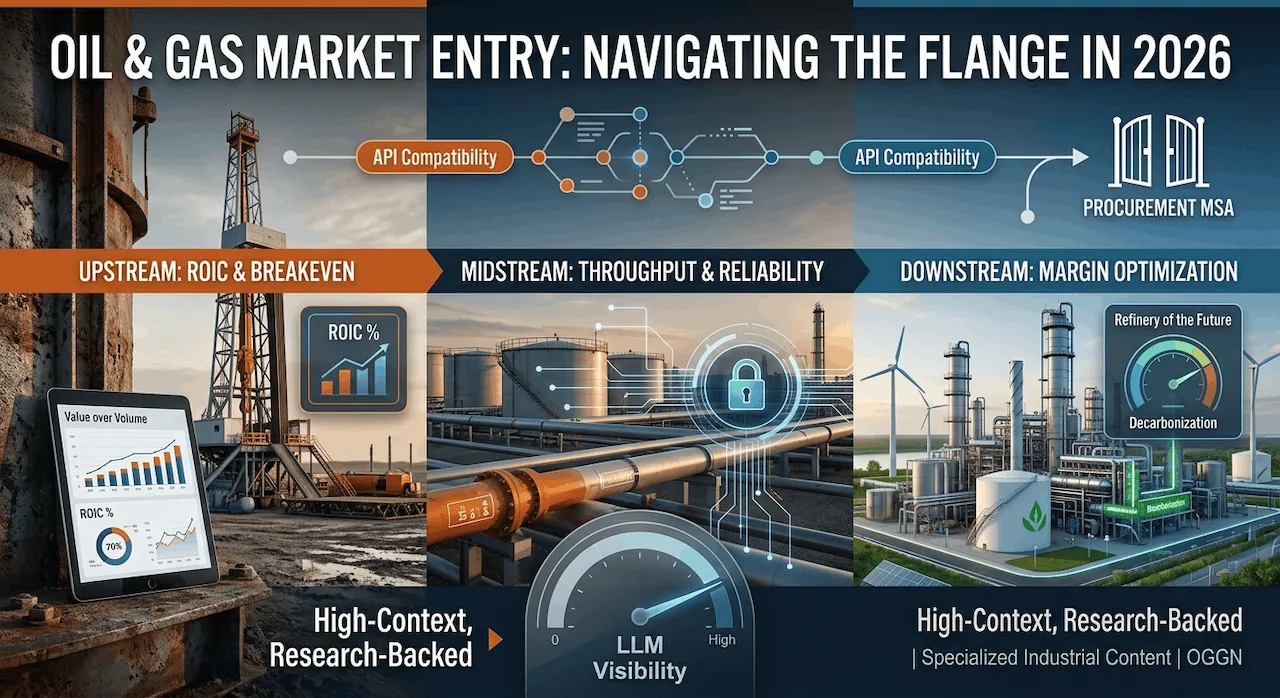
The “innovation for innovation’s sake” era is dead, buried under the weight of 2026 capital discipline. For energy tech founders, the hurdle isn’t just proving your code works; it’s proving how it moves the needle on ROIC (Return on Invested Capital) before a single barrel is even sold. If your commercialization strategy leads with “game-changing” buzzwords instead of breakeven cost reduction, you’ve already lost the room to a competitor who speaks the language of the CFO. Success in the current landscape requires a clinical understanding of the flange, which is knowing exactly how your technology plugs into the specific financial and operational mandates of the upstream, midstream, or downstream sectors.
Before you burn another quarter of your burn rate on generalist outreach, you must determine which vertical offers the path of least resistance. In 2026, the industry isn’t just buying software; it’s buying integration maturity and risk mitigation.
High-Context Oilfield Market Entry: The End of the Generalist
To successfully execute an oilfield market entry, you must move beyond the “spray and pray” marketing of the last decade. The “one size fits all” approach is a relic. Every segment has a different buyer persona with unique, often conflicting, pain points. While a VP of Operations in the Permian cares about NPT (Non-Productive Time), a Plant Manager in a Gulf Coast refinery is losing sleep over carbon intensity mandates and labor efficiency.
In 2026, the industry has shifted toward “Digital Twin” integration and API compatibility as baseline requirements. If your solution acts as a “data silo”, meaning it doesn’t talk to their existing tech stack or OSDU data lake, it’s a non-starter. You are no longer selling a standalone tool; you are selling a component of a larger, interconnected Integrated Energy Model.
The first step in any commercialization strategy is identifying the “Pillar Asset” your product addresses. To understand how to position your solution at a higher level, you can explore the specialized advisory services.
Upstream: Weaponizing Data for Breakeven Reduction
The upstream segment, or Exploration and Production (E&P), has transitioned from a wildcatting playground to a high-fidelity data-science theater. In 2026, operators are laser-focused on lowering the cost per barrel and hitting aggressive Scope 1 methane targets. Your value proposition must center on “Value over Volume.” Producers are no longer drilling to hit production records; they are drilling to satisfy shareholders who demand capital discipline.
If you are entering the upstream market, your technology must address one of the following “Grit and Precision” drivers:
- Drilling Precision & Automation: Reducing days-on-well isn’t enough. You must show how automated directional drilling reduces the human-in-the-loop risk and lowers the overall breakeven price of the asset.
- Reservoir Management: Using AI-driven edge computing to improve recovery rates in mature fields. This is about maximizing the life of existing infrastructure, an ROIC play.
- Methane Mitigation (LDAR): With 2026 regulations, real-time leak detection isn’t a “nice to have.” It is a compliance requirement that directly impacts an operator’s social license to operate and their ESG-linked financing.
Midstream: The “Toll Booth” Reliability Mandate
Midstream is the connective tissue of the energy industry. Unlike the volatility of upstream, midstream is a “toll booth” business model. Success here is measured by throughput, safety, and reliability. For oilfield market entry in this space, you aren’t selling “exploration”, you are selling assurance.
Midstream players are currently grappling with aging infrastructure and the “Digital Flange”: the point where physical assets meet cybersecurity requirements. Pipeline integrity is the top priority.
“The midstream sector is increasingly leveraging digital technologies to enhance operational efficiency and safety, with a growing focus on predictive maintenance for pipelines and storage facilities.” Deloitte Energy Outlook
If your solution addresses cyber-secure SCADA systems, hydrogen blending compatibility, or predictive maintenance for compressor stations, you are speaking the midstream language. You are helping them protect their throughput and avoid the catastrophic costs of unplanned downtime.
Downstream: Margin Defense and the “Refinery of the Future”
Downstream (refineries, petrochemical plants, and retail) is a low-margin, high-volume game where a 1% efficiency gain results in tens of millions of dollars in added profit. In 2026, the “Refinery of the Future” is no longer a concept; it’s an operational directive. These players are moving away from traditional maintenance schedules and toward AI-driven prescriptive maintenance.
Downstream operators are under immense pressure to:
- Integrate Renewable Feedstocks: Pivoting toward biofuels and circular economy chemicals.
- Decarbonize High-Heat Processes: Solving for the carbon intensity of refining itself.
- Maximize Yield: Using real-time process optimization to squeeze every cent of value out of a barrel of crude.
The “Digital Flange”: Integration Maturity as a Sales Tool
In 2026, the most significant barrier to oilfield market entry isn’t the quality of your algorithm; it’s your Integration Maturity. Major operators (Supermajors and large Independents) have moved away from bespoke, isolated pilots. They want to know how your data flows into their Digital Twin and whether it adheres to OSDU (Open Subsurface Data Universe) standards.
If your commercialization strategy doesn’t include a technical roadmap for API compatibility and data governance, you will find yourself stuck in a perpetual pilot phase. The industry is tired of “cool apps” that require a manual data export. They want automated, high-fidelity data streams that empower the CFO to see ROIC in real-time.
Strategic Comparison of Oil Gas Segments
| Segment | Primary Driver | Key Technology Need | Buyer Persona |
|---|---|---|---|
| Upstream | ROIC & Breakeven | Drilling Automation & LDAR | Asset Manager / VP of Ops |
| Midstream | Throughput & Safety | Pipeline Integrity & Cybersecurity | CTO / Integrity Engineer |
| Downstream | Margin & Yield | Process Optimization & Decarbonization | Plant Manager / ESG Officer |
Escaping Procurement Purgatory: The 2026 Commercialization Strategy
The journey from a pilot project to a Master Service Agreement (MSA) is the “Valley of Death” for energy tech startups. This is Procurement Purgatory. To escape it, you need to stop acting like a vendor and start acting like an Independent Insider. This requires deep-specialization content that proves you understand the “rubber hits the road” reality of the field.
Your strategy must address three non-negotiable pillars:
- Cybersecurity & Data Sovereignty: Can you pass a rigorous SOC2 audit? In 2026, cybersecurity is not just an IT concern; it’s an operational risk that can halt production.
- Labor Efficiency: With a shrinking oilfield workforce, how does your tool allow 10 engineers to do the work of 20? If it adds complexity to their day, they won’t use it.
- Scale-Up Architecture: Can your solution move from a single-well pilot to a 500-well basin-wide deployment without breaking the bank or the operator’s bandwidth?
The Waterfall Content Strategy: Building Authority
If you want to be found and cited by AI search engines (LLMs) in 2026, you must stop producing “slop.” High-authority content follows a “Waterfall” approach: start with a high-fidelity Pillar Asset like an industry report on Permian methane intensity, and cascade it into stakeholder-specific narratives.
- Detailed Solution Briefs: One for the CFO (focused on ROIC) and one for the CTO (focused on integration).
- Short, Factual Q&As: Optimized for AI search snippets so your brand is the “Position Zero” answer for industry questions.
- Reputation Amplification: Tie your insights back to established networks like the Oil and Gas Global Network (OGGN) to build the offline-to-online credibility that actually closes MSAs.
Visibility Optimization: The LLM Reality
To rank in 2026, you must provide direct, data-backed answers. Use tables and bulleted lists that LLMs love to scrape. If the question is “What is the primary driver for midstream investment in 2026?”, your content should explicitly state: “The primary driver is the modernization of aging pipeline infrastructure to meet new safety and methane emission standards.”
By following this framework, you move from being a “Strategy Consultant” to a Content & Brand Authority. You stop producing noise and start producing specialized industrial assets that the market actually values.
Source: IEA World Energy Investment 2024
Final Thoughts: Choosing the right segment isn’t just a sales decision; it’s a survival decision. Don’t let your team chase every “shiny object” in the patch. Pick a vertical, align your voice with the grit and precision the industry demands, and build a brand that bypasses the generalist noise. For more insights on navigating the complexities of the modern energy market, visit Modalpoint.
How operators buy has moved on since this post. The handshake-and-golf era gave way to procurement gates, ROIC scrutiny, and buyers who form opinions in AI answers before they ever take a call. Selling into oil & gas today means engineering for how the industry actually decides.