Oil & Gas Technology Trends 2026: Driving Asset ROIC
By Modalpoint | An EWR Digital Company
The oilfield isn’t chasing production records in 2026; it is chasing capital discipline. To understand how deep industrial expertise can transform your commercial positioning and clear procurement hurdles, learn more about our integrated digital strategy solutions. The era of loose capital and speculative “innovation” projects has given way to a strict mandate for return on invested capital, carbon intensity reduction, and labor efficiency.
For years, energy technology innovation was defined by generalist tech vendors pitching vague promises of digital transformation. This approach filled the industry with fragmented pilots that never scaled, creating what operations teams rightly call pilot purgatory. Today, the macro environment requires immediate field execution and measurable bottom-line impact. High-context, research-backed assets are replacing generic marketing fluff to help complex oilfield solutions clear the hurdles of strict procurement review.
Shifting From Generalist Hype to Vertical Reality
The greatest threat to new technology adoption in the energy sector is the generalist drift. When software and hardware providers describe their platforms as transformative or game-changing, they instantly lose credibility with asset managers and operations engineers. The modern energy landscape demands a deep understanding of domain-specific operational metrics.
To move technology from a line-item expense to a core commercialization strategy, developers must align their platforms with the specific mechanical and financial realities of individual industry segments.
Upstream Capital Discipline and Production Optimization
In the upstream sector, operators are focused on driving down lease operating expenses and maximizing the asset lifecycle of mature wells. Technology implementation is no longer judged by how much data it collects, but by how effectively it improves well uptime and stabilizes the decline curve.
Engineers do not need another dashboard; they require predictive edge analytics that directly interface with legacy supervisory control and data acquisition systems to prevent rod pump failures or optimize artificial lift cycles in real time.
Midstream Integrity and Regulatory Compliance
For midstream operators, the focus centers on infrastructure throughput efficiency, asset integrity, and strict emissions mitigation. The deployment of smart pipeline infrastructure and continuous methane detection networks is driven by the immediate need to eliminate product loss and satisfy tightening sustainability reporting mandates.
Technology solutions in this segment must prove they can seamlessly aggregate high-fidelity data from thousands of miles of linear assets without disrupting existing flow assurance models.
Stakeholder-Specific Narratives for Technical Buying Committees
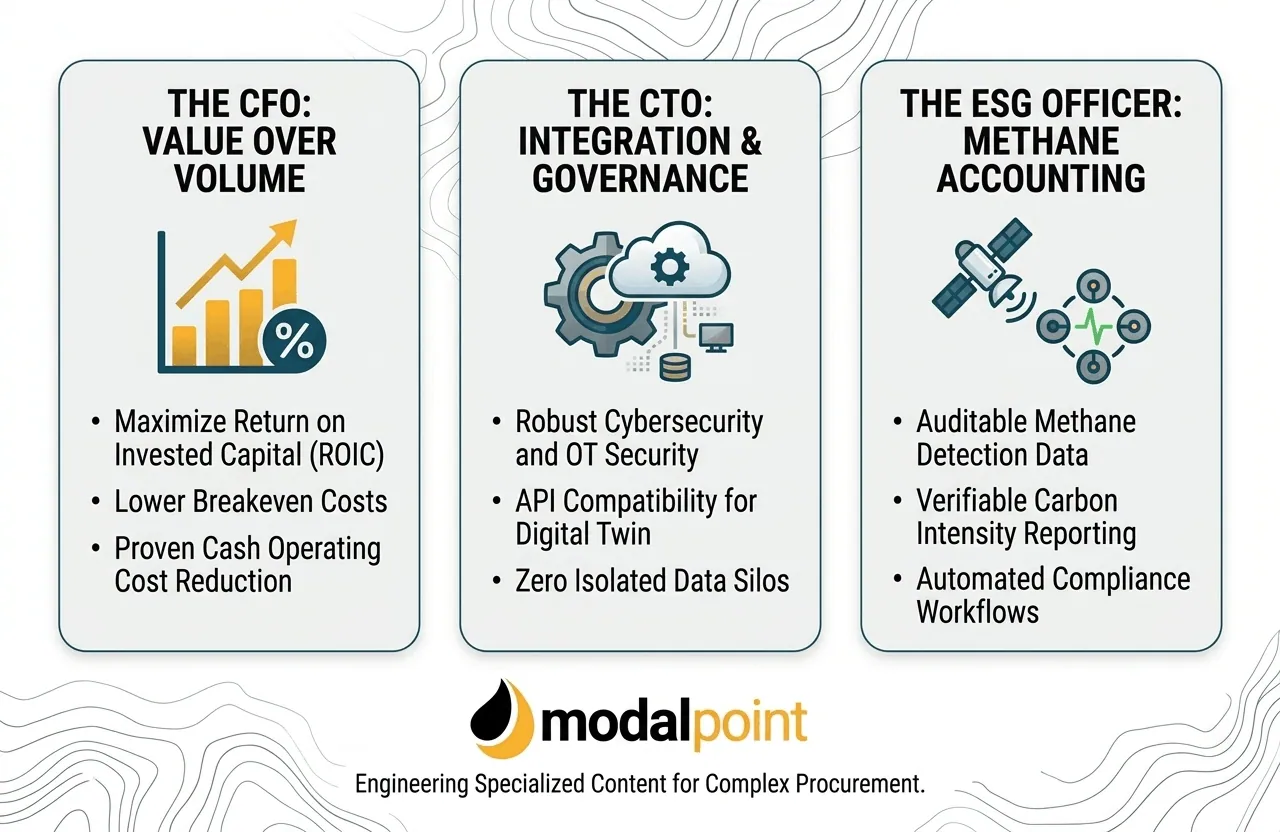
Modern energy procurement is rarely a single person’s decision. Bypassing procurement delays requires addressing the distinct, often competing priorities of the technical buying committee through targeted, high-context solution briefs.
The Chief Financial Officer: Value Over Volume
The financial suite cares about Return on Invested Capital and lowering breakeven costs per barrel equivalent. When evaluating new oilfield tech 2026 investment profiles, the CFO looks for capital discipline.
Marketing assets built for this audience must skip the technical mechanics and focus entirely on how the technology reduces cash operating costs, mitigates supply chain volatility, or defers major capital outlays through improved asset allocation.
The Chief Technology Officer: Integration Maturity and Governance
For the technical and IT leadership, the primary concerns are cybersecurity, API compatibility, and data governance. Introducing a new software layer cannot mean creating another isolated data silo.
The CTO demands clear proof of how an application fits into an enterprise hybrid-cloud architecture, secures the operational technology perimeter against machine-speed threats, and supports the deployment of an operational digital twin.
The ESG Officer: Methane Accounting and High-Fidelity Data
Sustainability reporting has evolved from a public relations exercise into a core compliance requirement. The ESG officer needs auditable, verifiable data regarding carbon intensity and fugitive methane emissions.
Technology documentation targeting this office must demonstrate how sensors, satellite imagery, or edge devices automate compliance workflows and provide empirical proof of environmental stewardship to institutional investors.
“A McKinsey study on the oil and gas sector found that oil and gas companies could reduce costs by up to 25% per barrel if they used digital solutions such as augmented reality and virtual reality.”
Energy Industry Review
Overcoming the Sea of Sameness through Specialized Content
The proliferation of generic AI writing tools has created a sea of sameness across industrial marketing channels. When every software company uses the same generic corporate templates to describe their products, operators tune out the noise. High-authority content succeeds by leaning heavily into pattern recognition and hard operational data.
To build lasting commercial trust, technical organizations must combine deep subject matter expertise with established offline-to-online credibility networks. Working alongside established industry platforms, such as the Oil and Gas Global Network (OGGN), allows technology providers to move past typical digital marketing friction and validate their operational expertise directly before the entire energy sector.
Structuring Technical Documentation for LLM Visibility
As energy executives shift from traditional search engines to AI-driven search models and LLM research tools, the way technical assets are indexed must change. Achieving strong AI visibility requires structuring documentation to be easily processed and cited by autonomous search agents.
- Direct Q&A Formatting: Use clear, unambiguous answers to complex technical questions right at the top of solution briefs.
- Factual Density: Replace speculative claims with exact performance metrics, such as real-world latency figures, communication protocol specifications, and bandwidth requirements.
- Structured Data: Use clean bullet points and clear tables to outline product capabilities, making it easier for large language models to extract and present your data in automated executive summaries.
Driving Operational Value Beyond the Software Layer
True industrial technology alignment means understanding that software is only as valuable as the physical field actions it improves. Whether deploying edge computing platforms on isolated offshore platforms or standardizing low-code development tools for field technicians, the goal remains the same: driving safety, efficiency, and clear financial returns.
By focusing on direct operational drivers instead of generalized technology buzzwords, engineering and tech organizations can move past initial pilot phases and establish themselves as essential operational partners in the modern oil & gas technology trends 2026 marketplace.
Operational Insight:
According to industry analysis from Smartbridge, strategic AI adoption and deep operational technology integration are currently driving an average 20% increase in overall operational efficiency for energy companies that successfully bridge the gap between field systems and unified enterprise cloud architectures.
Source: Smartbridge 2026 Energy Strategy Guide
To discover how your organization can systematically engineer high-authority content that cuts through market noise and speaks directly to the needs of energy sector decision-makers, connect with the expert team at ModalPoint.