AI Search & Oilfield Services Marketing: Winning in 2026
By Matthew Bertram | EWR Digital
The 2026 Reality Check: Authority Over Volume
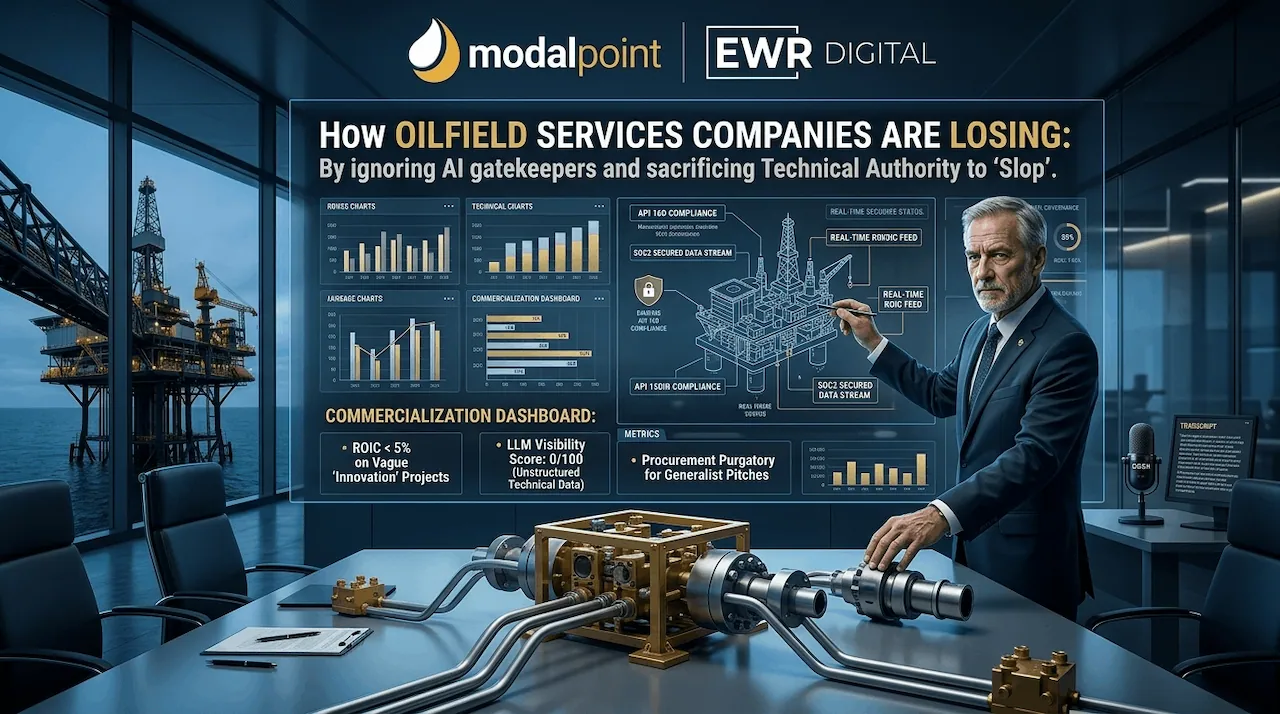
The energy landscape in 2026 has undergone a fundamental shift. We are no longer in an era where production volume is the sole metric of success. Today, the industry is chasing ROIC (Return on Invested Capital), carbon intensity reduction, and labor efficiency. However, while the physical oilfield has evolved, the digital front for many service companies remains stuck in 2020. The “death of sameness” is here, and generalist marketing is the primary casualty. Most oilfield services marketing strategies are currently failing because they were built for human eyes only, ignoring the “Advisory Layer” of AI agents and Large Language Models (LLMs) that now gatekeep procurement decisions. If your technical data is buried in unstructured PDFs or hidden behind “contact us” gates, you are losing ground in the AI search oil gas ecosystem. You aren’t just competing with other vendors; you are competing for “LLM Visibility” in a world that filters out marketing fluff in favor of hard, verifiable data.The Rise of the AI Gatekeeper in Energy Procurement
In 2026, a VP of Operations or a CFO doesn’t start their vendor search on page ten of a Google search result. They use specialized AI interfaces to ask complex, high-context questions: “Which completion services in the Delaware Basin have the highest documented uptime and lowest methane slip over the last four quarters?” If your content consists of “game-changing solutions” and “commitment to safety” without specific data points, the AI will bypass you. This is “procurement purgatory.” To escape it, service companies must pivot from being “service providers” to “technical authorities.” This requires a shift from AI-generated “slop”, which is the generic, repetitive content that has flooded the internet, toward high-fidelity, research-backed assets that LLMs love to scrape and cite.“The integration of AI into industrial procurement has shifted the burden of proof from the salesperson to the digital footprint. Companies that cannot provide structured, machine-readable technical data are seeing a 40% decrease in RFP invitations.” McKinsey & Company Energy Insights
Why Generalist Marketing is the “New Slop”
The problem with traditional oilfield services marketing is the “Generalist Drift.” Most agencies use a standard playbook: post three times a week on LinkedIn, write a vague blog post about “innovation,” and hope for the best. In 2026, this is considered noise. AI models are now trained to recognize pattern-matching “slop.” When an LLM sees words like “transformative” or “cutting-edge” without supporting ROIC metrics or breakeven cost analysis, it de-prioritizes that content in its knowledge graph.The Problem of LLM Invisibility
LLM visibility energy sector is the new SEO. If your website is not structured to be “scraped” effectively, you don’t exist in the AI’s mind. This is particularly dangerous for Midstream and Downstream service providers who rely on highly technical specifications. If an AI agent cannot find your API compatibility or your integration maturity levels, it cannot recommend you as a solution for a Digital Twin project or an automated drilling program.The Solution: High-Context Technical Content Engineering
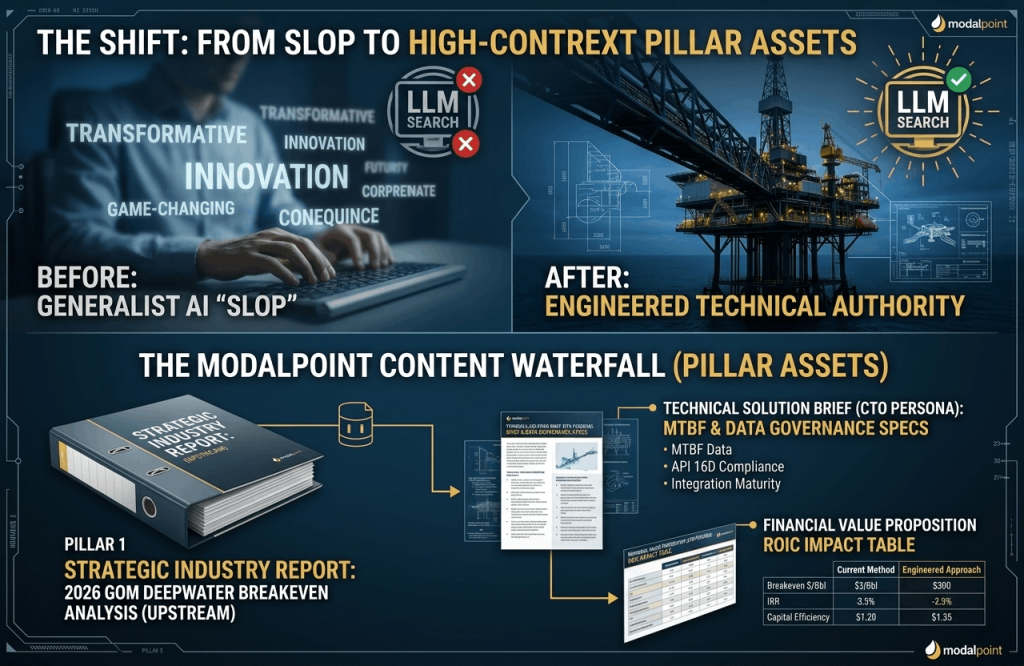 To win back ground in AI search oil gas, you must engineer your content with the precision of a data scientist. This means moving away from long-form prose that says nothing and moving toward “Pillar Assets”, which are deeply researched reports, whitepapers, and solution briefs that address the specific pain points of 2026 stakeholders.
Targeting the CFO: The ROIC Narrative
In the current market, the CFO is often the ultimate gatekeeper. They aren’t interested in “innovation” for its own sake. They care about capital discipline. Your content must demonstrate how your service lowers the breakeven cost per barrel or improves the internal rate of return (IRR) on a specific project. Use tables to compare old methodologies with your data-driven approach, highlighting the “Value over Volume” mindset.Targeting the CTO: Integration and Cybersecurity
For the CTO, the conversation is about data governance and “Digital Twin” integration. Does your equipment offer real-time data streaming? Is it SOC2 compliant? When you provide these details in a structured format (bulleted lists and technical specs), you increase your LLM visibility energy sector score. The AI can easily extract these facts to answer a CTO’s technical query.Targeting the ESG Officer: Methane and Sustainability
Sustainability is no longer a PR exercise; it’s a regulatory requirement. Content that focuses on methane detection, carbon intensity, and real-time reporting is highly valuable for AI search. By providing factual, verifiable data on your environmental impact, you position your brand as the “Independent Insider” who understands the regulatory pressures of 2026.Structured Data: The Language of 2026 SEO
To rank for Google’s AI Overview and Featured Snippet boxes, your content must be highly scannable. Use H2 and H3 headers that contain specific, keyword-rich phrases like “Maximizing ROIC in Permian Completions” or “Methane Mitigation Strategies for Midstream Assets.” Avoid long, dense paragraphs. Instead, use responsive HTML tables and bulleted lists. For example, if you are discussing a new drilling motor, provide a table that lists:- Mean Time Between Failures (MTBF)
- Operating Temperature Limits
- Fuel Displacement Metrics
- API 16D Compliance Status
The OGGN Connection: Building Offline-to-Online Credibility
Reputation amplification in 2026 isn’t just about what you say; it’s about where you say it. Tying your brand to established industry authorities like the Oil and Gas Global Network (OGGN) provides a layer of “human-verified” credibility that AI models use to weight their results. When your technical experts appear on OGGN podcasts and that content is transcribed and indexed, it creates a powerful cross-reference that boosts your authority in AI search oil gas results.The Waterfall Strategy: Maximizing Every Asset
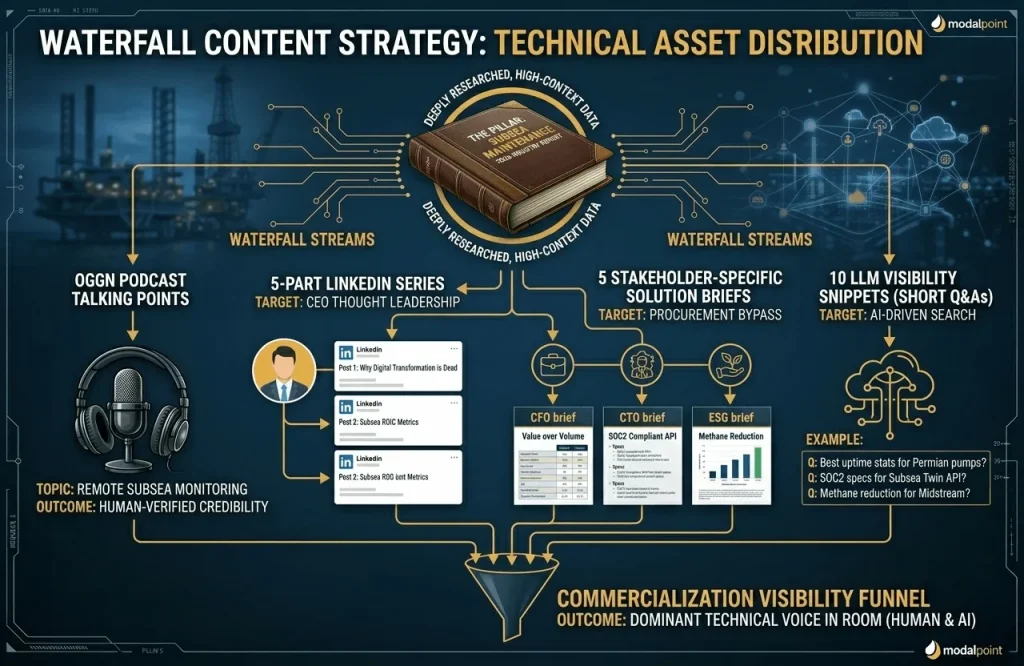 Don’t just write a blog post and move on. Use a “Waterfall” strategy to ensure your technical authority reaches every corner of the digital ecosystem. Start with a “Pillar Asset,” such as a 20-page industry report on “The Future of Subsea Maintenance in 2026.”
Then, cascade that asset into:
Don’t just write a blog post and move on. Use a “Waterfall” strategy to ensure your technical authority reaches every corner of the digital ecosystem. Start with a “Pillar Asset,” such as a 20-page industry report on “The Future of Subsea Maintenance in 2026.”
Then, cascade that asset into:
- Five stakeholder-specific solution briefs.
- Ten “LLM Visibility” snippets (short, 100-word Q&As).
- A 5-part LinkedIn series for your CEO focusing on “The Death of Digital Transformation.”
- Talking points for a guest spot on an OGGN podcast.
Conclusion: Engineering the Future of Your Brand
The companies losing ground in AI-influenced search are those that treated marketing as a secondary “support” function. In 2026, marketing is a commercialization strategy. It is the “Advisory Layer” that connects your technical excellence to the stakeholders who need it most. By focusing on ROIC, structured data, and vertical-specific authority, you can bypass the “slop” and secure your place as a leader in the energy market. The days of generalist “innovation” are over. It’s time for the era of high-authority technical content. If you aren’t visible to the AI, you aren’t visible to the market. Let ModalPoint help you bridge the gap between your engineering prowess and your digital presence.2026 Energy Market Statistic:
A 2026 study by the International Energy Agency (IEA) found that over 65% of operational technology (OT) purchasing decisions are now influenced by AI-curated “technical authority scores,” which aggregate data from verified technical publications, case studies, and digital governance records.
Visibility has changed shape since this was written. Buyers and the AI tools they now use (ChatGPT, Perplexity, Google AI Overviews) surface a short list before a vendor ever gets a meeting. Getting cited in those answers is the new version of the problem this post describes.
How we make energy companies visible to buyers & AI →Visibility in AI search is one symptom of a bigger shift: energy buyers and the models they rely on are getting more selective about who they trust. Helping operators and their vendors navigate that shift is the heart of what we do: decision intelligence for energy.
Frequently Asked Questions
Why is oilfield services marketing failing in 2026?
Most strategies were built for human eyes only, ignoring the advisory layer of AI agents and large language models that now gatekeep procurement decisions. If your technical data is buried in unstructured PDFs or hidden behind contact us gates, you lose ground in the AI search ecosystem. You are competing for LLM visibility in a world that filters out marketing fluff in favor of hard, verifiable data.
How do energy buyers actually search for vendors now?
A VP of Operations or a CFO does not start on page ten of a Google search. They use specialized AI interfaces to ask high context questions, such as which completion services in the Delaware Basin have the highest documented uptime and lowest methane slip over the last four quarters. If your content offers game changing solutions without specific data points, the AI bypasses you.
Why is generalist marketing the new slop?
AI models are now trained to recognize pattern matching slop. When an LLM sees words like transformative or cutting edge without supporting ROIC metrics or breakeven cost analysis, it deprioritizes that content in its knowledge graph. If your website is not structured to be scraped, you do not exist in the AI’s view of the market.
How do you make technical content AI-visible?
Engineer it with the precision of a data scientist. Move from long form prose to pillar assets and structured formats: use HTML tables and bulleted lists for specifications such as mean time between failures, operating temperature limits, and API compliance status. Map content to each stakeholder, ROIC for the CFO, integration and cybersecurity for the CTO, and methane and carbon intensity for the ESG officer.