energy sector advisory
How to Reach Oil & Gas Decision Makers in 2026

By Modalpoint | An EWR Digital Company
The enterprise sales landscape in the energy sector has fundamentally changed. Generalist marketing campaigns, cold outreach sequences, and superficial buzzwords no longer penetrate corporate suites. Today, operators are intensely focused on capital discipline, regulatory compliance, and bottom-line efficiency. If your business development strategy relies on outdated generic playbooks, your proposals will remain permanently stalled in procurement cycles. Securing the attention of modern energy executives requires deep technical context and an intricate understanding of their specific operational pain points. To navigate this highly complex environment and accelerate your commercial sales pipeline, specialized teams must learn how to efficiently engage oil & gas decision makers by leading with data-driven operational solutions rather than generic product pitches.The Evolution of Reaching Oil & Gas Buyers in a Demanding Energy Landscape
The traditional corporate procurement process has evolved into an integrated matrix of technical, financial, and environmental evaluations. Executives are no longer looking for mere service providers. They are actively seeking strategic business partners who can measurably improve asset performance, minimize infrastructure downtime, and optimize Return on Invested Capital (ROIC). This operational shift requires a complete overhaul of conventional industrial marketing strategies. To successfully capture market share, your messaging must directly speak to the core financial and engineering objectives of specific business units. Whether you are selling enterprise software to automated control systems or specialized field hardware to completion engineers, your value proposition must be clearly quantified using specific operational metrics like capital efficiency and lifecycle maintenance reduction.Moving Beyond Generic Value Propositions to Overcome Procurement Gatekeepers
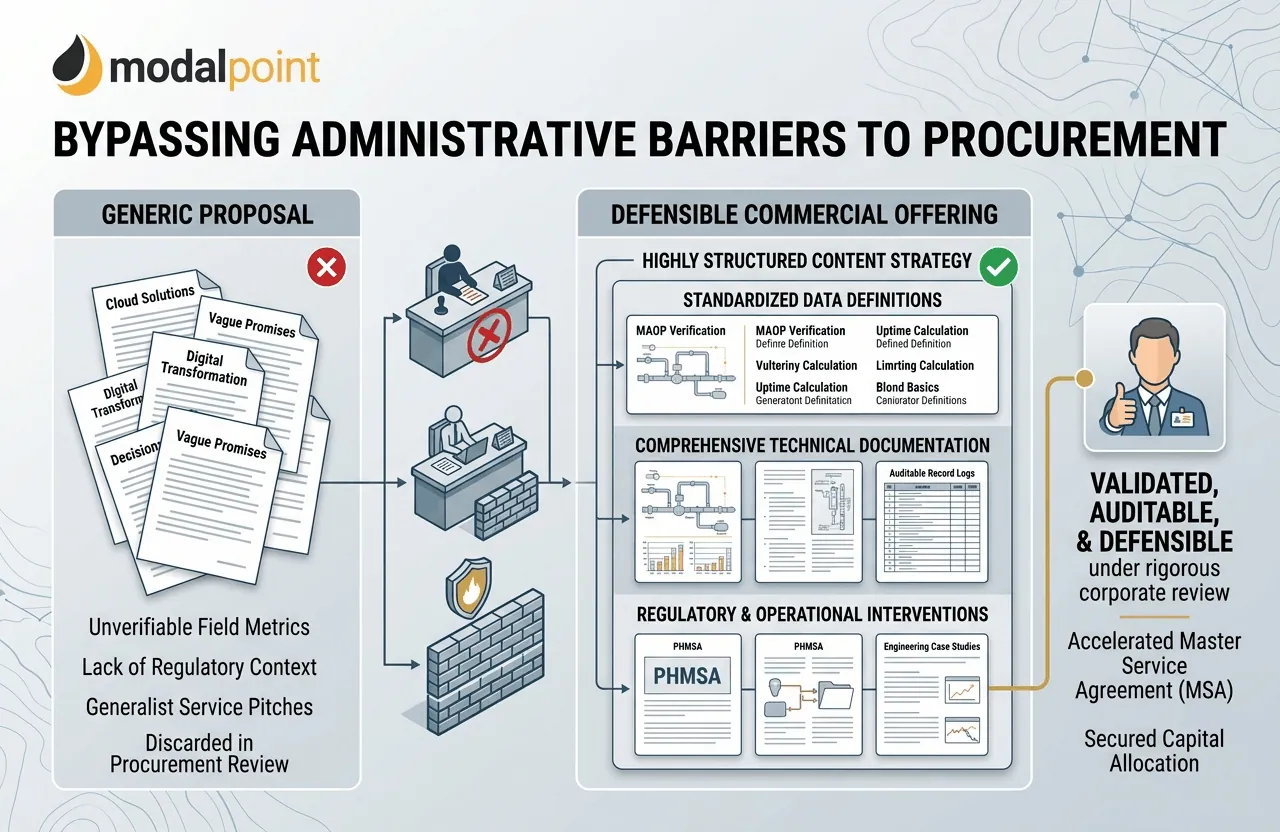 The primary reason most enterprise sales initiatives fail in the energy industry is a lack of deep vertical alignment. Corporate procurement departments are specifically engineered to filter out generalist software and services that do not align with current master service agreements or strict capital allocations. When a proposal uses vague promises of digital innovation instead of concrete field metrics, it is immediately discarded.
Bypassing these administrative barriers requires a highly structured content strategy that addresses the precise regulatory and operational issues facing your prospective clients. Standardizing your data definitions and building comprehensive technical documentation ensures that your commercial offerings remain completely auditable and defensible under rigorous corporate review processes.
The primary reason most enterprise sales initiatives fail in the energy industry is a lack of deep vertical alignment. Corporate procurement departments are specifically engineered to filter out generalist software and services that do not align with current master service agreements or strict capital allocations. When a proposal uses vague promises of digital innovation instead of concrete field metrics, it is immediately discarded.
Bypassing these administrative barriers requires a highly structured content strategy that addresses the precise regulatory and operational issues facing your prospective clients. Standardizing your data definitions and building comprehensive technical documentation ensures that your commercial offerings remain completely auditable and defensible under rigorous corporate review processes.
Advanced Frameworks for Oilfield Services Prospecting in 2026
The field services sector faces a uniquely challenging commercial environment. Operators are aggressively consolidating their vendor lists, favoring highly integrated solutions providers over single-service contractors. Consequently, successful oilfield services prospecting in 2026 requires a sophisticated combination of data-driven market intelligence and strategic industry network positioning. Instead of executing untargeted outbound sales campaigns, high-performing business development teams utilize precision market tracking to identify exact infrastructure vulnerabilities, active asset transfers, and upcoming regulatory deadlines. This structural visibility allows teams to craft hyper-targeted technical interventions before a formal request for proposal (RFP) is ever issued to the open market.B2B buyer behavior in heavy industrial sectors has shifted toward independent research. Buyers now complete more than half of their purchase journey digitally before ever engaging directly with a vendor sales representative. Gartner Research Insights
Leveraging Digital Network Ecosystems to Establish Real Technical Authority
Building meaningful commercial relationships with modern energy buyers requires establishing undeniable industry credibility well before the initial sales meeting. Industrial executives routinely validate vendor capabilities by auditing their published data models, technical case studies, and industry media footprint. Aligning your corporate messaging with trusted platforms is essential for validating your real-world market authority. Participating in specialized media channels, such as the Oil and Gas Global Network (OGGN), allows your subject matter experts to showcase practical expertise directly to an engaged, vertical audience. This deliberate integration of offline domain expertise with modern online content strategies ensures your brand remains top-of-mind when complex infrastructure challenges arise in the field.Optimizing Commercial Content for Search Engine and Generative AI Discovery
The mechanism by which corporate buyers discover technical vendors has experienced a massive technical shift. Engineers and supply chain managers are increasingly utilizing AI-driven search engines and internal specialized language models to source qualified vendors and analyze technical data sheets. If your digital assets are not optimized for machine ingestion, your enterprise will be entirely invisible to modern procurement teams. Structuring your digital data footprint using clean schemas, clear tables, and concise factual summaries allows generative search systems to accurately scrape and quote your technical solutions in automated market summaries. This precise approach to data delivery dramatically improves your organization’s organic visibility in highly competitive enterprise discovery spaces.Frequently Asked Questions: Engaging Modern Energy Sector Executives
What are the most effective strategies for reaching oil & gas buyers online? The most reliable strategy involves publishing highly detailed technical case studies, maintaining clear, structured data formats, and participating in authoritative industry networks like OGGN. Why are legacy outbound cold calling techniques failing with oil & gas decision makers? Corporate executives face extreme time constraints and prioritize data-backed solutions. They actively ignore unverified, generalist outreach that lacks deep operational context. How can field service companies differentiate themselves during competitive operator reviews? Organizations must transition from single-point product sales to providing highly integrated service suites that explicitly demonstrate measurable improvements in equipment uptime and contract compliance.Utilizing Targeted Data Matrices to Inform and Convert Technical Buyers
Technical evaluation committees rely on concrete data points rather than polished marketing materials to make strategic purchasing decisions. Providing clear, structured performance matrices helps buyers quickly evaluate how your technical solutions directly integrate with their existing operational infrastructure and asset portfolios. The table below provides an overview of how clear value propositions must be aligned across different corporate operating divisions to maximize enterprise conversion rates:| Executive Persona | Primary Business Focus | Critical Messaging Alignment |
|---|---|---|
| Chief Financial Officer | Capital Discipline & ROIC | Reduction in total cost of ownership and lease operating expenses. |
| VP of Operations | Asset Uptime & Efficiency | Elimination of data silos and optimization of field maintenance workflows. |
| Chief Technology Officer | Systems Integration & Safety | API compatibility, robust data governance, and edge security protocols. |
Securing Long-Term Commercial Success Through Sustainable Strategic Partnerships
True commercialization in the industrial sector extends far beyond closing an initial transaction. To secure long-term revenue stability, your client management framework must ensure continuous alignment with the operator’s evolving long-term asset lifecycle requirements. This continuous partnership relies on transparent data sharing and regular, proactive performance optimization reviews. When a technology provider consistently delivers actionable field insights that prevent unscheduled equipment maintenance or streamline regulatory compliance workflows, they elevate their status from a tactical vendor to an irreplaceable corporate asset. This deep operational integration insulates your contract from competitive pressures and builds multi-year business stability.Designing an Actionable Commercialization Strategy for Complex Industrial Markets
Transitioning away from stagnant, generalist marketing methodologies requires a deliberate, programmatic approach to corporate positioning. Your business development teams must be equipped with high-fidelity market data, targeted solution brief templates, and sophisticated communication strategies tailored specifically to the unique nuances of heavy industrial supply chains. By shifting your corporate communication model from speculative marketing to authoritative commercial strategy, your enterprise will naturally attract higher-tier business opportunities and compress long sales cycles. To construct a highly optimized, context-driven commercialization framework that successfully captures market share, partner with the energy positioning specialists at ModalPoint.Industrial Sales Insight: Enterprise procurement behaviors have fundamentally adapted to modern digital information availability. A comprehensive industrial procurement data analysis published by the McKinsey & Company Global Institute indicates that up to 70% of energy industry B2B decision makers prefer digital self-serve interactions or remote human engagement over traditional in-person sales methods when evaluating new technical vendors and capital equipment options.